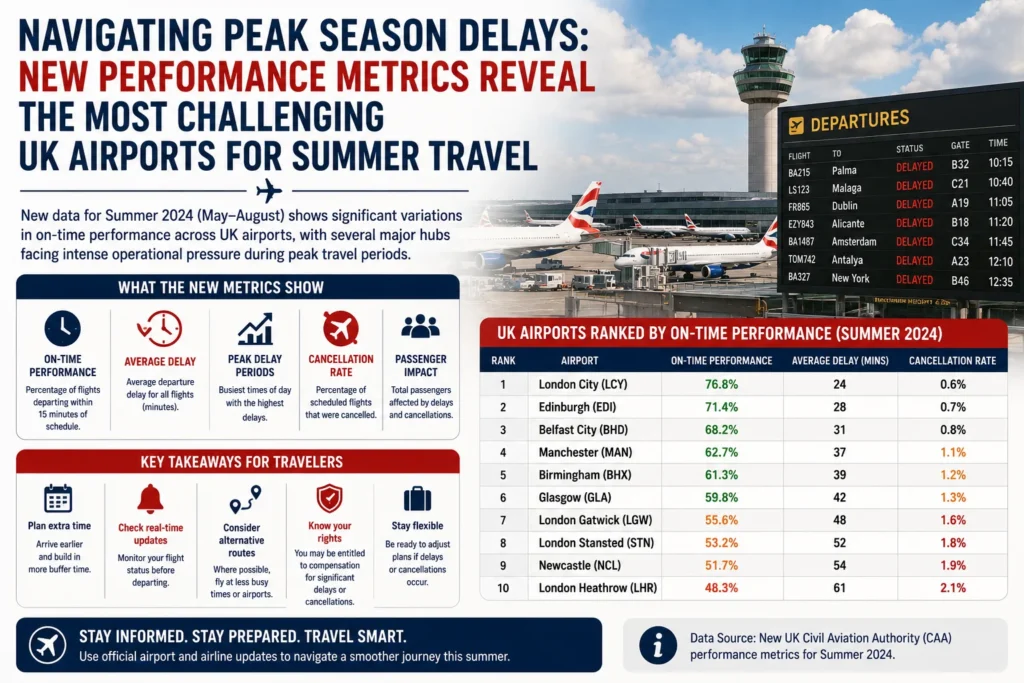
The peak summer holiday season across the United Kingdom is placing substantial pressure on the nation’s transportation network, as a surge in passenger volumes intersects with finite ground infrastructure limits. In response to these seasonal travel spikes, comprehensive data logs from the UK Civil Aviation Authority have provided the baseline for an extensive three-year performance review. The resulting analysis highlights the specific gateways where passengers are most likely to encounter significant schedule adjustments, tracking variables such as average departure delays and operational cancellation percentages.
According to verified aviation data measuring flight punctuality during the peak summer months of June, July, and August, there is a widening gap between high-performing regional airports and major hubs handling dense international traffic. The performance metrics combine both delay length and schedule fulfillment to establish an objective stress index, providing essential logistical insight for families and business travelers coordinating international or domestic itineraries.
Major Hubs and Regional Facilities Face Varying Operational Constraints
The data isolates London Gatwick as the most operationally constrained major airport in the study, posting the highest overall index score of 72.37. During the multi-year tracking window, the South London hub recorded an average departure delay of 31 minutes and 32 seconds, alongside a standard cancellation rate of 2.01 percent. While the airport authority has made progress in reducing average peak delays—improving from a high of nearly 40 minutes in 2023 to under 23 minutes in 2025—the sheer concentration of low-cost carriers and dense transatlantic schedules keeps the facility under continuous pressure during high-demand summer weekends.
In contrast, Exeter Airport presented a different operational challenge, securing the second position on the stress index with a score of 58.73. Unlike larger hubs where extended terminal waits are common, Exeter maintained a relatively modest average delay time of 18 minutes. However, the regional facility recorded the highest flight cancellation rate in the entire evaluation, averaging 3.49 percent. For passengers utilizing smaller regional entry points, this indicates that schedule volatility is more frequently driven by complete flight removals rather than creeping departure delays.
A Closer Look at Regional Titans and Small Business Hubs
Further down the performance table, northern and midland hubs show signs of systemic pressure. Manchester Airport ranked third with an index score of 52.07, reporting an average departure delay of 26 minutes and 59 seconds and an overall schedule cancellation rate of 1.17 percent. As the primary gateway for northern England, Manchester manages a massive network of long-haul holiday charters, making its gate availability highly sensitive to cascading delays from inbound European flights.
Scotland’s busiest terminal, Edinburgh Airport, followed in fourth place with a score of 49.36 and a 1.60 percent cancellation rate, while Birmingham Airport completed the top five with an index score of 48.61. Notably, separate punctuality audits show that over half of the July departures from Edinburgh left behind schedule, while Birmingham registered some of the longest individual terminal wait times during peak operation blocks in 2025.
Even smaller, business-oriented hubs were not entirely immune to operational friction. London City Airport occupied the sixth position with an index score of 47.05. Although the Docklands facility boasted a short average delay time of just 16 minutes and 30 seconds, it experienced a volatile 3.00 percent cancellation rate, demonstrating that short-runway regional operations can experience sudden capacity adjustments during adverse summer weather conditions.
Strategic Operational Achievements and Practical Advice for Travelers
A significant anomaly within the national data is the performance of London Heathrow. Despite handling a vastly larger passenger volume than any other facility in the British Isles—surpassing 84 million travelers annually—the country’s primary flag-carrier hub ranked fourteenth overall with a respectable stress score of 39.49. Heathrow’s extensive dual-runway system and highly integrated airline scheduling networks allowed it to absorb heavy summer traffic far more effectively than some smaller, single-runway points of exit.
At the positive end of the performance spectrum, East Midlands International Airport was recognized as the least stressful departure point in the country, earning a low index score of 18.53. The regional cargo and passenger hub delivered an exceptionally stable schedule, backed by a minimal 0.32 percent flight cancellation rate and an average delay of 18 minutes and 17 seconds.
As consumer demand for air travel continues to grow, aviation regulators emphasize that sustained investment in digital workforce coordination, air traffic control technology, and runway infrastructure resilience will be required to manage future travel spikes. For tourists navigating the current summer travel window, transportation safety bodies recommend selecting early morning departures to bypass afternoon backlogs, utilizing direct airline mobile applications for immediate gate notifications, and maintaining a thorough understanding of standard passenger compensation rights in the event of an extended delay.
For more travel news like this, keep reading Global Travel Wire