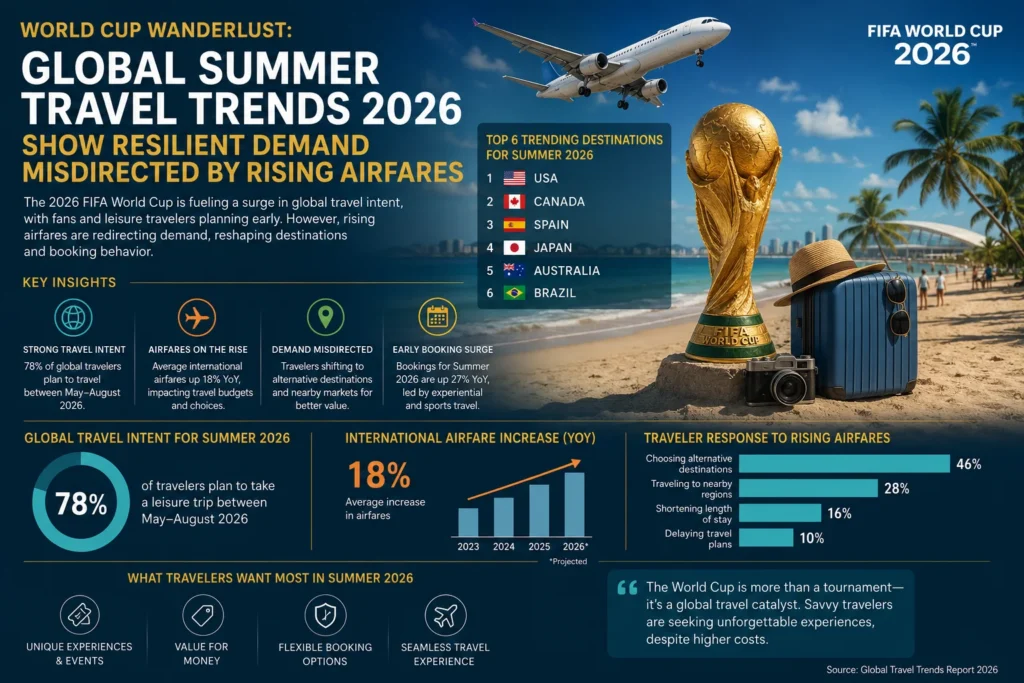
A comprehensive intelligence brief on global summer travel trends 2026 has revealed a highly resilient international travel consumer base that refuses to cancel vacation plans despite severe pricing pressures and global macro-economic headwinds. Released by travel technology conglomerate RateGain Travel Technologies through its predictive intelligence subsidiary Sojern, the dataset demonstrates that travelers are fundamentally altering their choice of final destinations rather than retreating from the market entirely.
The comprehensive assessment notes that approximately one-third of peak summer bookings remain unfinalized. This represents a distinct window for destination marketing organizations to capture last-minute travelers who are exhibiting a strategic “wait-and-see” approach to their holiday spending.
The World Cup Index: Re-route Over Reduction
The primary catalyst for destination reorientation this season is the ongoing FIFA World Cup 2026. The prestigious tournament has triggered a massive redistribution of passenger flows, generating substantial real-time booking spikes across specific host metropolitan areas within North America. According to official flight intent data, cities like Houston, Dallas, New York, Toronto, and Vancouver are experiencing unprecedented surges in inbound international arrivals.
Analysis from the research shows that the United Kingdom stands as the absolute largest international source market for these World Cup host destinations, accounting for nearly one-fifth of all incoming flight confirmations. Beyond the UK, the top international markets driving long-haul sports tourism into the host venues include Brazil, Germany, Colombia, and France. Notably, Asian powerhouse markets Japan and South Korea have secured dominant positions within the top seven global origin markets, reinforcing strong sports-travel intent originating from the Asia-Pacific region.
The Pricing Paradox: Flight Commitments and Room Hesitation
A unique consumer behavior highlighted in the report is the structural divergence between transportation bookings and accommodation confirmations. Outbound flight bookings originating from the United States have accelerated by 13 percent year-on-year. Conversely, generalized hotel search volumes within the same demographic have dropped by 16 percent.
This metric indicates that while consumers are highly eager to lock in volatile airline seat pricing early to guarantee transit, they are actively delaying their final lodging commitments. Tourism analysts attribute this pattern to intense pricing sensitivity and heightened caution regarding international developments, with consumers holding out for optimal regional resort discounts and flexible booking terms.
This behavioral trend is also significantly reshaping regional border crossings across North America:
The Canada Corridor: Outbound flight bookings from the US to Canada have skyrocketed by an impressive 44 percent year-on-year, heavily anchored by World Cup matches in Toronto and Vancouver.
The Mexico Shift: Cross-border travel from the United States to Mexico has experienced a 12 percent contraction compared to the previous year.
Domestic Realities: Internal US domestic leisure travel remains highly robust, tracking at a 15 percent year-on-year increase.
European Intracontinental Travel Achieves Historic Highs
While North America grapples with the massive influx of sports fans, Europe is delivering an incredibly powerful domestic performance. The data shows that intra-European flight bookings have surged by 37 percent compared to the same seasonal cycle last year, while domestic holiday flights within individual European countries expanded by 35 percent.
This exceptional internal growth reflects a determined consumer pivot toward familiar, closer-to-home destinations that provide a sense of economic and operational certainty. Major Mediterranean tourism economies have registered phenomenal gains in overall flight arrivals, with Spain reporting a 28 percent increase, Italy expanding by 24 percent, and Portugal moving up by 24 percent.
Despite these shifting regional numbers, London continues to preserve its status as the absolute premier gateway for international visitors entering the European theater. The historic city alone commands a staggering 13.7 percent of all European destination bookings made by North American outbound travelers, comfortably outpacing rival capitals such as Paris, Rome, and Madrid.
Latin America Self-Powers as Middle East Sells Short-Hul Content
Latin America has emerged as another standout success story in the global summer travel trends 2026 report, experiencing a major self-powered tourism boom. Inbound flight bookings into the region have grown by 38 percent from domestic points of origin and 16 percent from broader intra-regional markets. This baseline is further augmented by a 15 percent increase in European long-haul arrivals entering South and Central America.
In sharp contrast, hotel search metrics across the Middle East continue to trail significantly below historical levels across the vast majority of traditional long-haul corridors. Western Europe-to-Middle East travel searches have registered a steep decline of 49 percentage points year-to-date, while South Asia-to-Middle East pathways fell by 61 points.
However, official trackers note two highly vital exceptions to this downward trend. First, intra-regional travel within the Middle East is performing 9 percentage points higher than last year, showing that localized tourism pipelines remain remarkably intact. Second, the Middle East-to-United States flight corridor has experienced a massive traffic spike, directly fueled by regional football enthusiasts traveling overseas to attend World Cup fixtures. Ultimately, the global travel landscape is not shrinking; rather, it is dynamically recalibrating around premier entertainment events and strategic geographic certainties.
For more travel news like this, keep reading Global Travel Wire