The global travel landscape is witnessing a structural shift in how passengers navigate transit hubs, moving away from passive baggage towards active personal mobility. According to global transit infrastructure reports and aviation safety updates, the physical distance required to traverse international airports has steadily increased, causing transit fatigue to become a prominent factor in the overall travel experience. In response to these changing dynamics, transportation tech developers are integrating robotics, artificial intelligence, and lightweight electric vehicle engineering directly into consumer travel gear.
The recent international launch of the Airwheel flagship AI-powered smart suitcase series represents a major turning point in this sector. By transforming standard carry-on bags into motorized, connected vehicles, this technology redefines the relationship between travelers and their belongings. Tourism boards and airport operators are increasingly acknowledging that these personal mobility devices help streamline passenger flows through extensive terminal corridors, effectively turning tedious walking distances into highly efficient transit.
From Manual Hauling to Intelligent Electric Propulsion
For decades, the basic design of travel luggage remained largely unchanged, relying entirely on the physical effort of the traveler to pull or carry bags across terminals. The latest advancements in smart luggage innovation change this paradigm by treating baggage as an integrated short-distance transport solution. Equipped with built-in electric motors, internal transmission structures, and hidden, ergonomic handlebars, these specialized suitcases allow users to seamlessly switch from standard pulling to an active riding mode.
By sitting directly on the reinforced chassis, travelers can glide smoothly through crowded train stations, exhibition halls, and cruise terminals. This mechanical evolution addresses a major pain point for frequent flyers, elderly travelers, and individuals with limited mobility. The passive storage box has evolved into an active mobility companion, minimizing physical strain before a flight even begins.
Digital Connectivity and Mobile Power Systems on the Move
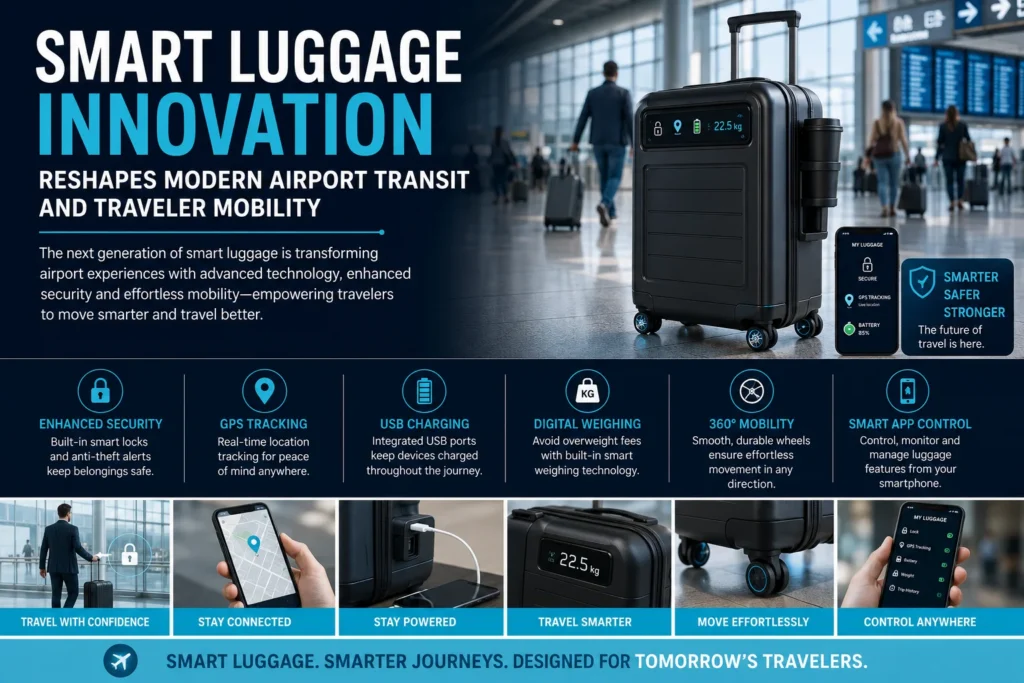
Modern tourism relies heavily on digital connectivity, with international passengers dependent on smartphones and tablets for electronic boarding passes, digital navigation, translation apps, and remote work. To mitigate the widespread challenge of device battery depletion during long travel days, the next generation of intelligent baggage incorporates dedicated external charging systems. By functioning as a mobile power hub, the luggage allows travelers to charge multiple electronic devices simultaneously while on the move, reducing reliance on crowded airport wall outlets.
Furthermore, advanced configurations utilize secure wireless connectivity to pair the baggage directly with the user’s smartphone. Through specialized application interfaces, travelers can monitor real-time diagnostics, including remaining battery life, current riding speed, and total distance traveled. The integrated digital dashboard also offers remote control capabilities, customizable lighting arrays for enhanced night-time visibility, and immediate proximity alerts to prevent accidental loss or theft in busy public spaces.
Strict Engineering Compliance with Global Aviation Safety Standards
A primary hurdle for the widespread adoption of rideable luggage has been navigating the strict safety regulations enforced by international aviation authorities and civil government agencies. Early iterations of motorized luggage often faced restrictions due to non-compliant, non-removable power sources. To achieve full regulatory compliance, contemporary smart luggage innovation focuses heavily on modular engineering.
Official aviation security statements confirm that lithium-ion battery packs must be easily accessible and strictly regulated in terms of watt-hour capacity to be permitted in aircraft cabins. The latest smart luggage models feature quick-release mechanisms that allow passengers to remove the battery cell instantly without using any tools during security screenings. Wrapped in durable, impact-resistant composite shells and reinforced with structural aluminum frames, these devices fulfill both standard carry-on dimensions and stringent international transport safety requirements.
Tailored Mobility Ecosystems for Multi-Generational Travel
The application of smart mobility technology is expanding into a diverse product ecosystem designed for various travel demographics. For business professionals, streamlined premium configurations offer high-speed capability and integrated tracking systems to ensure seamless business travel. Meanwhile, larger, specialized check-in models combine high-volume storage capacity with robust motor systems, allowing heavy loads to be transported effortlessly.
This technological evolution is also transforming family travel. The introduction of child-focused rideable luggage allows younger travelers to actively ride their own gear through busy terminals. Equipped with built-in safety speed governors and integrated audio systems, these junior mobility units help parents manage family logistics while keeping children entertained during long layovers.
As international tourism numbers rebound globally, the integration of personal mobility and smart luggage innovation is set to play an increasingly important role in urban transit infrastructure. By optimizing short-distance movement within massive transportation hubs, these intelligent systems ensure that freedom of movement becomes an achievable standard for modern global travelers.
For more travel news like this, keep reading Global Travel Wire