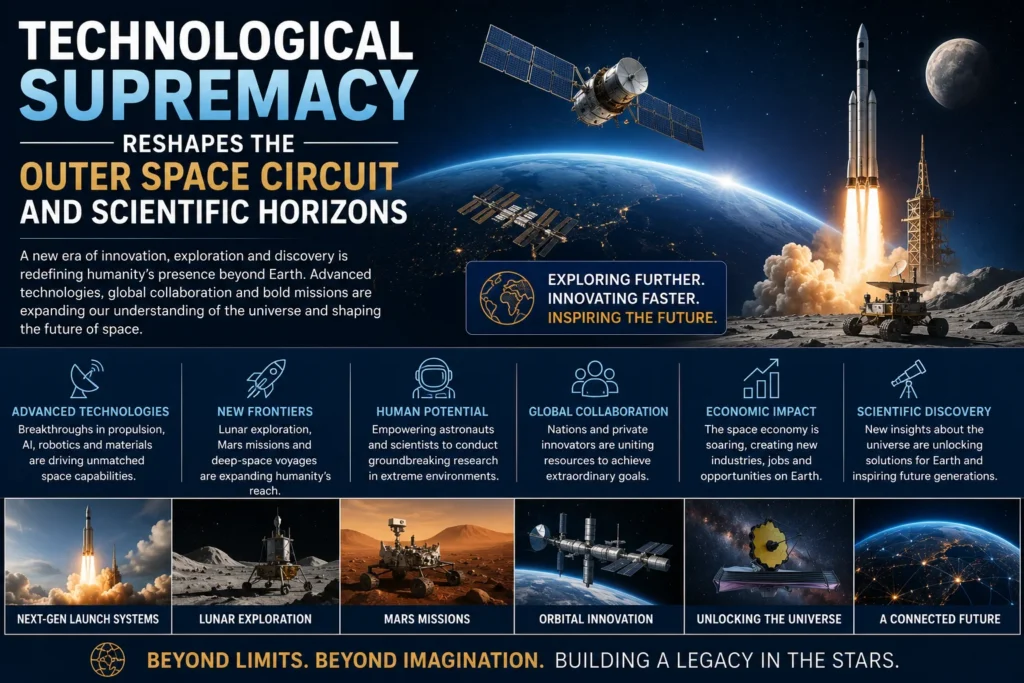
The international landscape of aerospace exploration is undergoing a major structural shift, moving from a multi-nation collaborative framework into an era defined by rapid technological independence and competitive logistics. According to recent public updates from international scientific bodies and space agencies, the global space race is intensifying as traditional boundaries of research and development are redrawn.
At the center of this transformation is China‘s accelerating space program, which has successfully positioned itself as a primary driver of cutting-edge orbital research. The sustained operations of the permanently crewed Tiangong space station highlight a strategic long-term vision aimed at capturing total global leadership in microgravity science, deep-space observation, and future off-planet industrial engineering.
Tiangong Space Station Becomes a Unique Hub for Orbital Research
As international planning committees prepare for the eventual retirement of the landmark International Space Station (ISS) by 2032, China’s space infrastructure is set to occupy a completely unique position. Once the ISS finishes its operational life cycle, the Tiangong space station will stand as the only permanently crewed research outpost orbiting the Earth.
The facility functions as a highly advanced microgravity laboratory, completing 16 orbits around the planet every single day. Official mission releases from the China Manned Space Agency confirm that the facility is currently hosting a three-person crew on an extended deployment designed to analyze the physiological impacts of long-term weightlessness.
Notably, the crew includes payload specialist Lai Ka-ying, the first female Chinese civilian and the first astronaut from Hong Kong to participate in an active flight mission. The inclusion of diverse specialists from regional administrative hubs underscores a broader strategy to expand internal talent pipelines while systematically executing complex, long-duration microgravity experiments in biology, physics, and chemistry.
Global Indexes Rank Asian Scientific Institutions at the Top
The visible milestones achieved in low-Earth orbit are directly supported by an unprecedented dominance in foundational earthbound research. The latest global research index published by the scientific tracker Nature highlights a historic shift in the distribution of global intellectual capital. For the first time in modern metrics, Chinese research institutions have secured the absolute top positions globally, outpacing traditional scientific strongholds in North America and Western Europe.
According to the validated data, nine out of the top ten research institutions worldwide are now located in China. Elite Western centers, such as Harvard University in the United States and the Max Planck Society in Germany, have been outranked in absolute output across key disciplines.
The publication analytics indicate that the nation’s scientific bodies hold an undisputed lead in the hard sciences, showing clear dominance in applied physics, chemistry, materials science, and biology. The United States maintains a narrow lead only within the highly specialized fields of health sciences and social sciences, illustrating a comprehensive rebalancing of global technological capabilities.
Systemic Investment in Advanced Infrastructure Fueling Long Term Gains
Independent funding administrators note that this scientific ascendancy did not happen overnight but is the direct result of two decades of highly organized, state-backed financial commitment. In the early 2000s, initial metrics indicated a massive spike in the raw volume of scientific publications originating from the region. Over the past decade, however, the focus shifted entirely from quantity to impact, resulting in a dramatic increase in highly cited, groundbreaking peer-reviewed discoveries.
International research foundation directors point out that the core driver of this success has been a sustained, multi-year funding stream dedicated to physical infrastructure and elite human capital. Billions of dollars have been systematically channeled into constructing world-class large-scale research facilities, advanced supercomputing clusters, and specialized universities.
Simultaneously, aggressive international training programs and highly attractive talent immigration frameworks have successfully cultivated a premier workforce capable of pioneering independent innovations without relying on foreign supply chains or external technology transfers.
Five Year Plan Establishes Innovation Driven Growth Engines
The strategic blueprint for the nation’s continued scientific expansion is explicitly codified in its highest national policy documents. The 15th Five-Year Plan, formally approved by the national legislature for the 2026–2030 period, mandates an extraordinary acceleration of innovation-driven capabilities and technological self-reliance. The overarching economic roadmap targets an ambitious annual growth rate of over seven percent specifically for research and development spending.
At the absolute core of this state-level doctrine is the cultivation of new productive forces—highly advanced, innovation-led growth engines designed to reshape industrial supply chains and national security frameworks. The plan identifies specific future industries designated for aggressive capital injection and rapid scaling over the next four years.
Among these prioritized sectors are quantum technology, industrial artificial intelligence, synthetic biology, nuclear fusion energy, and brain-computer interfaces. Crucially, the policy places deep-sea exploration and aerospace tourism developments at the absolute forefront of its long-term objectives, establishing a clear pathway toward executing a crewed lunar landing by 2030 and cementing its status as the premier spacefaring nation.
For more travel news like this, keep reading Global Travel Wire