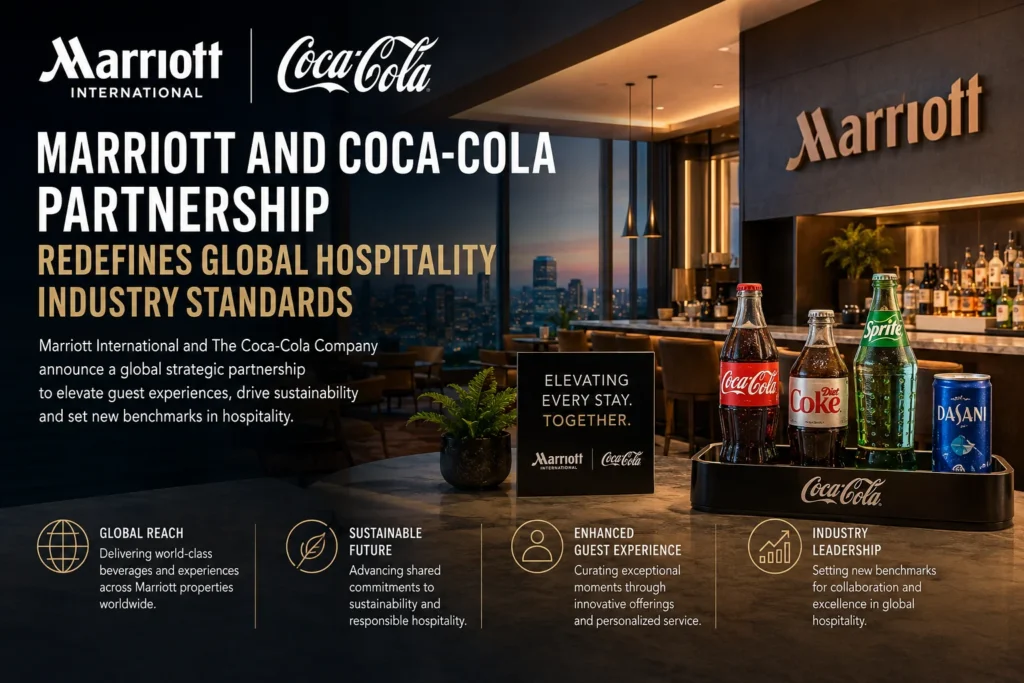
A monumental shift is underway across the international travel landscape as two of the world’s most recognizable corporate giants join forces. Marriott International has officially announced a sweeping global agreement naming The Coca-Cola Company as its strategic beverage partner. This historic decision effectively ends a 34-year relationship between the hotel powerhouse and PepsiCo, completely realigning the brand dynamics within the global hospitality industry.
The multi-year rollout targets a massive infrastructure footprint. According to recent operational releases from Marriott International, the phased implementation will eventually embed Coca-Cola’s extensive portfolio across nearly 10,000 lodging properties spanning 146 countries and territories. This expansive reach ensures that international travelers will soon encounter the beverage giant’s products at almost every phase of their journey.
Strategic Infrastructure Integration Across Global Destinations
The collaboration is designed to enhance the premium guest experience by integrating a diverse selection of refreshments across multiple touchpoints. The transformation extends far beyond traditional carbonated soft drinks. Official ministry and tourism board data highlight that modern leisure and business travelers increasingly demand wellness and lifestyle-oriented products.
To address these shifting consumer preferences, the phased deployment will include not only iconic sodas but also a robust lineup of specialized hydration products, juices, and functional beverages. Guests staying at participating luxury, premium, and select-service brands will see these options integrated directly into:
In-room guest mini-bars and curated welcome amenities
On-site dining venues, specialty restaurants, and upscale lounges
Dedicated executive clubs and Marriott Bonvoy loyalty spaces
Convention centers, corporate meeting rooms, and major international event venues
The seamless supply chain implementation was engineered by Hot Shoppe Services International, which serves as Marriott’s centralized global procurement organization. By leveraging its immense institutional scale, the procurement group aims to drive enhanced operational efficiency and strong economic benefits for independent hotel owners and franchise operators managing properties worldwide.
Analyzing the Impact on Tourism Sectors and Travel Sentiment
From a tourism perspective, this alignment is a direct reflection of data-driven guest insights. Internal passenger and hospitality preferences indicate that a vast majority of international visitors favor the broad accessibility and cross-border consistency offered by Coca-Cola’s brand family. For global hospitality industry operators, consistency across different jurisdictions is critical to securing high customer satisfaction scores and maintaining brand loyalty.
Industry analysts tracking official tourism statistics note that large-scale procurement alignments often mirror broader economic realities within the travel sector. As international tourism figures continue to climb, corporate hospitality brands are heavily focusing on optimized food and beverage programs to boost non-room revenue streams.
By utilizing unified global distributors, hotel chains can streamline regional supply chains, especially in rapidly growing markets across Africa, the Middle East, and the Asia-Pacific region, where hotel development pipelines are expanding at a historic pace.
Long-Term Value and the Shifting Business Travel Landscape
The timing of the rollout aligns perfectly with the robust resurgence of international meetings, incentives, conferences, and exhibitions (MICE). As corporate travel budgets normalize and large-scale global conventions see record-breaking attendance, the presence of universally recognized beverage options provides an added layer of familiarity for business delegates operating in unfamiliar foreign markets.
Furthermore, this arrangement gives the beverage manufacturer an unparalleled platform for international visibility. By capturing the exclusive beverage rights for the world’s largest hotel company, the brand ensures continuous daily exposure to millions of high-spending business and leisure travelers. This creates a powerful marketing feedback loop that reinforces brand dominance far outside traditional retail environments.
Operational Horizons and Next Phases
Execution of the global shift is already underway. While the initial operational changes began immediately upon the official signing, the sheer scale of updating thousands of properties means the complete transition will follow a carefully managed schedule over the coming months.
Franchise networks and regional property managers are collaborating closely with local bottling partners to update physical infrastructure, swap out dispensing equipment, and retrain culinary staff on new brand standards. Tourism boards and hospitality sector leaders view this massive transition as a prime example of how major players are adapting to the evolving tastes of global travelers, ensuring that the modern guest experience remains as seamless and refreshing as possible.
For more travel news like this, keep reading Global Travel Wire