The global aviation landscape is entering a highly automated era where traditional physical documentation is rapidly being replaced by digital alternatives. Across the United Arab Emirates, international airports are scaling up the deployment of biometric authentication systems and artificial intelligence frameworks to facilitate entirely paperless passenger processing. Official declarations from regional aviation bodies indicate that this structural transition is geared toward absorbing massive surges in connecting traffic while delivering a highly secure, touchless terminal environment.
These pathbreaking innovations are scheduled to take center stage at the upcoming 25th edition of the Airport Show, occurring at the Dubai World Trade Centre from October 12 to 14, 2026. Held under the patronage of Sheikh Ahmed bin Saeed Al Maktoum, President of the Dubai Civil Aviation Authority and Chairman of Dubai Airports, the specialized B2B exhibition will gather over 150 exhibitors from 30 countries. The convention serves as a primary clearinghouse for multi-billion-dollar airport infrastructure investments across the Middle East, Africa, and South Asia, focusing heavily on automated identity management architectures.
Digital Identity Processing Across Major UAE Aviation Hubs
The massive investment in passport-free travel technology coincides with a powerful regional transit boom, with total passenger traffic across Middle Eastern gateways projected to touch 240 million by the close of 2026. Data compiled by the International Air Transport Association (IATA) shows that replacing standard manual identity verifications with biometric confirmation loops effectively reduces passenger processing times by up to 40%. For international hubs managing tens of millions of transiting guests, this efficiency gain expands maximum terminal capacity and drastically shortens security queues.
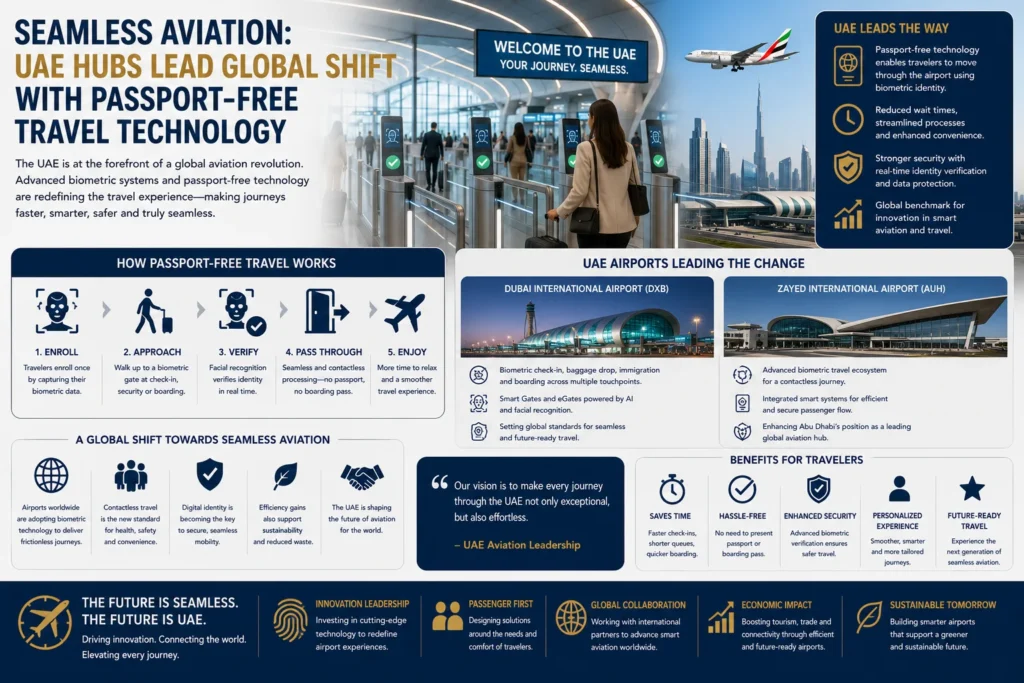
Dubai International Airport, retaining its rank as the world’s busiest hub for international passengers since 2014, has implemented a highly sophisticated, AI-driven “Red Carpet” smart tunnel system. This digital corridor utilizes advanced spatial optics and facial scanning arrays to process more than 10 travelers simultaneously without requiring them to pause or present physical passports.
This infrastructure is heavily supported by Emirates Airline, which pioneered large-scale commercial biometrics via a major investment in facial recognition systems. The carrier has deployed over 200 biometric boarding cameras across its primary departure terminals. This integrated layout allows registered global travelers to navigate check-in kiosks, border control checkpoints, premium lounge entrances, and final boarding gates through simple, automated camera scans. Additionally, a synchronized mobile application links three major UAE airports, enabling pre-verified passengers to clear immigration steps before stepping foot inside the departure hall.
Expanding Face Recognition Infrastructure in Abu Dhabi
Mirroring the technological upgrades in Dubai, Abu Dhabi’s Zayed International Airport has integrated facial recognition frameworks across five of its nine core passenger touchpoints. This systematic rollout ensures that a traveler’s biometric profile functions as an unchangeable digital token throughout their journey, covering everything from initial luggage drop-offs to final gate clearances.
Parallel to these airport-wide installations, individual regional airlines are executing localized testing of next-generation identity systems. Etihad Airways is actively conducting live trials of AI-backed facial identity validation for aircraft boarding and elite lounge access management. Simultaneously, flydubai has initiated the integration of biometric verification modules directly into its self-service check-in kiosks, establishing a highly decentralized network of automated passenger processing.
A key regulatory catalyst for this nationwide system synchronization is set to conclude by the end of 2026, as the UAE completes the full integration of its national Emirates ID database with the Smart Gate architectures across all international airports. This integration means domestic citizens and residents can traverse international borders without presenting passports or physical tickets, utilizing their pre-existing government biometric registration.
Future Capacity Scaling and Al Maktoum International Development
The ongoing digital transformation extends into the UAE’s long-term master plans for aviation infrastructure expansion. Ground engineering works are progressing steadily on the initial phase of the multi-billion-dollar Al Maktoum International Airport expansion, with runway paving and primary structural foundations for the passenger terminals on track for the planned commencement of operations in 2032.
The future megahub is being built from the ground up around a highly connected, passenger-focused digital ecosystem. Rather than retrofitting older structures, the facility will natively incorporate real-time AI-driven analytics. These advanced systems will actively monitor passenger flow patterns, dynamically allocate gate resources, and personalize retail and hospitality notifications based on the real-time movement of passengers through the terminal.
Market forecasting data presented by industry organizers reveals that the global airport biometric services market is on track to reach an evaluation of $276.56 billion by 2032. Industry analysis from SITA indicates that over 43% of global airports have already implemented biometric boarding gates, with more than half planning comprehensive identity solutions within the next three years. With over 67% of Middle Eastern passengers actively using biometric processing—the highest regional adoption rate globally—the continuous deployment of passport-free travel technology positions the UAE as the definitive benchmark for the future of international travel management.
For more travel news like this, keep reading Global Travel Wire