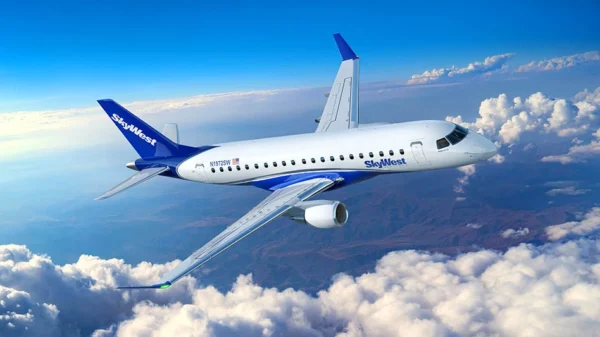
SkyWest Airlines flight SKW5314 was diverted to Kansas City International Airport while operating from Chicago to Lincoln, disrupting passenger journeys and highlighting how quickly weather and operational conditions can affect regional air travel across the United States.
The flight, operated using a Mitsubishi CRJ-200LR regional aircraft, had been scheduled to complete the relatively short journey between Chicago O’Hare International Airport and Lincoln Airport in Nebraska. Instead, passengers were taken to Kansas City after conditions prevented the aircraft from completing its planned arrival.
Kansas City International Airport carries the airport code MCI because it was originally known as Mid-Continent International Airport. Its extensive airfield infrastructure and central location allow it to function as a practical alternative when severe weather or operational restrictions affect airports across the Midwest.
For passengers, the diversion may result in an extended wait, a continuation flight, ground transportation, rebooking or an overnight stay, depending on weather, crew availability and the airline’s recovery plan.
Severe Weather Can Force Rapid Diversion Decisions
Flight diversions are precautionary operational decisions made when conditions at the intended destination no longer support a safe landing.
Thunderstorms can bring strong winds, turbulence, lightning, reduced visibility and rapidly changing runway conditions. These hazards are particularly disruptive during warmer months, when convective weather systems can develop quickly across the central United States.
When Lincoln became unavailable or unsuitable for landing, the crew would have assessed alternate airports based on weather, fuel, runway availability, ground support and distance from the original destination.
Kansas City offers long runways, passenger facilities and airline handling services, making it capable of receiving diverted commercial aircraft. Selecting a well-equipped alternate also gives pilots more flexibility than remaining airborne while waiting for uncertain weather improvements.
Although passengers may view a diversion as a major disruption, the decision is fundamentally a safety measure intended to keep the aircraft away from hazardous conditions.
CRJ-200LR Supports Regional Airline Operations
The Mitsubishi CRJ-200LR is a regional jet commonly associated with short- and medium-distance services linking smaller cities with major airline hubs.
Its approximately 50-seat configuration allows carriers such as SkyWest to connect regional destinations with airports including Chicago O’Hare. These routes support business journeys, family travel and domestic tourism while feeding passengers into larger national and international networks.
Regional aircraft operate with carefully calculated fuel requirements that include reserves and provisions for reaching an alternate airport. Flight crews and airline dispatchers continuously review weather and operational conditions throughout the journey.
Aircraft size alone does not determine whether a flight must divert. Instead, pilots consider the complete operational picture, including fuel remaining, airport conditions, forecast developments and air traffic instructions.
Passengers Could Face Delays or Rebooking
After landing in Kansas City, the airline must determine whether the aircraft can continue to Lincoln.
A continuation may be possible when weather improves, the aircraft can be refuelled and the assigned crew remains within legally permitted duty limits. However, an extended delay can make same-day completion difficult, especially late in the evening.
If the original crew reaches its duty limit, the flight cannot continue until a replacement crew becomes available or the pilots receive the required rest. These restrictions are designed to reduce fatigue and preserve aviation safety.
Passengers may consequently be transferred to another flight, placed on a later service or offered ground transportation. Kansas City and Lincoln are separated by a substantial road journey, meaning any bus arrangement would require additional coordination.
Travellers should monitor the operating airline’s mobile application, text alerts and departure screens because revised plans can change as weather and aircraft availability develop.
Federal Rules Protect Passengers During Tarmac Delays
US Department of Transportation rules provide important protections when passengers remain aboard an aircraft during an extended ground delay.
For domestic flights at US airports, airlines generally must provide passengers with an opportunity to leave the aircraft before a tarmac delay exceeds three hours, subject to limited safety, security and air traffic control exceptions.
Airlines must also provide adequate food and drinking water no later than two hours after the delay begins. Lavatories must remain operational, while medical assistance must be available when required.
These protections do not guarantee that a gate will be immediately available during widespread disruption. Airports receiving several diverted flights simultaneously may experience gate congestion as ground teams work to accommodate unexpected arrivals.
Hotel Support Depends on the Cause of Disruption
Hotel and meal assistance following a diversion depends largely on why the flight was interrupted and the airline’s customer-service policy.
When a disruption is within an airline’s control, carriers may provide accommodation, meal vouchers or ground transportation. However, severe weather is generally treated as an uncontrollable event, and US federal regulations do not automatically require airlines to pay for hotel rooms.
Passengers should speak with airline representatives before independently booking accommodation, as the carrier may have negotiated hotel rates or alternative transport arrangements.
Travel insurance and some credit-card benefits may also cover reasonable expenses caused by weather-related delays, subject to individual policy terms.
The SKW5314 diversion demonstrates the operational challenges facing regional aviation during severe weather. Although the unexpected landing may create uncertainty, diversion procedures, crew-duty rules and passenger protections are designed to ensure travellers continue their journeys as safely as possible.
For more travel news like this, keep reading Global Travel Wire