The shifting geopolitical landscape in the Gulf region has prompted aviation regulators and maritime transit agencies to implement urgent updates to international transport networks. As diplomatic negotiations continue behind closed doors to restore stability, transportation ministries across the globe are prioritizing the safety of commercial passengers and trade lanes. The recent escalation in regional friction has directly impacted crucial maritime corridors and commercial flight routes, leading to a coordinated re-evaluation of security postures by global aviation bodies and maritime authorities.
For travel operators, airline carriers, and international cruise logistics networks, the latest updates require proactive route planning and strict adherence to governmental guidelines. Official notifications from civil aviation registries emphasize that while global connectivity remains open, specific travel corridors require immediate tactical adjustments to mitigate risks associated with regional transit zones.
Severe Airspace Realignments and Flight Path Security
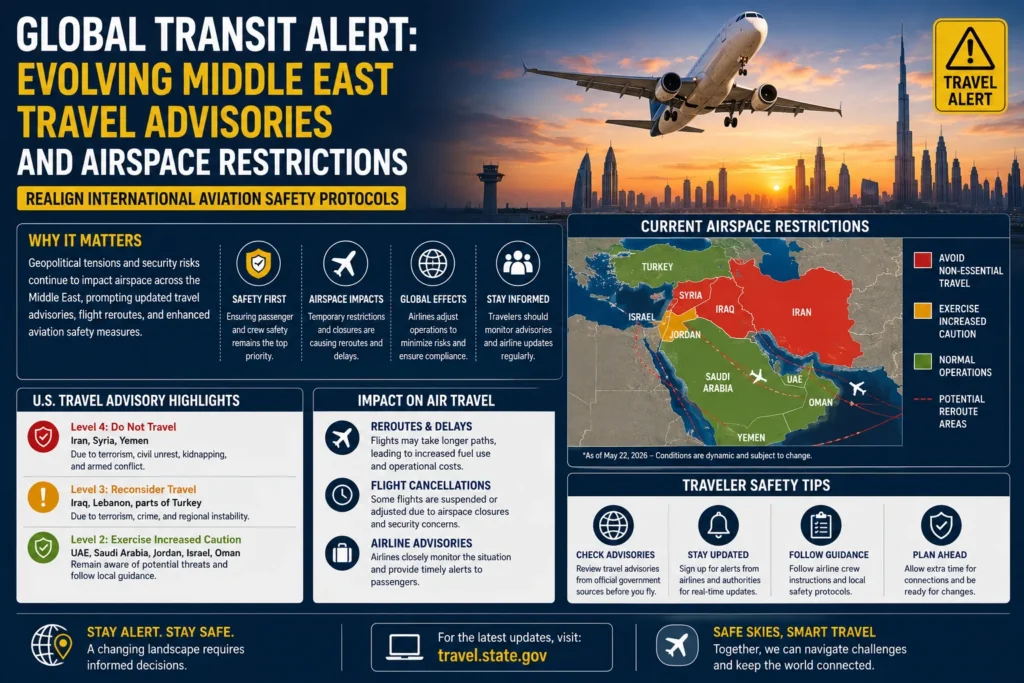
International aviation safety remains the highest priority for global regulatory bodies following recent strategic changes in airspace classifications. The Federal Aviation Administration and the European Union Aviation Safety Agency have updated their flight routing directives for commercial carriers traversing the skies above the Middle East. Due to the potential for crossfire and localized anti-aircraft operations, major commercial routes connecting Western Europe with South Asia are being actively diverted away from specific flight information regions.
These precautionary flight path adjustments have immediate operational implications for global tourism. Carriers are utilizing alternative corridors over Central Asia and parts of northeastern Africa, which adds significant flight duration and fuel consumption to long-haul routes. International travel registries advise passengers booking flights between Europe, Asia, and the Americas to anticipate scheduling shifts and potential transit delays as airlines adapt to the newly configured airspace realities. Aviation ministries emphasize that these measures are pre-emptive, designed to safeguard civilian passengers from unintended exposure to active defense systems.
Maritime Disruptions and Cruise Itinerary Modifications in the Gulf
The operational safety of maritime transport faces parallel challenges, particularly surrounding the strategic Strait of Hormuz transit lanes. Local authorities in the region have reasserted claims over the management of vessel movement through these narrow waters, creating a complex regulatory environment for commercial shipping and civilian luxury liners. In response to reports of localized interference involving maritime commercial vessels, international maritime bureaus have elevated safety warnings for all non-essential sea traffic in the Gulf of Oman and the Persian Gulf.
This development has led global cruise lines to structurally adjust their regional itineraries for the upcoming seasons. Major international luxury cruise brands have suspended scheduled port stops within the inner Gulf zone, rerouting their multi-generational fleets toward alternative ports of call in the wider Indian Ocean and the Red Sea districts. Maritime ministries are working in tandem with coast guards to ensure that any commercial transport proceeding through surrounding international waters maintains close contact with naval security escorts, guaranteeing the safety of merchant crews and civilian passengers alike.
Updated Diplomatic Travel Directives and Consular Advisories
In response to the rapid exchange of rhetoric and strategic actions by regional governments, ministries of foreign affairs worldwide have elevated their domestic travel warnings to their highest levels for several countries in the immediate area. Comprehensive safety portals urge citizens to indefinitely postpone all non-essential leisure and business travel to the affected jurisdictions, citing the unpredictability of infrastructure availability and the potential for sudden closures of international exit points.
Furthermore, public safety offices warn that standard international holiday insurance policies may be rendered invalid if individuals choose to travel into zones explicitly designated under active government restrictions. Consular networks warn that during periods of heightened diplomatic tension, the capacity to provide emergency administrative support or legal evacuation services inside restricted territories is severely limited. Travelers are instructed to regularly verify the operational status of their respective national consulates and register all immediate movements through verified tracking programs operated by their home governments.
Macroeconomic Implications for Global Hospitality Networks
The structural changes within Middle Eastern travel networks are creating a ripple effect across the broader global hospitality and tourism industry. Regions that historically served as crucial layover points and transit oases for international travelers are adjusting to fluctuating arrival patterns. While localized tourism within immediate conflict zones has experienced a sharp contraction, surrounding destination markets in the Mediterranean and East Africa are seeing an influx of diverted travel volume, as holidaymakers seek alternative winter-sun destinations with lower risk profiles.
Tourism boards in adjacent peaceful territories are actively working to expand their hospitality capacities to accommodate this shifted demand. Concurrently, international transport ministries are reinforcing the resilience of global supply chains and passenger networks by investing in enhanced monitoring technologies at major border checkpoints. Government analysts project that the long-term recovery of regional travel relies entirely on the successful implementation of verified multilateral security agreements that permanently guarantee the neutrality and safety of international transport corridors. By maintaining a highly informed approach and respecting the updated boundary definitions enforced by global security ministries, the international travel community can ensure the continued safety and continuity of global exploration.
For more travel news like this, keep reading Global Travel Wire