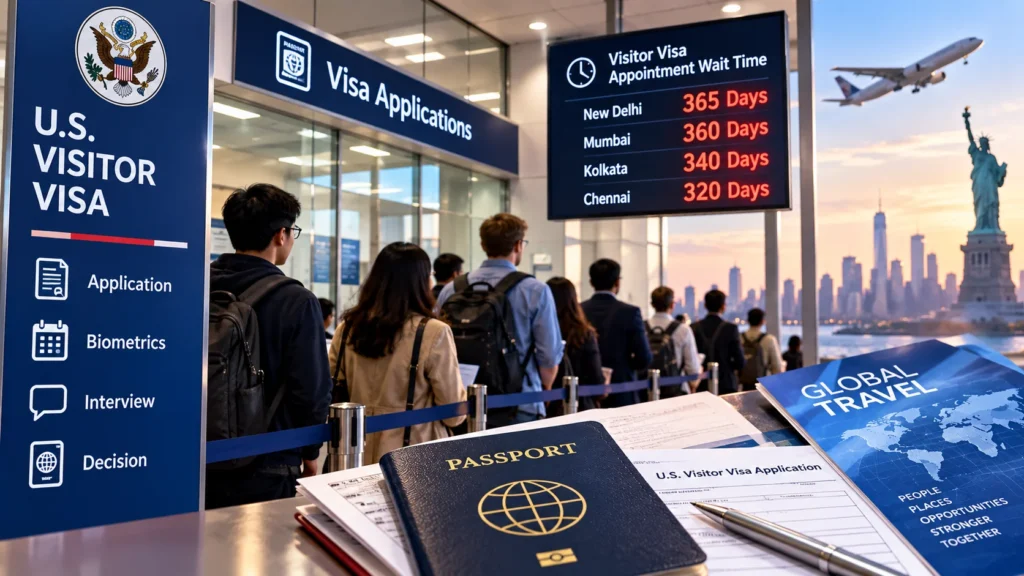
Global waiting times for United States visitor visa interviews have increased substantially as consular staffing levels decrease while international travel demand remains robust. According to an official evaluation released by the United States Government Accountability Office (GAO), prolonged interview scheduling timelines are directly affecting leisure tourists, business travellers, and families planning travel to the United States.
Official statistics show that the average worldwide wait time for a nonimmigrant visitor visa interview rose to 201 days in fiscal year 2025, compared to an average of 26 days recorded in fiscal year 2019. The findings indicate that extended appointment backlogs are posing ongoing challenges for the United States travel and tourism sector as it works to return to pre-pandemic economic output levels.
The backlog comes amidst a sustained volume of visa filings worldwide. Official government metrics report that global nonimmigrant visa applications surged from 11.4 million in fiscal year 2019 to 13.54 million in fiscal year 2025, demonstrating strong interest in international travel to American destinations.
Consular Staffing Reductions and Operational Workload Pressure
The government review identified consular staffing shortages and gaps in workforce allocation as key structural factors contributing to appointment delays at high-demand diplomatic posts.
Across global consulates, the total number of full-time staff dedicated to processing visitor visas fell from 1,342 in fiscal year 2024 to 904 in fiscal year 2025—representing an approximate 32% decline in frontline personnel. Official statements attribute this reduction to hiring limits and natural workforce attrition over consecutive operating cycles.
The mandatory in-person interview requirement remains the primary operational step driving lengthy scheduling delays. While consular posts must maintain rigorous document checks and national security standards, balancing administrative security protocols with processing speed has proved challenging under reduced staffing levels.
Impact on High-Volume International Travel Markets
Appointment timelines vary widely across international regions, with high-demand markets experiencing significant processing pressures:
India: Consular operations in India recorded 1,455,255 nonimmigrant visa filings in fiscal year 2025. With 68 designated consular officers processing these filings, the workload averaged approximately 21,401 applications per officer. This high ratio directly affects Indian holidaymakers, business executives, and family visitors needing fixed travel dates.
Colombia: Recorded an average visitor visa interview wait time of 597 days in fiscal year 2025, illustrating major regional discrepancies in scheduling availability.
Official agencies clarify that published wait times refer specifically to interview appointment availability and do not account for post-interview processing decisions or specialized administrative clearances.
Economic Consequences for United States Tourism Industry
International travel and tourism made significant contributions to the national economy, generating $176 billion in 2025. However, this total represents a $5 billion decline from 2024 figures and remains $28 billion below pre-pandemic economic baselines.
In response to workload challenges, the United States Department of State has implemented operational countermeasures, including expanding remote processing options for eligible visa renewals, outsourcing select administrative tasks, and reallocating daily interview schedules.
However, government auditors noted that workforce planning frameworks—such as the annual Global Repositioning Exercise (GREX) designed to align staffing allocations with application volume—have been executed only once since fiscal year 2019. Regularizing workforce planning tools and maintaining adequate consular staffing remain essential steps to reducing global application backlogs, supporting international visitor flows, and strengthening tourism revenue.
For more travel news like this, keep reading Global Travel Wire