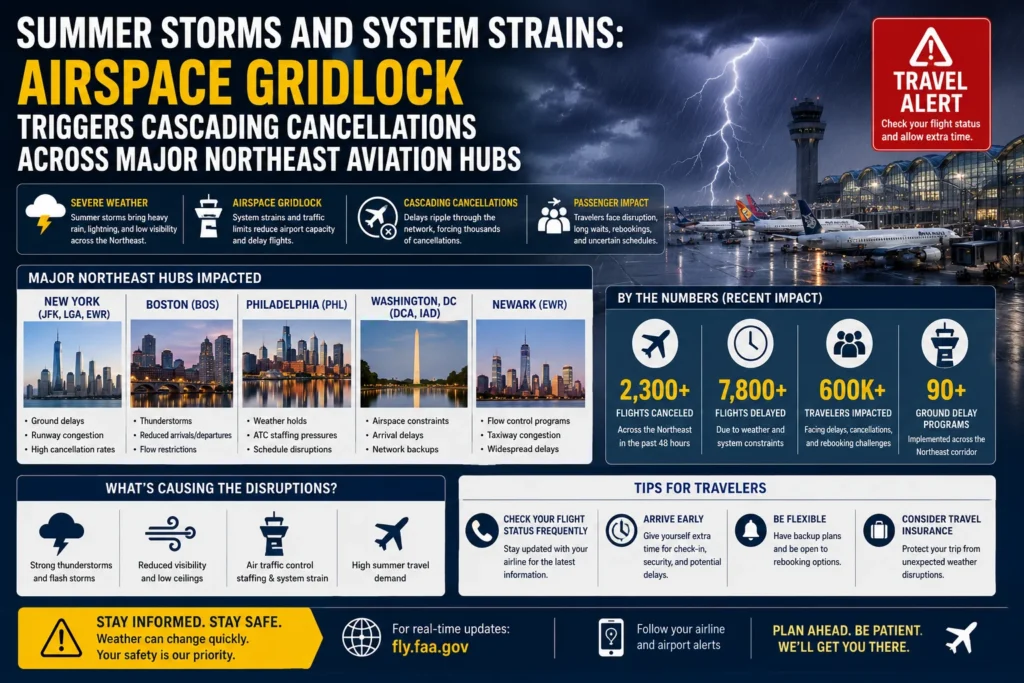
The delicate balance of the North American aviation network faced severe disruption during the current high-demand travel season. According to official operational bulletins from the Federal Aviation Administration, a potent combination of severe convective summer weather patterns and persistent technical resource constraints has forced regulators to implement sweeping traffic management initiatives. The result has been a major operational breakdown, culminating in more than 500 cancelled flights and upwards of 4,000 delayed departures vibrating through the highly congested Northeast corridor.
The primary epicenter of the disruption encompasses the dense airspace cluster managing arrivals and departures for the greater New York and Philadelphia metropolitan areas. Air traffic managers have been forced to systematically slow down the acceptance rates for incoming aircraft at John F. Kennedy International Airport, LaGuardia Airport, Newark Liberty International Airport, and Philadelphia International Airport. Travel authorities emphasize that the structural limits of the airspace are being pushed to their capacity, creating major complications for thousands of domestic and international commuters.
Unpacking the Mechanics of Ground Stops and Delays
To prevent dangerous congestion in the skies and manage terminal capacity safely, federal coordinators rely on specialized traffic management parameters known as ground stops and ground delays. During peak disruption windows, Newark Liberty International Airport was placed under a complete ground stop as line-oriented thunderstorms moved directly across the airfield.
According to standard operational directives published by federal aviation agencies, a ground stop represents the most restrictive immediate tool available to traffic managers. When firmed, it dictates that some or all flights bound for the impacted destination must be held entirely at their point of origin. This prevents an unsustainable backlog of aircraft from entering a holding pattern over a storm-ravaged metropolitan area where terminal acceptance rates have dropped significantly.
Conversely, a ground delay program represents a more scalable approach to traffic mitigation. Under a ground delay protocol, planes are still authorized to depart for the target airport, but they are held on the tarmac at their origin airports and issued specific, staggered takeoff times. This meticulous spacing ensures that planes arrive in the destination airspace only when air traffic teams can safely accommodate them, eliminating the need for long, fuel-consuming holding patterns in volatile weather zones.
The Impact of Staffing Shortages on Airspace Capacity
While volatile summer thunderstorms represent the immediate physical catalyst for the gridlock, underlying structural strains within the national airspace framework have amplified the severity of the delays. Official workforce documents released by federal aviation oversight boards acknowledge a longstanding national shortage of certified professional controllers. The current baseline system operates with roughly 11,000 certified controllers against a revised agency operational target of 12,563 professionals.
This systemic resource gap is particularly acute at the regional radar facilities that orchestrate the complex routing sequences for the New York triconfined airspace. When severe convective weather reduces the available flight paths to just a few narrow lanes, the workload on active radar teams increases exponentially. Without optimal staffing density to rotate personnel and manage peak travel volumes—which are currently elevated due to seasonal vacation traffic—the facility must lower its total traffic capacity. Consequently, even minor localized weather fronts that would normally cause brief disruptions now trigger multi-hour delays that ripple across the entire continental flight grid.
Comprehensive Consumer Advisory and Passenger Rights
Given the reality of ongoing periodic ground delays throughout the evening hours, transport ministries and consumer protection bureaus urge international and domestic travelers to maintain strict awareness of their passenger rights. Under the updated enforcement guidelines issued by the Department of Transportation, the specific origin of a flight cancellation or significant delay dictates the exact level of mandatory carrier assistance.
When flight disruptions are categorized as strictly weather-driven, airlines are legally exempt from providing direct cash compensation, complimentary lodging, or meal vouchers. However, federal passenger rights explicitly guarantee that if a carrier cancels a flight for any reason—including severe convective weather or air traffic staffing constraints—the passenger remains unconditionally entitled to a full cash refund rather than just a promotional travel voucher, provided they choose not to accept the airline’s alternative rebooking options.
Logistics specialists recommend that passengers diligently monitor active airfield advisories via official public flight tracking systems and download their specific carrier’s mobile application to receive immediate automated push alerts regarding gate changes, aircraft tracking, and revised boarding windows.
Long-Term Airspace Modernization Strategies
To address these recurring systemic vulnerabilities, federal administrators have initiated the rollout of a comprehensive air traffic controller workforce plan designed to build long-term operational resilience. The multi-year initiative targets the aggressive recruitment and training of thousands of new controllers, utilizing advanced simulator-based training protocols to reduce baseline facility certification times by up to twenty-seven percent.
Furthermore, transportation planners are integrating predictive machine learning systems into regional command centers to better project airspace capacity limits hours before departure times. Until these long-term staffing pipelines and technical modernizations are fully established, travelers navigating the busy Northeast travel hubs must continue to balance opportunistic exploration with structured flexibility, ensuring they remain thoroughly informed by checking the latest public aviation registries prior to departing for the terminal.
For more travel news like this, keep reading Global Travel Wire