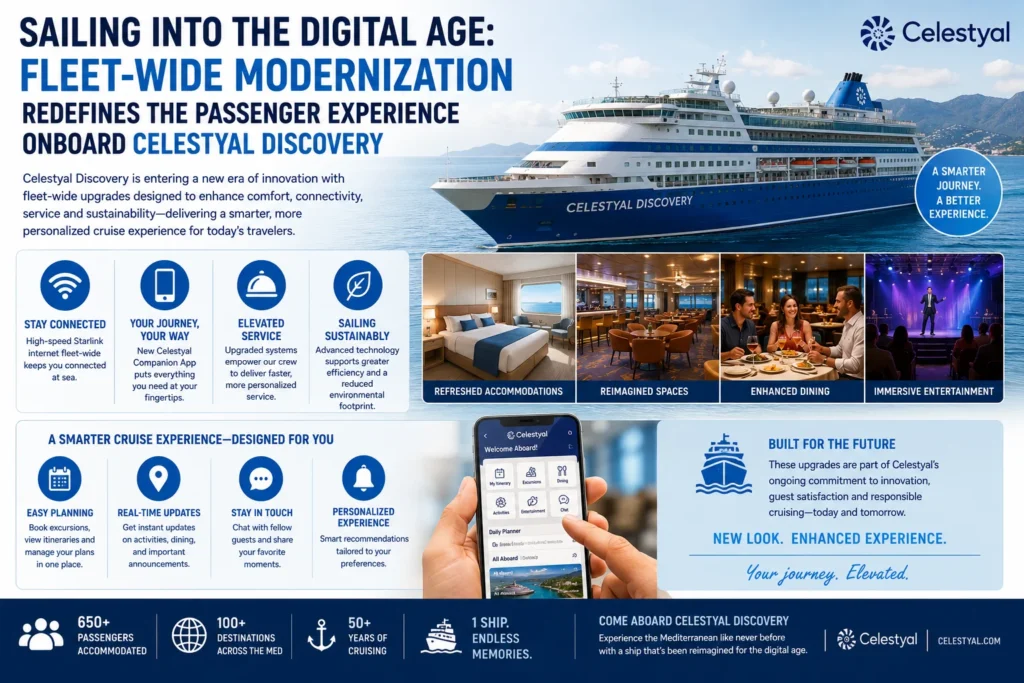
The international maritime sector is entering a new era of guest convenience and structural modernization as the 2026 cruising season highlights unprecedented integrations of guest-facing digital systems. Following successful initial operational tests across its premium fleet, official announcements from Celestyal confirm that the line has completed the deployment of custom-built, interactive stateroom solutions. By introducing high-end interactive guest systems across its full inventory of staterooms, the cruise operator has taken a significant step toward reshaping how travelers interact with onboard operations and premium hospitality services.
The immediate completion of this fleet-wide digital upgrade introduces a paperless, hyper-connected framework designed to elevate passenger autonomy. By providing instant access to vessel amenities, real-time activity schedules, and personalized hospitality management tools directly from the comfort of a stateroom, the modernization removes friction points that have traditionally complicated the cruise travel experience.
The Operational Integration of Specialized Guest Software
The choice to implement customized hardware across stateroom configurations addresses a growing global demand for personalized, instantaneous self-service options in the hospitality sector. Following an initial launch on the sister vessel Celestyal Journey earlier this year, the standard rollout has successfully expanded to include every traveler sailing onboard the 1,360-guest vessel. This strategic expansion marks the first time a major regional operator has fully embedded specialized in-room guest portals across all accommodation categories, setting a new benchmark for the global cruise market.
The central software interface allows passengers to handle their schedules with minimal reliance on central guest relation desks or telephone queues. Through the digital interface, guests can view real-time daily schedules, coordinate reservations at specialized dining venues, arrange cabin upgrade options, and submit instantaneous service requests to housekeeping and maintenance teams. Furthermore, the platform integrates direct access to retail catalogs and quick-response room service menus, turning the tablet framework into an active mechanism for onboard revenue generation and internal logistical coordination.
Environmental Sustainability and Fleet Operations Efficiency
Beyond the immediate luxury and ease provided to individual travelers, the widespread adoption of digital stateroom platforms serves as a critical element of the line’s broader environmental and operational strategy. Historically, managing the daily operations of a large vessel required the constant creation and disposal of printed agendas, excursion brochures, and marketing flyers. The transition to fully digital media libraries systematically eliminates thousands of pounds of single-use paper waste per cruise, directly supporting international green maritime protocols.
From a crew management perspective, the implementation of automated stateroom communication drastically lowers manual labor burdens. Rather than deploying crew members to manually deliver schedule revisions or printed documents to hundreds of individual cabins, shore-side teams and shipboard directors can execute immediate, fleet-wide updates with a single command. This localized automation ensures absolute structural accuracy under varying maritime connectivity states, allowing the on-board crew to dedicate more time to high-value passenger care and interactive hospitality support.
Expanding Horizons: The Launch of the New Western Mediterranean Footprint
The baseline upgrades to the ship’s internal technology arrive at a pivotal moment, precisely as the operator pivots its geographic focus toward high-value European destinations. Public itinerary releases reveal that the vessel will spearhead the company’s inaugural dedicated expansion into the Western Mediterranean during the upcoming winter season, introducing an ambitious fourteen-night flagship deployment termed the Mediterranean Odyssey.
This newly engineered journey weaves together a diverse network of historic ports across Spain, Portugal, and Morocco, including fourteen distinct maiden calls for the cruise line. The comprehensive travel path highlights a deliberate emphasis on extended stays and overnight port calls, a strategy intended to counter the hurried nature of traditional mass-market cruise tourism.
The extensive journey features deep-water port calls at Malaga, Cadiz, and Valencia in Spain, paired with an overnight anchor in Barcelona. The path also includes strategic stops at the Rock of Gibraltar, along with prolonged exploration windows in Casablanca and Tangier in Morocco. Furthermore, the route highlights a multi-day focus in Lisbon, Portugal, and visits the picturesque coastal destination of Sète in southern France.
Microeconomic Impact on Coastal Municipalities and Year-Round Travel
The long-term economic success of the regional cruise market relies heavily on its capacity to establish mutually beneficial partnerships with target destinations. By structuring itineraries that feature late-night departures and overnight stays in gateway hubs like Lisbon and Barcelona, the vessel guarantees that international passenger spending is not restricted solely to daytime tour buses. Instead, arrivals can engage with local evening economies, supporting family-owned restaurants, cultural events, and regional transportation services.
This balanced approach provides a steady economic buffer for coastal communities during the traditional shoulder and winter travel months. By distributing high-value international travelers away from overcrowded central plazas and into historic heritage assets across southwestern Europe and North Africa, the operator is illustrating how next-generation shipboard enhancements and visionary route mapping can work in perfect alignment to secure the future of global maritime tourism.
For more travel news like this, keep reading Global Travel Wire