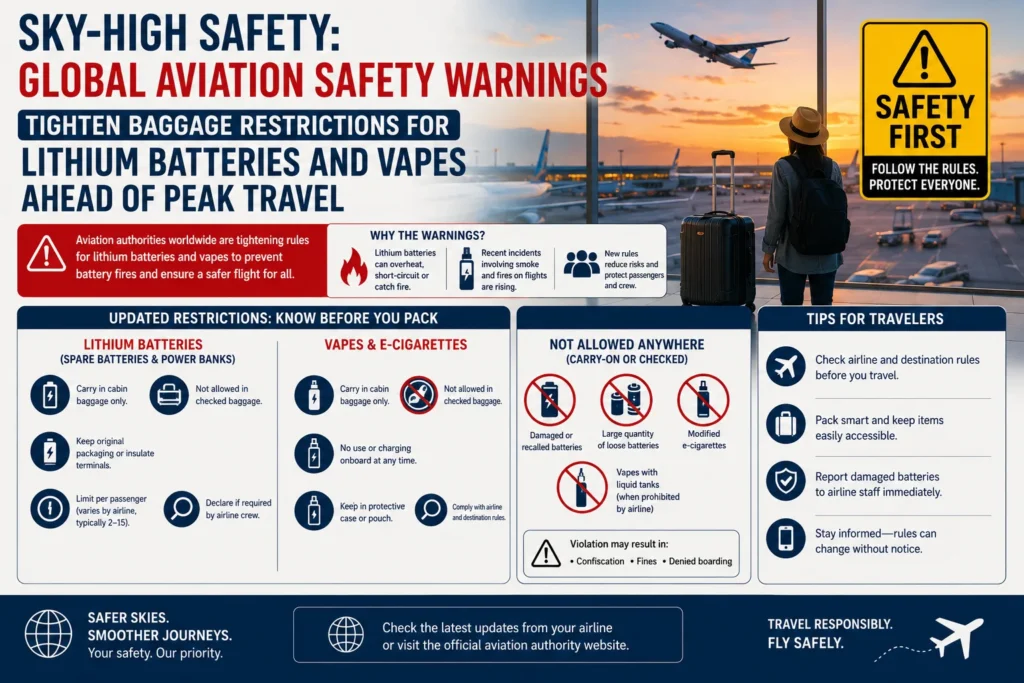
The global aviation landscape is adjusting to reinforced dangerous goods protocols as the high-volume travel season highlights critical shifts in consumer electronics compliance. Following a series of thermal events on commercial flights, international aviation safety organizations—including the International Civil Aviation Organization, the International Air Transport Association, and the United States Federal Aviation Administration—have issued harmonized directives targeting portable power sources. Under these updated guidelines, packing loose lithium batteries in checked baggage, alongside electronic vaporizers and personal power banks, faces strict global enforcement prohibitions.
The proactive regulatory push is designed to address a fundamental risk to aircraft survivability: cargo hold fires. While consumer electronics are standard parts of modern travel, the underlying lithium-ion chemistry remains highly sensitive to physical damage, manufacturing defects, exposure to high temperatures, and electrical short-circuiting. By ensuring these items remain exclusively within the passenger cabin, regulators guarantee that if a thermal failure occurs, flight crews can respond instantly using specialized containment tools before an isolated incident escalates into a wider emergency.
The Operational Anatomy of Airspace Gridlock and Gate Offloads
The presence of prohibited battery configurations within checked suitcases triggers immediate friction across airport infrastructure. Modern terminal baggage handling networks utilize automated computed tomography scanners engineered to automatically flag the distinct signature of high-density lithium cells. When a suspect device is identified within the automated sorting system, the entire baggage line faces a temporary hold while airport security protocols are activated.
For airlines and ground crews, the logistical fallout from an improperly packed suitcase can cause cascading delays across the daily flight grid. If a bag containing a vape or a high-capacity power bank is successfully loaded into the cargo hold before detection, the aircraft may be forced to execute a terminal gate return or a prolonged tarmac delay. Ground handlers must physically locate, access, and offload the specific passenger luggage from the belly of the aircraft to manually extract the hazard.
Furthermore, as airlines increasingly mandate that passengers gate-check their carry-on luggage due to overhead bin capacity limits, travelers frequently forget to strip their power banks out of their bags, inadvertently transferring dangerous goods directly into the lower cargo hold and compounding checkpoint bottlenecks.
Categorized Global Baggage Configurations and Capacity Thresholds
The framework dictating how consumer electronics must be transported across international borders divides devices into clear, non-negotiable capacity tiers:
Vaporizers and E-Cigarettes: Prohibited entirely inside checked cargo holds. They are authorized exclusively within carry-on luggage, provided they are fully insulated against accidental activation. Recharging these units via seat power outlets or onboard power supplies is strictly illegal during flight.
Standalone Power Banks: Classified formally as loose lithium cells. They are strictly banned from checked luggage. Passengers are globally restricted to a maximum of two personal power banks in their carry-on bags, and each unit must feature clear, legible factory capacity markings.
Spare Lithium-Ion Batteries: Authorized exclusively within the passenger cabin. Individual battery contacts must be fully covered with non-conductive tape, sealed within original retail packaging, or placed inside dedicated fire-retardant sleeves to prevent terminal bridging. Swollen, dented, or recalled batteries are completely banned from air transport.
Medium-Capacity Power Cells: High-performance drone batteries and professional filming packs rated between 100 and 160 Watt-hours require mandatory operator authorization prior to travel. Passengers are limited to two spare units, which must remain in hand luggage. Anything exceeding 160 Watt-hours is banned from passenger transport entirely.
Integrated Device Batteries: Laptops, tablets, and smartphones are permitted in both carry-on and checked luggage. However, if a passenger chooses to check a suitcase containing a laptop, the device must be powered down completely—never left in sleep mode—and packed securely within structural padding to shield it from accidental activation or crushing forces.
Consumer Legal Protections and Carriage Frameworks
Understanding the distinction between weather delays and security-related disruptions is crucial for passengers navigating modern travel regulations. Under standard aviation consumer frameworks, including European and British civil passenger rights, flight delays caused by the emergency offloading of a passenger’s non-compliant baggage are legally categorized as extraordinary circumstances. Because the source of the delay falls outside the direct control of the operating carrier, airlines are legally exempt from providing direct cash compensation to affected travelers.
However, carriers maintain a strict, unconditional duty of care to all delayed passengers, regardless of the underlying cause of the schedule shift. If a security search or baggage extraction delays a departure by two hours or more, the operating airline must provide passengers with complimentary refreshments, meals, and essential communication access. Should the operational delay extend overnight, the carrier is contractually required to arrange and finance suitable hotel accommodations and round-trip ground transportation between the terminal and the lodging facility.
Additionally, under the latest enforcement rules issued by the United States Department of Transportation, if a security-related delay significantly alters a flight schedule and the passenger chooses to cancel their itinerary entirely rather than accept alternative routing, the airline is required to issue a full cash refund to the original form of payment.
Long-Term Safety and Technological Outlook
To mitigate recurring gate-side delays, international aviation bodies are aggressively deploying updated digital check-in flows that force passengers to explicitly declare all portable power assets before printing baggage tags. Simultaneously, aviation researchers are evaluating next-generation solid-state batteries that eliminate the volatile liquid electrolytes responsible for thermal runaway, offering a long-term cure for cargo hold hazards.
Until these advanced battery technologies achieve widespread market integration, the safety of international flight relies on individual passenger compliance. By verifying device metrics at home, protecting loose terminals, and ensuring all portable power sources remain inside the cabin, global travelers can play a direct role in maintaining the integrity of global aviation infrastructure.
For more travel news like this, keep reading Global Travel Wire