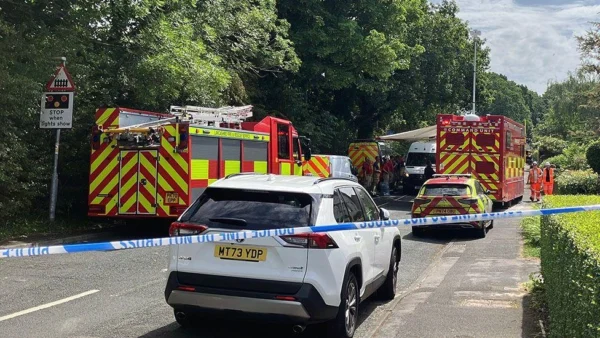
Britain’s level-crossing safety controls face urgent examination after investigators found that a passenger train approached Hoghton crossing with a green signal while its road lights, audible alarm and automatic half-barriers remained inactive.
The Northern service from Colne to Preston struck a car at approximately 8:48 a.m. on June 25, 2026. The car’s driver died, while a child travelling inside the vehicle sustained serious injuries. No injuries were reported among passengers or employees aboard the train.
The Rail Accident Investigation Branch has not established why the railway signal authorised the train to continue while the crossing’s warning equipment did not activate.
Consequently, no technical failure, maintenance problem, design defect or human error should be treated as confirmed while the independent investigation continues.
Green Signal and Raised Barriers Create Critical Questions
Hoghton uses an automatic half-barrier crossing system. Under normal operation, an approaching train should trigger road traffic lights and an audible warning before barriers lower across the left-hand side of each road approach.
Preliminary evidence shows that this expected sequence did not occur before the collision.
The train had passed a green signal, giving its driver authority to proceed. However, the warning lights had not started, the pedestrian alarm remained silent and the barriers stayed raised.
These conditions create a serious but unresolved question about how the train-detection, signalling and road-protection systems interacted.
Investigators are expected to examine recorded data, control circuitry, equipment condition, fault histories, inspection records and maintenance procedures. They will also assess the actions of those involved and the crossing’s existing risk-management arrangements.
RAIB investigations aim to identify safety lessons and prevent future accidents rather than determine criminal blame or legal liability.
Fatalities Have Risen Across Britain’s Crossings
The Hoghton findings emerged as the Office of Rail and Road reported worsening national level-crossing safety figures.
Eleven people died at level crossings during the financial year ending March 31, 2026. This compared with five fatalities during 2024–25 and one during 2023–24.
The regulator therefore classified level-crossing risk as increasing and warned that existing controls were not producing consistently effective outcomes.
Britain recorded 29 high-potential train accident incidents during 2025–26. Twelve involved level crossings, highlighting how road-rail interfaces continue to represent a concentrated area of risk despite Britain’s wider railway safety record.
The Hoghton collision occurred after that reporting period. It represents a separate fatal event during the new financial year and was not included among the eleven deaths.
Whole-System Safety Comes Under Pressure
Level crossings depend on several safety layers working together.
Train-detection equipment must recognise an approaching service. Railway signals must provide the correct movement authority. Lights and alarms must warn road users, while barriers must lower at the appropriate time.
Inspection, maintenance, remote monitoring and local risk assessments must support those operational systems.
The Hoghton investigation will determine whether the observed divergence resulted from a local equipment issue or a broader weakness involving system design, testing, assurance or organisational coordination.
Network Rail manages nearly 6,000 level crossings across Britain. Inspection frequencies depend on individual risk levels and can range from every seven weeks to every twelve months.
Closing a crossing removes its risk most effectively. However, where closure is impractical, infrastructure upgrades may include additional barriers, obstacle detection, improved warning equipment or replacement bridges and underpasses.
Regional Travel Reliability Also Faces Scrutiny
The train involved served the regional corridor linking Colne, Blackburn and Preston.
These services support daily commuting, education, business journeys and leisure travel across East Lancashire. Preston also provides connections to wider regional and long-distance railway networks.
A serious level-crossing incident can disrupt journeys beyond the immediate location. Emergency access, infrastructure examinations and route closures may affect several stations and connecting travel plans.
Tour operators and group organisers using the corridor should therefore monitor official journey information and build additional connection time into itineraries involving Preston.
However, the collision does not establish that the wider railway route is unsafe. The investigation concerns the circumstances surrounding this specific crossing and train movement.
Rail Reform Raises Accountability Questions
The investigation is unfolding while Britain reorganises its passenger railway and develops the framework for Great British Railways.
The Office of Rail and Road has warned that safety responsibilities must remain clear during major organisational change. Infrastructure, signalling, train operations, highway management and emergency response cannot become fragmented during the transition.
Level-crossing safety particularly requires cooperation because responsibility extends across railway and road environments.
The final Hoghton report may recommend changes involving equipment, inspection, maintenance, signalling interfaces or risk assessment. It may also find that some of these areas did not contribute.
Until investigators complete their work, the established conclusion remains limited but significant: a train proceeded under a green signal while the crossing’s warning lights, alarm and barriers had not activated.
That unexplained divergence, combined with rising national fatalities, ensures that Hoghton will remain central to Britain’s debate over level-crossing investment, regulatory assurance and public safety.
For more travel news like this, keep reading Global Travel Wire