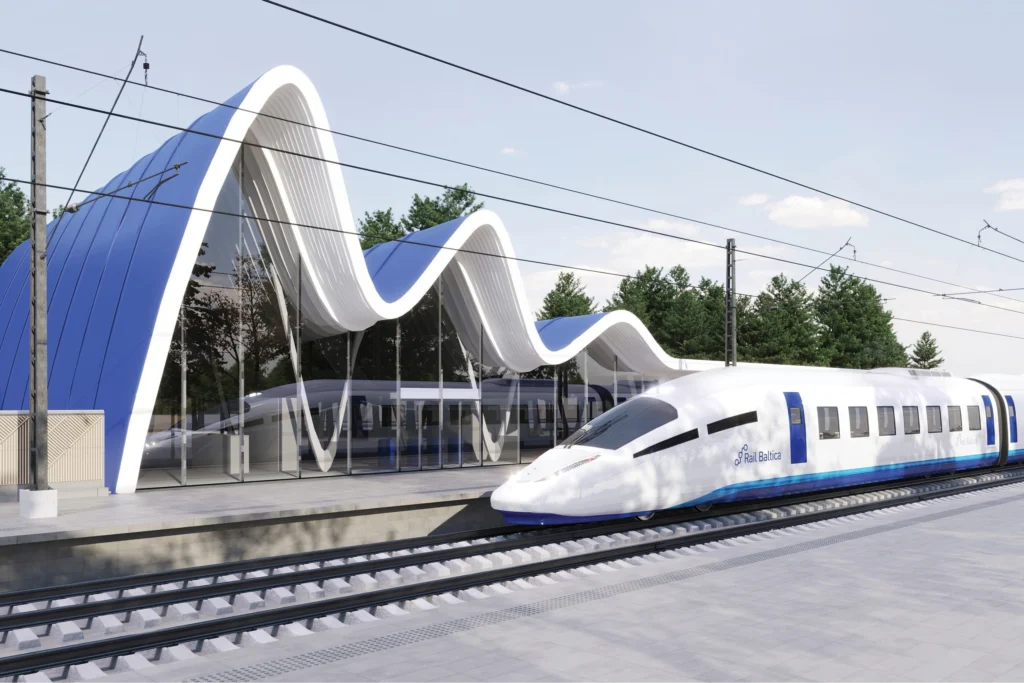
Latvia has entered one of Rail Baltica’s most important procurement stages as framework agreements make steel rails available for ordering from July 2026.
However, this milestone does not confirm that rails have entered production or begun arriving at Latvian construction sites. National implementing bodies must still convert the framework agreements into funded call-off orders that specify quantities, delivery schedules and receiving locations.
Reinforced-concrete sleepers and railway ballast are expected to become available for ordering from September. This staggered timetable creates a crucial mobilisation period for Latvia and the wider Baltic programme.
Project managers must now align financing, manufacturing capacity, construction progress and logistics before complete track packages can reach installation-ready sections.
Framework Agreements Do Not Guarantee Deliveries
Rail Baltica’s consolidated procurement programme uses seven-year framework agreements for essential railway materials.
These agreements establish technical requirements, pricing structures, quality controls and delivery conditions. However, they do not automatically commit national authorities to immediate expenditure.
Separate orders must be placed when construction schedules and available funding justify the purchase.
Rail supply contracts in Latvia have already been signed, while implementation activities have started. Cable ducts and multiduct systems are also available for ordering.
The sleeper contract entered its commencement phase after being signed in December 2025. Turnout systems, high-speed turnouts and expansion joints have also been contracted, with their first ordering availability expected later in 2026.
The commercial test now involves turning contractual access into physical progress without purchasing materials too early or causing delays through late orders.
September Will Raise the Logistics Stakes
Rails alone cannot create an operational railway.
Sleepers maintain the track gauge and support rail alignment, while crushed-stone ballast distributes loads and stabilises the track structure. These materials must arrive in quantities coordinated with track-laying productivity.
Early rail deliveries could require secure storage areas, specialised handling equipment and regular condition monitoring. Materials must remain protected until contractors can install them.
Delayed orders could create a different problem. Completed embankments, bridges and other civil structures may remain unused while contractors wait for rails, sleepers or ballast.
Latvia must therefore coordinate steel production, sleeper manufacturing, quarry capacity, rail transport and temporary storage facilities.
The procurement sequence may offer time to reserve steel-manufacturing slots before full track packages become necessary. However, it also increases the importance of accurate worksite planning.
Latvian Construction Creates Genuine Material Demand
Rail Baltica construction has expanded across all three Baltic states.
Latvia is advancing a priority southern mainline section while continuing work at Riga Central Station and Riga Airport. These projects will eventually require track systems, electrification, signalling and station connections.
Estonia reported 107 kilometres of mainline under construction in April 2026, together with work at the Ülemiste terminal. Lithuania had 114 kilometres under construction and had begun laying track on an initial 8.8-kilometre section.
Across the wider programme, 267 kilometres had reached a construction-ready position by June 2026. This represented approximately 43 per cent of the Phase I mainline.
Construction-ready mileage does not mean railway services can begin. Civil engineering must be followed by track installation, power systems, signalling, certification and operational testing.
Lithuania Provides an Early Track-Laying Model
Lithuania began installing Rail Baltica track before the July 2026 consolidated ordering window.
Its early programme demonstrates how material procurement must connect with civil construction, welding, ballast placement and technical inspections.
Latvia’s current procurement stage carries a different significance. It is intended to support larger and more coordinated purchasing across the Baltic programme rather than establish the project’s first physical supply chain.
The consolidated framework model may strengthen purchasing power and produce common technical standards.
Nevertheless, each country will continue placing orders according to its construction progress and financing position. Different national timelines could create supply imbalances unless cross-border coordination remains strong.
Funding Will Determine the Ordering Pace
Rail Baltica’s first implementation phase carries an estimated capital cost of €15.3 billion.
The phase aims to establish an operational connection across Estonia, Latvia and Lithuania towards Poland. Some sections may initially use a single track on formations designed for eventual double-track operation.
European Union support remains central to the project, but national contributions are still required.
Framework agreements provide procurement flexibility because authorities do not need to purchase all materials immediately. Yet that advantage depends on predictable funding.
Without confirmed financial coverage, implementing bodies may struggle to issue orders early enough to secure production capacity and meet construction schedules.
Future Tourism Benefits Depend on Execution
Rail Baltica is intended to connect Tallinn, Pärnu, Riga, Panevėžys and Kaunas with Poland’s standard-gauge railway network.
For tourism, the corridor could eventually support faster multi-country holidays, lower-emission journeys and easier connections between Baltic cities.
Riga Central Station and Riga Airport could become important passenger interchanges, supporting city breaks, business travel and combined air-and-rail itineraries.
However, travel companies should not market Rail Baltica services as operational or attach firm itineraries to the 2030 target.
Passenger benefits will only emerge when tracks, stations, signalling, electrification and trains become available within compatible schedules.
July therefore represents a contractual activation window rather than proof of large-scale material delivery. September will create the next major test as sleepers and ballast join rails within a more complete construction package.
Rail Baltica’s progress will now depend on how efficiently Latvia and its Baltic partners convert procurement frameworks into funded orders, coordinated deliveries and installed railway infrastructure.
For more travel news like this, keep reading Global Travel Wire