Official survey data released by Japan’s Ministry of Land, Infrastructure, Transport and Tourism (MLIT) reveals that 60 percent of passengers on luxury and expedition cruise ships actively participate in organized local tours during port calls. The comprehensive study highlights a growing preference among inbound international travelers for premium excursion experiences, underscoring the significant economic contribution of high-end maritime tourism to regional coastal economies across Japan.
The Ministry’s investigation analyzed passenger behaviors across 18 cruise ships that called at Japanese ports between August and December 2025. To capture clear economic distinctions, the survey categorized vessels into two primary operational groups: Casual and Premium (CP) class ships, represented by eight vessels, and Luxury and Expedition (LE) class ships, represented by ten vessels.
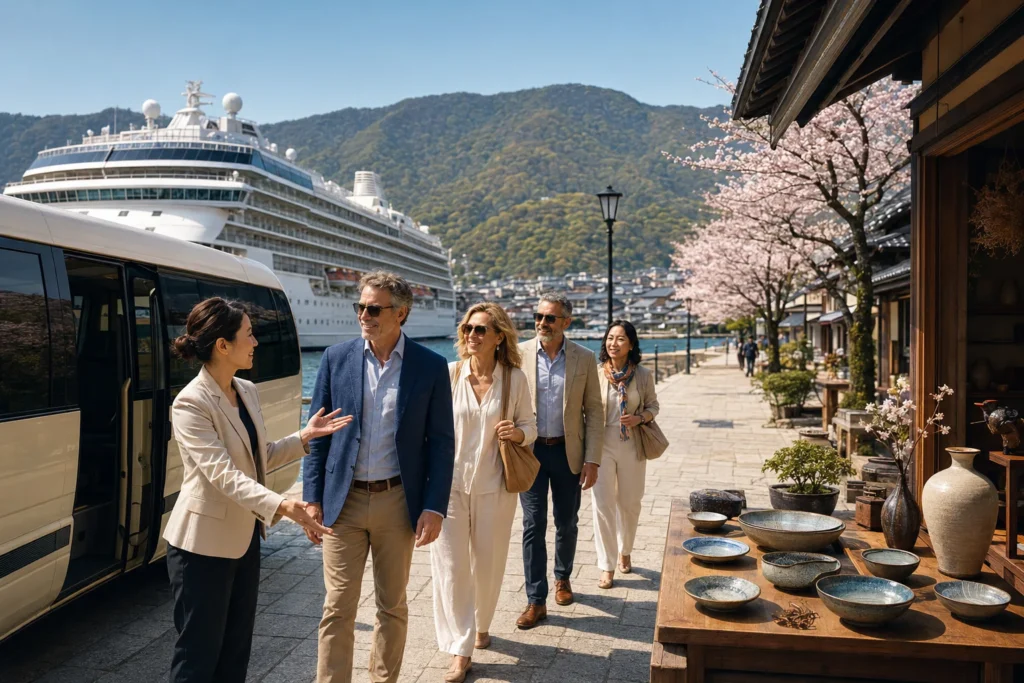
The statistical findings demonstrate a marked contrast in excursion engagement based on vessel class. While optional local tour participation averaged 20 percent among passengers traveling on Casual and Premium vessels, engagement surged to 60 percent among travelers on Luxury and Expedition class ships. This indicates that high-end cruise itineraries foster far higher direct engagement with local shore excursions and cultural experiences.
Inbound Travelers Demonstrate Strong Preference for Premium Port Excursions
The survey highlights distinct spending behaviors between foreign national passengers and Japanese citizens across both vessel categories and tour price points. On Casual and Premium class vessels, the average price of shore tours selected by passengers was 20,000 yen for Japanese travelers and 23,000 yen for international inbound visitors. Within this category, excursions priced between 10,000 yen and 20,000 yen recorded the highest sales volume across both demographic groups.
However, spending patterns diverged significantly on Luxury and Expedition class vessels. While Japanese passengers on LE-class ships spent an average of 21,000 yen on port tours, international passengers spent an average of 40,000 yen per excursion.
Among international travelers on luxury and expedition ships, premium tours priced between 50,000 yen and 60,000 yen emerged as the second most popular price range, trailing only excursions in the 20,000 yen to 30,000 yen range. This preference for higher-priced tours reflects strong demand among high-net-worth inbound travelers for exclusive, immersive, and specialized shore experiences in Japan’s coastal regions.
Turnaround Port Spending Highlights Comprehensive Economic Impact
Beyond excursion purchases, the Ministry of Land, Infrastructure, Transport and Tourism measured total average spending per passenger per port of call, uncovering substantial economic contributions at embarkation and disembarkation locations. Inbound foreign travelers generated significantly higher expenditure compared to domestic cruisers, particularly at turnaround ports where cruises begin and end.
At departure and arrival ports, foreign passengers on Casual and Premium class ships spent an average of 63,000 yen, whereas foreign passengers on Luxury and Expedition class ships spent an impressive 142,000 yen. In contrast, Japanese passengers spent an average of 17,000 yen at turnaround ports for CP-class cruises and 11,000 yen for LE-class voyages.
Ministry analysts noted that foreign international passengers frequently extend their travel itineraries by arranging pre-cruise and post-cruise hotel accommodations, dining, and regional sightseeing near major port cities like Yokohama, Kobe, and Tokyo.
At intermediate ports of call along cruise itineraries, foreign passengers spent an average of 17,000 yen on CP-class ships and 29,000 yen on LE-class ships. Japanese passengers spent an average of 12,000 yen on CP-class ships and 18,000 yen on LE-class vessels during standard port visits. Applying these baseline survey figures to total national port call statistics yields an estimated overall average passenger expenditure of approximately 22,000 yen per port call across all vessel types.
Extending Port Stay Duration Yields Direct Revenue Increases
Analytical modeling by the Ministry indicates a direct correlation between the length of time a cruise ship remains docked and total passenger expenditure ashore. According to government estimates, extending a cruise ship’s port stay by just one additional hour generates approximately 900 yen in additional spending per passenger.
This analytical finding provides municipal authorities and port operators with a clear operational incentive to optimize dockside services, streamline customs procedures, and expand late-evening cultural programming to encourage longer ship stays.
Strategic Alignment with Japan 2030 Tourism Objectives
The survey results serve as an essential benchmark for measuring progress under the government’s 5th Basic Plan for the Promotion of a Tourism-Oriented Nation. Under this national policy framework, the Japanese government has set a target to increase average spending per cruise passenger per port call to 1.5 times the 2025 baseline by the year 2030.
Based on the baseline estimate of 22,000 yen derived from the survey data, the target average spending figure for 2030 is established at approximately 33,000 yen per passenger per port call.
By expanding high-value shore excursion offerings, enhancing regional port infrastructure, and attracting a greater proportion of luxury and expedition vessels, Japan aims to capture maximum economic benefit from the expanding global cruise market while dispersing tourism revenue into regional coastal communities.
For more travel news like this, keep reading Global Travel Wire