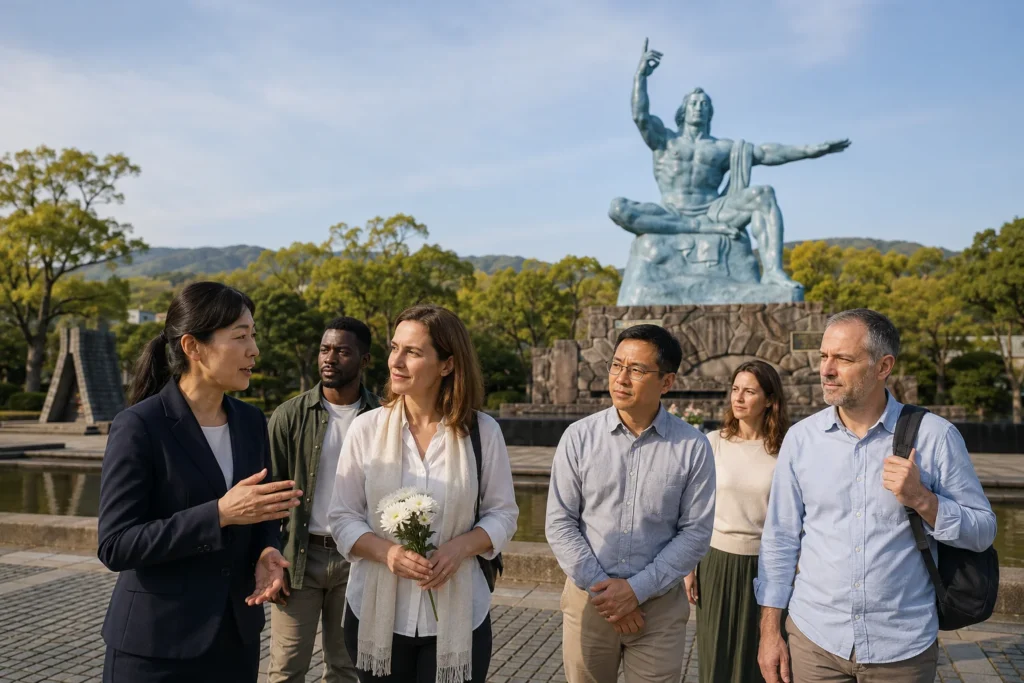
Nagasaki continues to strengthen its standing as a premier global hub for peace tourism, attracting international travelers, educators, and historians dedicated to understanding world history and promoting global harmony. According to official municipal statements from Nagasaki City, the city’s peace memorials and educational venues serve as vital destinations for peace travel, offering visitors a profound opportunity to reflect on historical events while engaging with contemporary global dialogue.
A key highlight of Nagasaki’s annual cultural calendar took place on July 25, 2026, when the city hosted the International Symposium for Peace 2026 inside the historic hall of the Nagasaki Atomic Bomb Museum. Co-organized by Nagasaki City and the Nagasaki Peace Promotion Association, the symposium carried the theme: “The Road to Nuclear Weapons Abolition: The 70th anniversary of Nihon Hidankyo, Returning to the Origin: Nagasaki.” The event underscored Nagasaki’s ongoing effort to welcome international tourists seeking meaningful cultural and educational travel experiences centered on humanitarian values.
Inspiring Educational Journeys at the Heart of Historic Memorial Destinations
The Nagasaki Atomic Bomb Museum, situated near the hypocenter of the 1945 atomic blast in the Urakami district, stands as the central focal point for visitors exploring peace tourism in Japan. Official tourism statistics from municipal authorities indicate that peace-focused travel to Nagasaki has seen a steady rise in overseas visitors, driven by growing global interest in heritage preservation and educational travel.
Addressing an audience of international guests, scholars, and local youth at the symposium, keynote speaker Peter Kuznick, a professor at American University and director of the Nuclear Studies Institute, emphasized Nagasaki’s pivotal role in global peace education. Kuznick commended the historical efforts of Nihon Hidankyo, the Japan Federation of A- and H-Bomb Sufferers Organization, which received the Nobel Peace Prize for its grassroots advocacy. He highlighted how the organization’s members have worked tirelessly to ensure that Nagasaki remains a beacon of hope and that the devastating impacts of nuclear warfare are never repeated.
For international travelers visiting the city, attending such high-level symposiums and visiting memorial halls provides a unique perspective that bridges historical learning with active participation in global peacebuilding.
Preserving Hibakusha Legacy to Enrich Visitor Experiences
A central pillar of Nagasaki peace tourism is the opportunity to learn directly from the living history of atomic bomb survivors, known as Hibakusha. During a special dialogue segment at the 2026 symposium, 94-year-old Terumi Tanaka, co-chair of Nihon Hidankyo who survived the atomic bombing at age 13, shared his personal testimony with younger participants, including third-generation descendants of survivors.
Official releases from the Nagasaki Peace Promotion Association emphasize that intergenerational storytelling plays a crucial role in maintaining the city’s identity as an international peace capital. By integrating survivor testimonies into visitor programs, museum exhibits, and guided walking tours, Nagasaki offers travelers an emotionally resonant educational experience that cannot be replicated elsewhere.
The event also featured a special video message from actress Satomi Ishihara, who has collaborated with Nagasaki City survivors on peace initiatives over many years. In her message, Ishihara expressed her commitment to carrying forward the heartfelt wishes of survivors, reassuring visitors and participants that the legacy of peace will continue to guide future generations.
Multidisciplinary Insights Enhance Cultural and Academic Tourism
Beyond historical remembrance, Nagasaki’s peace tourism initiatives encourage academic engagement and cross-cultural exchanges. A panel discussion titled “To Avoid the Final War” brought together leading international scholars to examine global security and peacebuilding from diverse perspectives.
Panelists included Roschanack Shaery-Yazdi from the University of Antwerp, specializing in the contemporary Islamic world; Yoshiyuki Kato, a professor of religious studies at Rikkyo University; and Kimiyo Ogawa, a literary scholar and professor at Sophia University. Shaery-Yazdi pointed out the necessity of re-evaluating traditional deterrence vocabulary and examining the underlying global power dynamics, urging audiences to foster genuine cross-cultural understanding.
These interdisciplinary discussions highlight how Nagasaki’s tourism sector expands beyond traditional sightseeing, positioning the city as a dynamic destination for conferences, academic retreats, and international exchange programs.
Discovering Nagasaki’s World-Class Peace Landmarks and Heritage Sites
Visitors participating in peace tourism in Nagasaki can explore an interconnected network of historic monuments, tranquil parks, and architectural landmarks located throughout the Urakami district.
Key sites across the city’s peace tourism corridor include:
Nagasaki Atomic Bomb Museum: Featuring preserved artifacts, historical photographs, and interactive exhibits depicting pre-war life, the blast impact, and the city’s post-war reconstruction.
Nagasaki Peace Park: Established in 1955, featuring the iconic 9.7-meter-tall Peace Statue created by sculptor Seibo Kitamura, the serene Fountain of Peace, and international peace monuments contributed by nations worldwide.
National Peace Memorial Hall: An underground architectural memorial designed with water and light elements to offer visitors a quiet space for contemplation and remembrance.
Hypocenter Park: Marking the exact epicenter of the atomic explosion with a black stone monolith and preserved remnants of the original Urakami Cathedral wall.
Nagasaki City municipal guides recommend taking the local streetcar system to access Urakami’s peace cluster, allowing travelers to combine their historical visits with explorations of Nagasaki’s famous harbor views, historic slope districts, and unique culinary traditions. As international interest in purposeful travel continues to grow, Nagasaki remains dedicated to offering world-class, educational, and inspiring journeys for travelers from around the globe.
For more travel news like this, keep reading Global Travel Wire