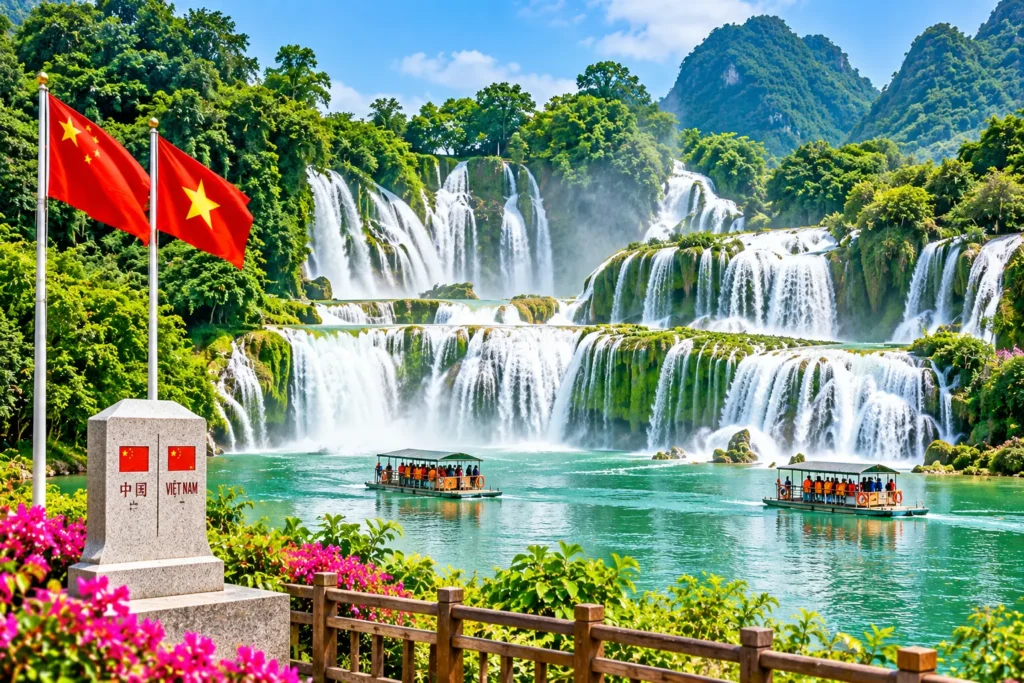
Official statistical releases and joint border management bulletins confirm that the landmark cross-border tourism cooperation zone linking the Detian-Ban Gioc Waterfall between China’s Guangxi Zhuang Autonomous Region and Vietnam’s Cao Bang Province has achieved substantial visitor growth. Public data released by regional tourism administrations and border inspection directorates show that the bilateral destination registered 54,450 tourist crossings between January and September 2026, marking a 40.4 percent expansion over the corresponding period in the prior operating year. Daily visitor counts set a new operating benchmark, peaking at 1,272 crossings.
Since trial operations were formally initiated across the international natural cascade in September 2023, the cooperation zone has facilitated nearly 160,000 smooth border crossings without a single recorded operational error, incident, or security breach. State tourism administrations and immigration agencies note that the initiative has established a successful institutional model for green ecological travel, bilateral diplomatic collaboration, and cross-border regional economic revitalization across Southeast Asia.
Integrated Bilateral Management and High-Speed Clearance Protocols
The Detian-Ban Gioc scenic corridor allows registered leisure travelers to experience the natural landscapes and cultural heritage of both sovereign territories within a single excursion itinerary. State development bodies and municipal management committees have integrated ticketing systems and digitized booking platforms, enabling visitors to reserve cross-border tours through unified electronic verification portals.
To minimize transit friction along the land frontier, border inspection authorities and customs directorates have deployed advanced automated immigration infrastructure. Facial recognition technology for permit verification, centralized bag-scanning screening, and advance electronic baggage declarations have reduced passenger clearance times to approximately twenty seconds per individual.
Furthermore, immigration authorities have simplified international processing protocols by waiving mandatory physical fingerprint collection and traditional passport endorsement stamps for eligible foreign tour groups. Coordinated security frameworks between Chinese and Vietnamese law enforcement agencies maintain continuous surveillance, waterborne safety monitoring on tourist sightseeing rafts, and real-time operational communications to safeguard visitor welfare throughout the natural reserve.
Expanding International Visitor Arrivals and Regional Economic Integration
The rapid growth in traveler numbers across the international waterfall complex has generated substantial economic value for local communities in both Daxin County in Guangxi and Trung Khanh District in Cao Bang. Comprehensive economic reviews from local commerce and agricultural departments reveal that increased visitor expenditure has directly supported regional hotel occupancies, traditional restaurants, agricultural cooperatives, and artisanal souvenir workshops.
Beyond daily leisure travel, the cross-border cooperation framework has evolved into an active venue for bilateral cultural exchanges and festive public events. Official government accounts indicate that cross-border cultural activities, craft exhibitions, and international trade showcases hosted within the zone engaged more than 100,000 participants in 2026 alone.
Traditional performances, indigenous culinary showcases, and community-based handicraft markets allow local Zhuang and Tay ethnic communities to present their distinctive intangible heritage to a diverse international audience. These cultural activities encourage longer visitor stays across surrounding rural counties, stimulating tourism-driven rural development, modern homestay creation, and sustainable job creation in remote border districts.
Environmental Stewardship and Sustainable River Management
The Ban Gioc–Detian Falls, situated along the upper reaches of the Quay Son River, represent the largest transnational waterfall system in Asia and the second-largest worldwide along an international boundary. Environmental protection ministries from both sovereign administrations have prioritized ecological conservation alongside visitor expansion, establishing strict zoning restrictions to preserve surrounding karst topographies, riverbed biodiversity, and sub-tropical forest ecosystems.
Motorized bamboo rafts navigating the river basin operate under strict carrying-capacity regulations and low-emission navigational guidelines. Dedicated park management teams conduct joint river patrols and environmental monitoring to prevent water pollution, mitigate bank erosion, and preserve the natural grandeur of the multi-tiered cascades. By balancing infrastructural development with strict environmental preservation, regional planners ensure that rising visitor footfall does not degrade delicate riverine environments.
Regional Promotion Across Southeast Asian Travel Circuits
Building upon the success of the bilateral arrangement, state tourism boards and provincial authorities are intensifying promotional marketing campaigns across broader Southeast Asian source markets. Destination marketing organizations are positioning the Detian-Ban Gioc corridor as an anchor stop within expanded regional touring circuits, actively marketing the destination across Vietnam, Thailand, and neighboring ASEAN nations.
Regional tourism agencies are aligning cross-border railway connectivity, scenic highway networks, and international aviation gateways in Nanning and Hanoi to offer combined multi-day itineraries. These packages link the border waterfalls with regional UNESCO World Heritage sites, including Halong Bay in northeastern Vietnam and the Zuojiang Huashan Rock Art Cultural Landscape in Guangxi.
As sovereign travel agencies review operating metrics and prepare for upcoming high-season travel windows, the Detian-Ban Gioc Waterfall cooperation zone illustrates how coordinated public management, innovative immigration technology, and ecological preservation can transform shared natural landmarks into internationally recognized models of sustainable cross-border tourism.
For more travel news like this, keep reading Global Travel Wire