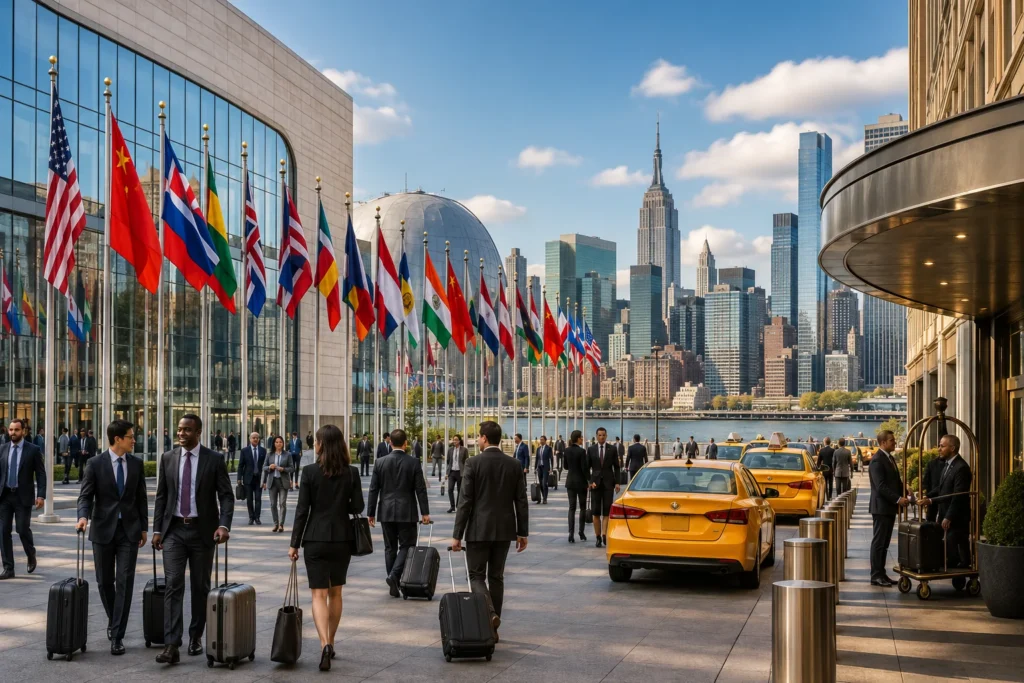
The arrival of high-profile international dignitaries and foreign government delegations in New York City continues to serve as a vital catalyst for the regional economy. Every autumn, as world leaders, ministerial representatives, and official diplomatic missions gather for the United Nations General Assembly and associated bilateral summits, the city experiences a major surge in high-value business travel, luxury hotel bookings, and cross-border visitation. Official projections and performance metrics released by municipal destination marketing organizations and global tourism bodies demonstrate that diplomatic travel remains a foundational pillar of international tourism resilience.
According to official statistics from New York City Tourism + Conventions, overall visitor arrivals are projected to reach 66.3 million, reflecting sustained growth in both domestic and international market segments. International visitation is rebounding toward 12.9 million travel arrivals, buoyed by expanding long-haul flight connectivity and diplomatic events that draw global delegations to Manhattan. Official municipal financial reports indicate that visitor spending generates an estimated $84.7 billion in total economic impact for the city, contributing over $7.5 billion in local and state tax revenue while supporting nearly 400,000 hospitality and service sector jobs.
The Economic Weight of Diplomatic Travel and International Delegations
While leisure travel accounts for the largest volume of total visitors, diplomatic missions and official government assemblies deliver disproportionate economic value per attendee. Official economic impact evaluations published by state government agencies reveal that international business and government travelers spend significantly more per trip than average domestic visitors. Premium accommodations, secure transportation services, formal dining venues, and event spaces across Midtown Manhattan experience peak demand during major international conferences.
Diplomatic assemblies require specialized municipal infrastructure, law enforcement coordination, and elevated security protocols managed by federal authorities and local emergency services. Despite operational complexities, official tourism statistics confirm that the concentration of world leaders and supporting delegations elevates hotel occupancy rates across the five boroughs to nationwide highs. New York City routinely leads top United States urban markets with average hotel occupancy exceeding 84 percent, driven largely by high-volume demand in luxury and upscale lodging properties surrounding diplomatic quarters.
Official statements from the United Nations World Tourism Organization highlight that government-led summits generate cascading economic benefits beyond direct hotel room sales. Delegations, media corps, and civil society representatives contribute heavily to regional retail, catering services, transportation infrastructure, and cultural institutions. The sustained inflow of international diplomatic travel reinforces the city’s position as a premier global gathering place for international governance and economic cooperation.
Elevating Hospitality Standards and Luxury Tourism Performance
The annual influx of government officials and diplomatic staff places a premium on high-tier hospitality infrastructure. Official market statistics show that luxury hotels achieve annual occupancy rates near 82 percent, with average daily room rates climbing steadily to support rising operational costs and enhanced service standards. The expansion of new hotel properties across the city—adding thousands of rooms to the municipal inventory—reflects long-term investor confidence in international business and diplomatic tourism demand.
Municipal tourism statistics highlight that international travelers account for roughly half of all direct tourism spending in the five boroughs, despite representing a smaller fraction of total headcounts compared to domestic drive-in visitors. Delegations originating from Europe, Latin America, Asia, and the Middle East represent crucial source markets that sustain year-round commercial aviation routes into regional international airports, including John F. Kennedy International Airport and LaGuardia Airport.
To support this demand, city government announcements highlight ongoing infrastructure investments aimed at expanding airport terminal capacities, improving mass transit links, and modernizing convention facilities. The combination of state-of-the-art infrastructure and world-class diplomatic infrastructure ensures that high-level international travel remains seamless and secure.
Strategic Outlook and Long-Term Global Travel Recovery
Looking ahead, government tourism authorities forecast continued expansion in global travel arrivals, underpinned by international sports tournaments, trade conventions, and recurring diplomatic summits. The anticipated arrival of international delegations for multi-lateral conferences provides a reliable baseline of demand for local hospitality workers and small business owners across the metropolitan area.
Official public statements from tourism officials emphasize that fostering international diplomatic travel directly strengthens global brand visibility for host cities. When international leaders and foreign ministers convene for bilateral discussions, global media spotlighting reinforces the city’s cultural and economic prominence. As international flight capacities normalize and government travel budgets adapt to evolving global economic conditions, high-level diplomatic events will continue to anchor international visitor growth, driving economic stability and supporting hundreds of thousands of local livelihoods across the urban ecosystem.
For more travel news like this, keep reading Global Travel Wire