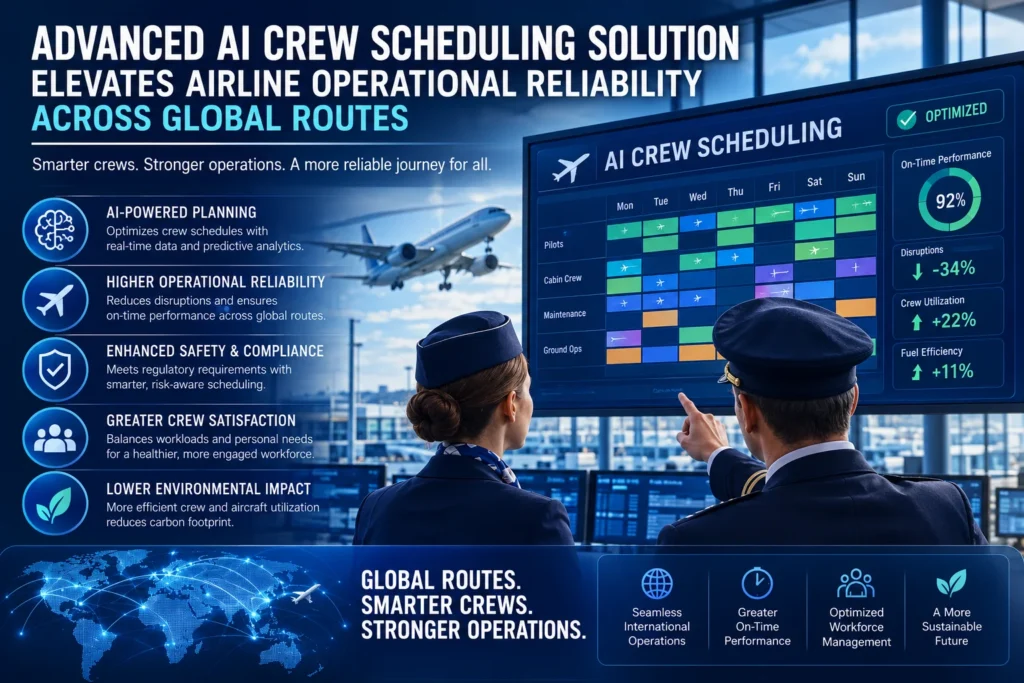
All Nippon Airways has transitioned a proprietary automated crew scheduling platform into full-scale operations to manage monthly rosters for approximately 2,000 flight crew members. Developed over four years of proof-of-concept testing in partnership with artificial intelligence and mathematical optimization specialists from R&D Co., Ltd., a University of Tokyo startup, the system automates one of the most intricate administrative processes in commercial aviation.
By streamlining roster creation while maintaining strict compliance with aviation safety regulations, fatigue risk management standards, and crew qualifications, the Japanese flag carrier aims to strengthen overall flight schedule integrity, reduce operational delays, and elevate the passenger experience across its domestic and international flight networks.
Automated Scheduling Algorithm Processes Complex Aviation Constraints
Planning monthly duty rosters for flight deck crews requires balancing tens of thousands of dynamic variables. Schedulers must evaluate mandatory flight hour limits, legal rest periods, specialized aircraft type ratings, language proficiency certifications, internal corporate guidelines, and individual leave requests. Historically, administrative teams spent weeks manually drafting and refining these assignments.
The newly deployed automated scheduling system, known as the AI Scheduler, processes complex operational constraints in a matter of hours. Official company statements indicate that the technology generates optimized roster proposals that satisfy regulatory frameworks set by the Japan Civil Aviation Bureau while maintaining crew workload balance.
By automating repetitive computational tasks, the platform is projected to reduce crew scheduling workloads by approximately 6,300 hours annually, equivalent to 525 hours per month. This administrative efficiency allows scheduling specialists to redirect operational focus toward long-term network planning, irregular operations management, and personalized flight crew support.
Human-AI Collaboration Enhances Work-Life Balance and Schedule Precision
The operational philosophy behind the system relies on a hybrid framework that pairs algorithmic automation with human oversight. While the artificial intelligence engine instantly processes routine legal parameters, mandatory safety rules, and qualification prerequisites, human scheduling specialists retain final approval authority to handle non-quantifiable individual preferences and complex operational exceptions.
Key operational features of the scheduling technology include:
Regulatory and Safety Verification: Automatic auditing of flight crew qualifications, medical clearances, and fatigue risk management metrics against national civil aviation mandates.
Workload Leveling: Algorithmic distribution of flight hours and layover assignments across crew members to mitigate fatigue and promote equitable duty allocation.
Exception Handling: Direct human intervention for unexpected flight disruptions, emergency leave requests, or specialized route assignments that require qualitative evaluation.
This collaborative approach not only improves operational efficiency but also enhances work-life stability for flight crews, contributing directly to higher service quality and operational stability across the flight network.
Traveler Guidance and Airport Transit Logistics Across Japanese Hubs
For international and domestic passengers, enhanced back-end workforce optimization translates directly into higher flight punctuality and smoother connections through major Japanese aviation gateways, including Tokyo Haneda Airport and Tokyo Narita Airport.
To ensure seamless transit when connecting through Japanese airports, travelers are encouraged to incorporate key logistical guidelines into their trip planning:
Layover Buffers: When connecting between international long-haul flights and domestic feeder routes at Haneda or Narita, maintaining a minimum layover buffer of 2.5 to 3 hours accommodates security re-screening, baggage transfers, and potential terminal shifts.
Terminal Connections: Passengers transferring between terminals at Narita Airport should utilize designated airport shuttle buses and account for transit times between international arrival halls and domestic departure gates.
Automated Immigration Systems: Overseas visitors traveling to Japan can utilize expanded automated biometric gates at primary international airports by registering passport details upon entry, significantly accelerating arrival processing.
Real-Time Operations Monitoring: In the event of localized weather events or air traffic control holds, automated scheduling tools enable the airline to adjust crew rosters rapidly, minimizing cascading flight delays and returning flight operations to normal schedules faster than traditional manual processes allowed.
Future Outlook for Intelligent Workforce Management in Global Aviation
The full-scale deployment of automated crew scheduling reflects a broader digital transformation across the global aviation sector. As international passenger volumes continue to expand, airlines are increasingly adopting artificial intelligence, predictive analytics, and automated decision-support tools to manage increasingly complex flight networks.
In alignment with the official ANA Group Medium-Term Management Strategy, the integration of digital tools aims to build a flexible, resilient operational infrastructure capable of adapting to sudden market shifts and weather disruptions. By embedding intelligent automation into core operational workflows, commercial aviation operators are establishing new benchmarks for safety compliance, workforce management, and destination reliability worldwide.
For more travel news like this, keep reading Global Travel Wire