Air travel across the Gulf and broader Middle East continues to undergo dynamic realignments as flag carriers and civil aviation regulators respond to evolving security advisories and airspace updates. With summer seasonal demand remaining high, aviation authorities across the region are issuing updated operational guidelines to assist travelers navigating schedule modifications, re-routings, and temporary flight suspensions.
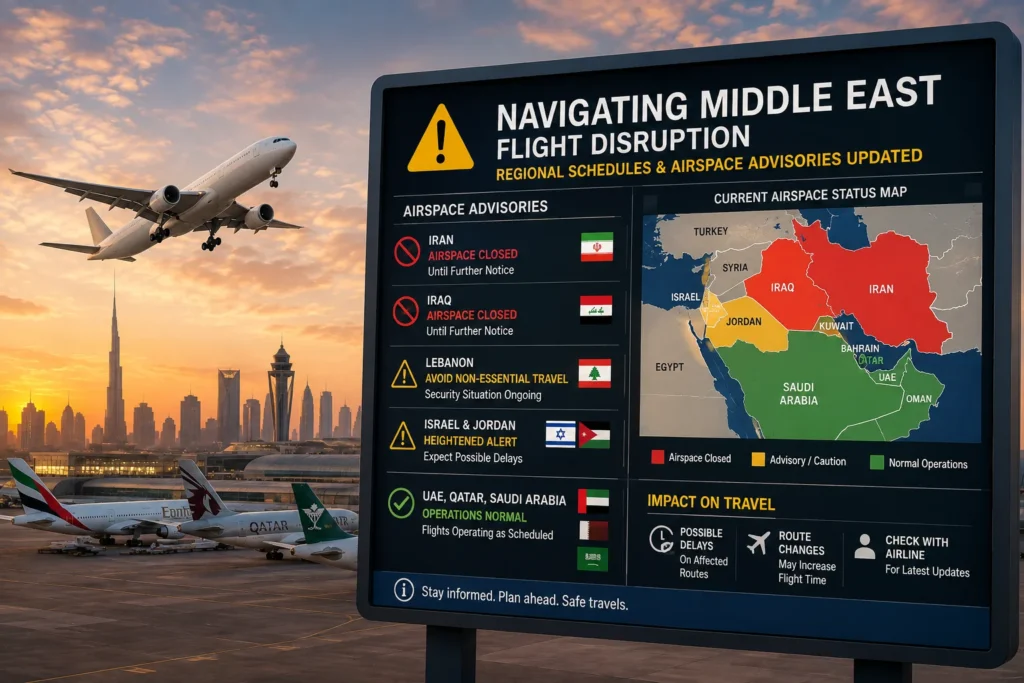
Official statements from civil aviation governing bodies confirm that while sovereign airspace across several key transportation corridors remains fully or partially open under active monitoring, flight networks are operating on calibrated schedules to prioritize flight safety and operational integrity.
Civil Aviation Statements and Regional Airspace Operations
National civil aviation bodies across the Arabian Peninsula maintain real-time evaluation systems to ensure the safety of commercial flights. The General Civil Aviation Authority of the United Arab Emirates has reaffirmed that air traffic operations remain restored and under continuous real-time safety supervision. Similar operational reopenings have been confirmed in neighboring civil aviation FIRs, though specific flight corridors remain subject to tactical re-routing.
Concurrently, European safety regulators, including the European Union Aviation Safety Agency, have extended conflict zone information bulletins recommending that international operators maintain cautious flight routing choices over parts of the Gulf region. These bulletins, valid through late August, advise carriers to evaluate operational risks carefully, prompting several European and international long-haul operators to alter flight paths or extend seasonal route pauses.
Because aircraft must occasionally navigate alternative flight paths to bypass restricted sectors, technical fuel stops and extended flight times remain possible, particularly on longer transcontinental routes.
Major Regional Flag Carriers Adjust Schedules and Network Capacity
National carriers headquartered in the Gulf region continue to operate extensive network schedules while accommodating localized airspace constraints through route modifications and flight consolidation.
Emirates has maintained global operations connecting over 130 destinations across its international network. Operating a significant portion of its scheduled weekly capacity, the Dubai-based carrier continues to fine-tune regional connections, particularly on routes serving Bahrain and Kuwait. To provide travel reassurance, the airline offers flexible rebooking policies alongside specialized travel insurance coverage that includes disruption and medical support for eligible international passengers.
Etihad Airways continues servicing an expansive global summer schedule, including more than 80 international cities. While specific regional services to neighboring Gulf destinations face temporary schedule realignments, the airline has implemented ticket waiver policies, allowing fee-free booking modifications for confirmed travelers on impacted itineraries. Incoming passengers also benefit from state-backed travel insurance coverage during their stay.
Qatar Airways has expanded its network to cover more than 160 destinations worldwide, including restored multi-daily frequencies to key UAE hubs. However, targeted temporary suspensions remain in effect on select regional sectors, accompanied by flexible rebooking allowances through autumn.
Regional low-cost operators, including Air Arabia and flydubai, continue operating major portions of their point-to-point networks. Flydubai operates a robust summer schedule across Europe, Central Asia, and the Middle East, while advising passengers that tactical route adjustments may slightly increase transit durations. Air Arabia maintains scheduled flights from its UAE operating bases to destinations across Europe, Asia, and North Africa, while issuing regular travel alerts regarding temporary schedule adjustments to selected regional points.
National flag carriers across South Asia, including Air India and IndiGo, have restored extensive flight schedules linking the Gulf Cooperation Council region with major international airports, operating hundreds of weekly flights while closely aligning route planning with regulatory guidance.
International Airlines Extend Operational Pauses
While regional airlines sustain high-volume transport operations, several long-haul international carriers have implemented extended pauses or reduced frequencies into Gulf aviation hubs to align with home-country safety bulletins.
Major European, East Asian, and North American airlines—including Air France, British Airways, KLM, Lufthansa, Cathay Pacific, Singapore Airlines, and Air Canada—have updated their flight schedules, extending operational pauses on select regional routes through late summer and early autumn. Several long-haul operators have consolidated multiple daily flights into single daily operations or introduced seasonal pauses until full airspace stability is established.
Airlines affected by these regulatory advisories are providing full refunds, complimentary rebooking windows, or alternative transit arrangements in collaboration with partner airlines.
Passenger Travel Recommendations and Airport Protocol Guidance
In light of heavy summer passenger volumes and regional route realignments, aviation authorities and airport management agencies have issued essential guidelines for individuals traveling through major regional hubs:
Early Airport Arrival: Passengers departing from major hubs, including Dubai International Airport and Zayed International Airport, are advised to arrive at departure terminals at least three hours prior to scheduled flight times.
Pre-Travel Verification: Travelers should verify the exact operational status of their flight through official carrier applications or websites before leaving for the airport, even after completing online check-in.
Updated Contact Information: Ensure correct mobile numbers and email addresses are registered within booking profiles to receive real-time operational notifications via SMS or instant message.
Security Timeline Planning: Travelers should aim to clear security checkpoints at least 90 minutes before departure and present themselves at departure gates at least one hour before scheduled take-off.
Civil aviation authorities and national tourism boards continue to emphasize that passenger safety remains the highest priority, with technical monitoring teams operating continuously to adjust air navigation protocols as regional conditions evolve.
For more travel news like this, keep reading Global Travel Wire