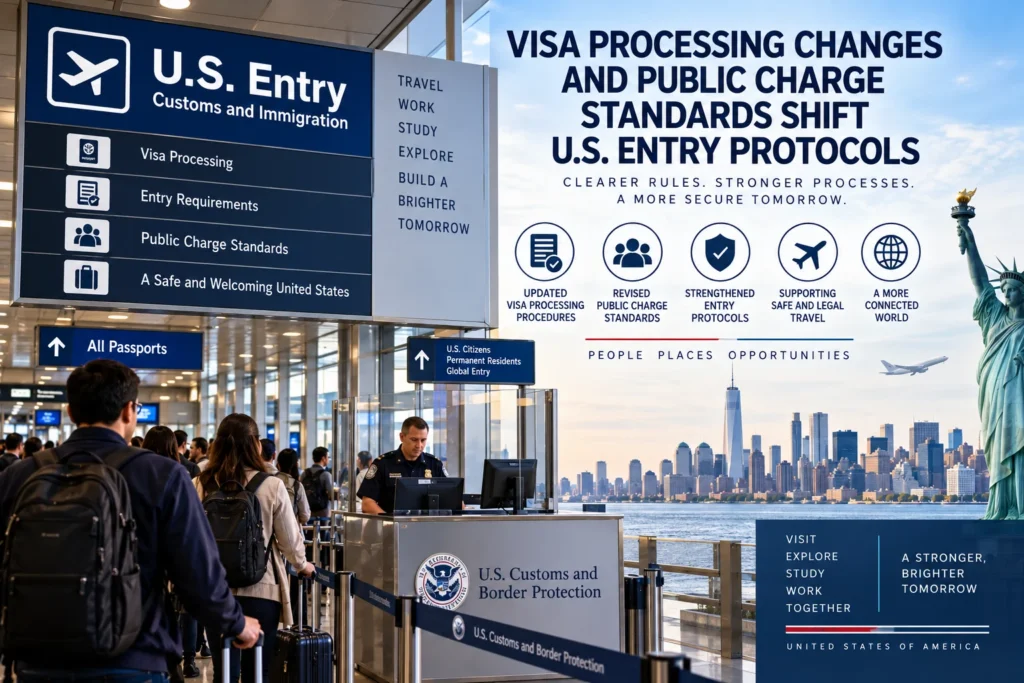
Significant policy updates and ongoing judicial challenges are reshaping United States visa processing, permanent residence evaluations, and educational travel protocols. Regulatory revisions governing public benefit reviews took effect this week alongside federal court injunctions protecting international student status, impacting global travel planning and visa issuance worldwide.
For prospective visitors, international students, and adjustment-of-status applicants, navigating current consular operations and regulatory frameworks requires strict attention to updated federal guidelines.
+------------------------+---------------------------------------+------------------------------------------+
| Immigration Category   | Policy & Regulatory Status            | Operational Impact on Travelers & Applicants|
+------------------------+---------------------------------------+------------------------------------------+
| Permanent Residence    | Expanded public charge review criteria| Officers evaluate means-tested benefits  |
| (Form I-485 Filings)   | implemented across all filings        | like Medicaid, SNAP, and housing support |
+------------------------+---------------------------------------+------------------------------------------+
| Student & Exchange     | Duration of Status system preserved   | F-1, J-1, and I visa holders maintain    |
| Visas (F-1, J-1, I)    | via federal court preliminary injunction| standard academic stay plus grace period |
+------------------------+---------------------------------------+------------------------------------------+
| Consular Operations    | Regional appointment availability     | Country-specific wait times and target   |
| & Visa Restrictions    | varies; Proclamation 10998 enforced   | restrictions affect selected nationalities |
+------------------------+---------------------------------------+------------------------------------------+
Public Charge Assessment Framework Takes Effect Amid Legal Challenges
Under newly implemented Department of Homeland Security regulations, U.S. Citizenship and Immigration Services officers hold broader discretion when evaluating green card applications for potential public charge inadmissibility. The updated assessment framework allows adjudicators to review an applicant’s enrollment in or receipt of federally funded, means-tested public benefits, including Supplemental Nutrition Assistance Program (SNAP), Medicaid, Children’s Health Insurance Program (CHIP), and federal housing assistance.
While benefit utilization does not trigger an automatic application denial, officers evaluate usage as part of the broader totality of an applicant’s circumstances, weighing age, health, financial status, skills, and sponsor affidavits. Concurrently, U.S. Citizenship and Immigration Services has deployed a revised edition of Form I-485, requiring mandatory compliance for all filings submitted on or after the implementation date.
A multi-state litigation coalition comprising state attorneys general, municipal governments, and legal advocacy groups has filed federal lawsuits challenging the regulatory authority behind the expansion. Because no emergency court stay was issued, the revised screening standard remains operational nationwide while judicial proceedings continue.
Court Decision Preserves Duration of Status for International Students
In a major development for international education and academic travel, a federal district court judge issued a preliminary injunction blocking proposed Department of Homeland Security regulations that aimed to eliminate “duration of status” admission periods for foreign students and media representatives.
The blocked regulation sought to replace flexible academic stays with fixed admission periods, capping standard student permissions at maximum four-year increments. Following the preliminary injunction, traditional duration of status guidelines remain fully active:
F-1 Academic Students: Maintain lawful status for the full duration of their enrolled academic program plus the standard 60-day post-completion grace period.
J-1 Exchange Visitors: Retain status for the duration of their designated exchange program plus the applicable post-program departure window.
I Visa Media Representatives: Continue operating under open-ended status tied directly to active credentials and employment.
Global Consular Service Trends and Country-Specific Visa Rules
Consular processing and interview appointment scheduling across U.S. embassies and consulates continue to display substantial geographic variation. While diplomatic posts maintain international operations, appointment wait times for non-immigrant visitor visas and immigrant visas fluctuate based on staffing levels and regional demand.
Certain overseas posts require applicants from high-demand regions to redirect filings to designated regional processing centers. Furthermore, consular posts continue enforcing visa issuance restrictions established under Presidential Proclamation 10998, which applies specific issuance limits to nationals originating from 39 designated countries.
In separate foreign policy action, the U.S. Department of State announced targeted non-immigrant visa restrictions applying to specific South African government personnel and affiliated individuals connected to contested land reform policies. The diplomatic measure addresses targeted policy concerns while standard travel processing for general South African citizens remains operational through diplomatic posts.
Essential Travel and Compliance Guidelines for Applicants
Travelers, international students, and adjustment applicants preparing U.S. visa documentation should observe updated administrative rules:
Verify Correct Form Editions: Applicants submitting permanent residence adjustments must ensure Form I-485 matches the current edition required by U.S. Citizenship and Immigration Services to avoid rejection.
Confirm Consular Appointment Lead Times: International travelers planning travel to the U.S. should check official embassy portals early to confirm local interview wait times and document submission rules.
Maintain Educational Status Compliance: International students should coordinate with Designated School Officials before embarking on international travel to ensure SEVIS records and travel signatures remain active.
Frequently Asked Questions
Does receiving public benefits automatically result in a green card denial under public charge rules?
No. Utilizing means-tested public benefits like Medicaid or SNAP is evaluated as one factor within the totality of an applicant’s financial, health, and age profile rather than an automatic ground for denial.
Are international students affected by fixed-period visa limits?
No. Due to a federal court preliminary injunction, the proposed four-year fixed cap was blocked, allowing F-1 and J-1 visa holders to remain under duration of status rules.
How can international travelers check U.S. visa appointment wait times?
Travelers can check real-time appointment availability and consular operational updates directly on the official U.S. Department of State visa information portal.
For more travel news like this, keep reading Global Travel Wire