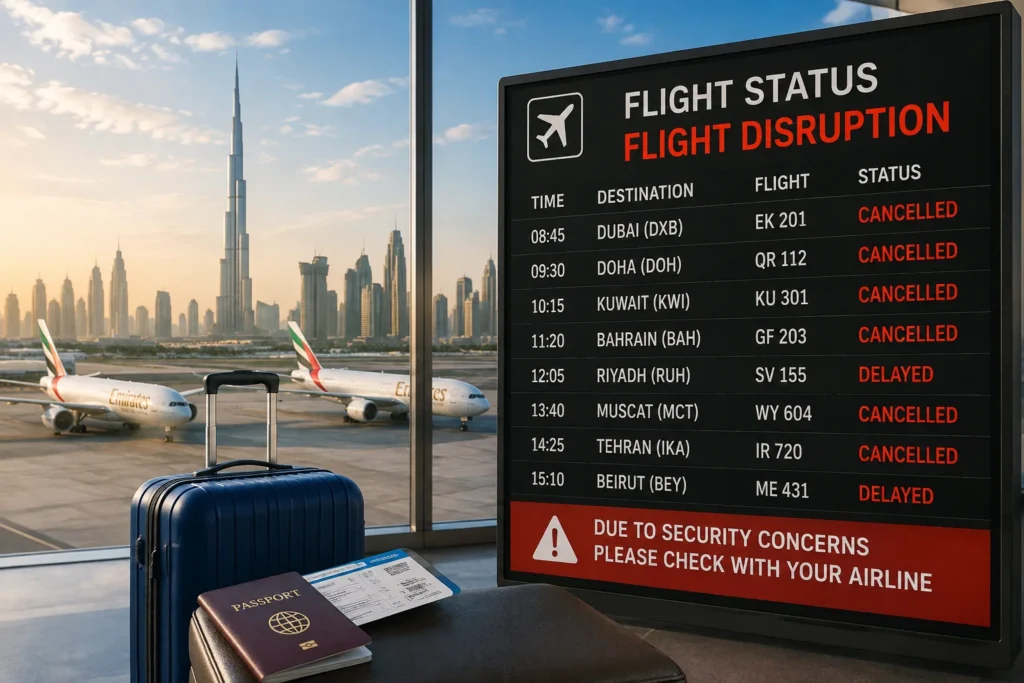
As geopolitical tensions persist across the Middle East, commercial aviation continues to face widespread adjustments, route modifications, and extended flight suspensions. Air travel across major Gulf transit hubs remains subject to heightened monitoring, with regional and international carriers aligning operations with conflict zone safety guidelines. Passengers planning travel to, from, or through the region are urged to closely track flight statuses as air corridors adjust to evolving security conditions.
Regional Conflict and Airspace Dynamics Impact Aviation Corridors
The ongoing geopolitical instability involving the United States, Israel, and Iran has significantly impacted regional civil aviation for nearly half a year. Following a period of heightened hostilities, diplomatic communications have introduced potential pauses in military action to facilitate peace negotiations, though uncertainty in the Gulf region remains elevated. Unrest in proximity to crucial maritime and aviation corridors, including the Strait of Hormuz, has kept energy markets and transport networks on high alert.
Airspace restrictions have directly affected multiple countries across the Gulf and broader Levant. Missile and drone activity reported in Qatar, Oman, Kuwait, Bahrain, and Jordan has prompted national aviation authorities to periodically alter flight paths and enforce safety precautions. Consequently, commercial operations to and from key regional airports face operational friction, leading to rerouted long-haul journeys, delayed departures, and temporary grounding of specific services.
EASA Safety Advisories Lead to Extended International Carrier Suspensions
In response to volatile conditions, global aviation regulators have issued stringent guidelines to protect civilian aircraft. The European Union Aviation Safety Agency (EASA) recently extended its conflict zone advisory for the Gulf region, explicitly advising commercial operators to avoid airspace over the United Arab Emirates, Bahrain, Kuwait, Oman, and Qatar through late August.
Following EASA’s updated evaluation, numerous international airlines have revised their operational schedules and pushed back prospective relaunch dates for regional routes. Flagship European carriers, including Air France, Lufthansa, and KLM, have extended flight cancellations across primary Gulf destinations. Similarly, other major global operators have modified schedules to avoid high-risk air corridors, redirecting transcontinental flights between Europe, Asia, and North America.
These international route suspensions have concentrated passenger demand onto regional carriers that continue to operate under modified flight corridors. Middle Eastern airlines operating out of primary hubs—such as Dubai International Airport, Zayed International Airport in Abu Dhabi, and Hamad International Airport in Doha—are managing elevated passenger volume while navigating complex schedule adjustments.
Peak Summer Travel Surge Increases Pressure on Regional Transit Hubs
The ongoing flight disruptions coincide with the annual peak summer travel season. During these months, thousands of residents and expatriates depart the Gulf region to escape high summer temperatures, while global tourists transit through regional mega-hubs. With reduced long-haul capacity from international airlines, available seats on regional carriers operating into Europe, North America, and Asia are experiencing exceptionally high load factors.
To mitigate severe congestion and ensure smooth security processing, major regional carriers and airport authorities have issued formal travel advisories. Emirates released a specialized advisory instructing passengers—particularly families traveling with young children—to adhere strictly to adjusted airport arrival timelines:
Passengers should arrive at the airport terminal at least three hours prior to their scheduled departure time.
Travelers must clear passport control and security checks at least 90 minutes before flight departure.
Passengers must present themselves at their designated boarding gate at least 60 minutes before scheduled takeoff.
Airport operators emphasize that late arrivals risk missing their flights due to intensified security checks and heavier terminal foot traffic.
Key Recommendations for Affected Middle East Passengers
Travelers with active bookings or upcoming trips passing through the Middle East should adopt a proactive approach to manage potential itinerary changes:
Verify Flight Status Regularly: Confirm flight schedules directly via official airline mobile applications or official websites prior to traveling to the airport, as operational conditions can change on short notice.
Review Rebooking Policies: Most regional and international carriers operating in the Middle East have activated flexible rebooking waivers, enabling passengers to change travel dates or apply for full refunds without penalty.
Allow Buffer Time for Connections: Passengers holding multi-leg international itineraries should build generous layover windows to account for potential air traffic control delays or modified flight routings.
Monitor Official Government Advisories: Consult statements issued by civil aviation authorities, ministries of transport, and official tourism boards for verified travel guidelines and safety alerts.
For more travel news like this, keep reading Global Travel Wire