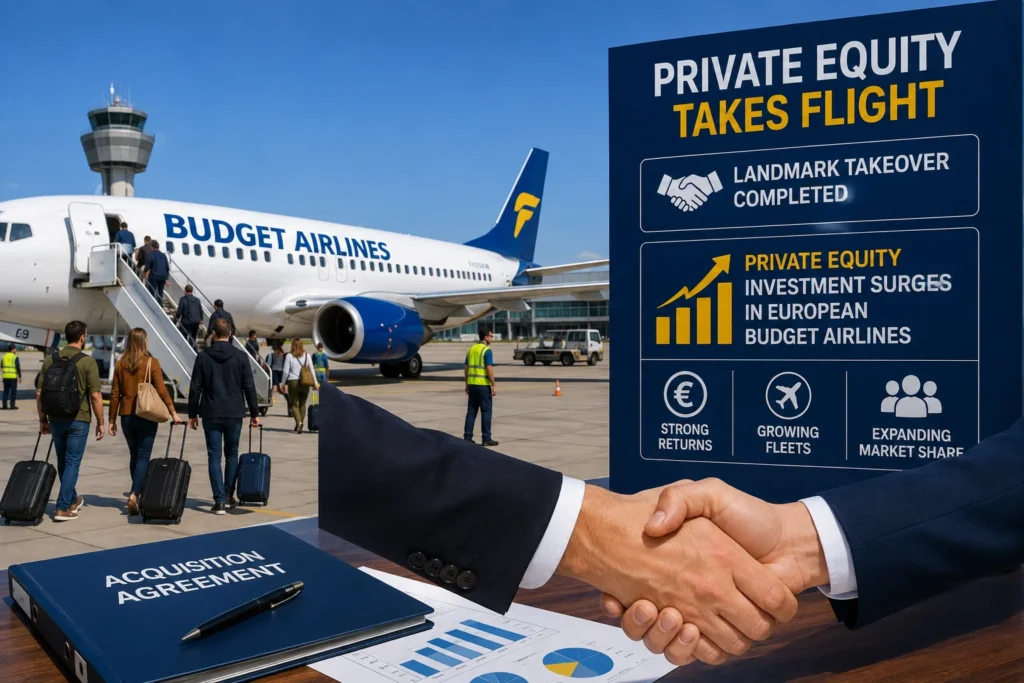
Private equity interest in European budget aviation is accelerating following the high-profile agreement by Apollo Global Management to acquire EasyJet in a transaction valued at approximately $7.7 billion (£5.7 billion). The move signals a major shift in how low-cost aviation networks and leisure travel operations across Europe may be financed, structured, and expanded over the coming years. As international tourism demand remains resilient, global investment firms are increasingly eyeing public aviation equities across the United Kingdom and Europe, with established regional carriers such as Jet2 emerging as potential candidates for future strategic buyouts.
The transaction highlights a broader trend where international capital is recognizing the fundamental value embedded in European low-cost carriers. For decades, budget airlines have served as the backbone of European regional tourism, transporting millions of holidaymakers between major urban centers and popular sun-and-beach destinations across the Mediterranean. The move by private equity to take major carriers private reflects confidence in long-term air travel demand despite short-term economic fluctuations, elevated fuel costs, and geopolitical headwinds.
Why European Low-Cost Carriers Are Targeted by Global Private Equity
The European aviation landscape has historically been characterized by low profit margins, cyclical earnings, and strict regulatory oversight. However, public market valuations for several United Kingdom and European airlines have lagged behind broader global equity benchmarks, creating attractive entry points for long-term institutional investors.
Budget airlines offer distinct structural advantages that appeal directly to private capital:
High-Density Route Networks: Low-cost carriers operate point-to-point networks connecting high-demand tourism markets, maximizing aircraft utilization and passenger volume.
Integrated Travel and Holiday Packages: Leading budget operators have successfully expanded into tour operations and package holidays, capturing additional consumer spend beyond flight seats.
Resilient Consumer Demand: Leisure travel and holiday trips have proven to be among the most resilient segments of consumer spending, maintaining consistent booking volumes even during periods of broader economic uncertainty.
Strong Cash Generation: Well-managed budget carriers generate substantial operational cash flow through unbundled pricing models, ancillary seat fees, and advance ticket sales.
Following the acquisition of EasyJet, market analysts and aviation strategists point to carriers with similar operational models as potential targets. Jet2, a major British holiday and flight operator known for its integrated resort flight packages, has seen its equity valuation recover significantly from multi-year lows, making it an attractive prospect for private equity groups seeking steady exposure to European leisure travel.
Key Valuations, Asset Holdings, and Slot Portfolios Driving Investor Interest
Beyond passenger booking revenue, the primary value driver for European low-cost airlines lies in their physical and operational assets. Aircraft fleets, brand equity, and constrained airport takeoff and landing slots represent immensely valuable assets that are difficult for new entrants to replicate.
A major strategic factor behind recent acquisition activity is control over slot portfolios at capacity-constrained primary airports across Europe. Key leisure gateways such as London Gatwick, Paris Orly, Amsterdam Schiphol, and Milan Linate operate near peak capacity. Established budget airlines hold extensive slot allocations at these high-demand hubs, giving them an enduring competitive moat over regional competitors.
Furthermore, many European low-cost carriers own a significant portion of their modern, fuel-efficient aircraft fleets. These tangible assets provide private equity owners with flexible financing options, including sale-and-leaseback arrangements or debt refinancing, allowing new parent companies to optimize balance sheets while funding ongoing fleet modernization programs.
Consumer and Tourism Sector Implications of Private Airline Ownership
The transition of publicly traded airlines into private equity ownership carries notable implications for consumers, travel agents, and regional tourism boards. While public shareholders typically focus on quarterly earnings performance, private equity firms generally operate on multi-year horizon plans aimed at scaling operations, expanding route networks, and optimizing capital efficiency.
In a privately held corporate environment, budget airlines may gain greater strategic flexibility to invest in long-term expansion initiatives without the constant pressure of short-term public market scrutiny. For European tourism destinations, this capital infusion could translate into several positive developments:
Route Network Expansion: Private capital can enable airlines to open new point-to-point routes into emerging regional destinations across Southern and Eastern Europe.
Expanded Holiday Package Offerings: Increased investment in in-house tour operator divisions allows carriers to partner directly with hoteliers, boosting year-round tourism flows.
Fleet Modernization: Accelerated delivery of next-generation, fuel-efficient aircraft helps airlines lower unit operating costs while meeting strict European environmental standards.
Competitive Pricing: Capital-efficient financing structures can help airlines maintain competitive baseline fares for cost-conscious leisure travelers.
However, industry observers also emphasize the importance of maintaining service reliability and employee retention as private investors navigate complex airline operations and regulatory frameworks.
Regulatory Alignment and the Future Outlook for European Air Travel
Cross-border aviation investments in Europe must adhere to strict regulatory requirements regarding airline ownership and effective control. Under United Kingdom and European Union aviation laws, air carriers operating within the bloc must remain majority-owned and controlled by national or EU entities to retain their operating licenses and traffic rights.
To satisfy these statutory requirements, international private equity firms structure acquisitions through specialized holding structures, European trusts, or local management partnerships. These legal arrangements ensure that operational control remains compliant with civil aviation authorities while securing the capital needed for long-term fleet and route investments.
As global financial institutions increase their footprint in European aviation, the low-cost carrier sector is poised for a period of strategic transformation. Supported by private equity backing, Europe’s budget airlines are well-positioned to drive the next phase of sustainable aviation growth, enhancing air connectivity and supporting regional tourism economies across the continent.
For more travel news like this, keep reading Global Travel Wire