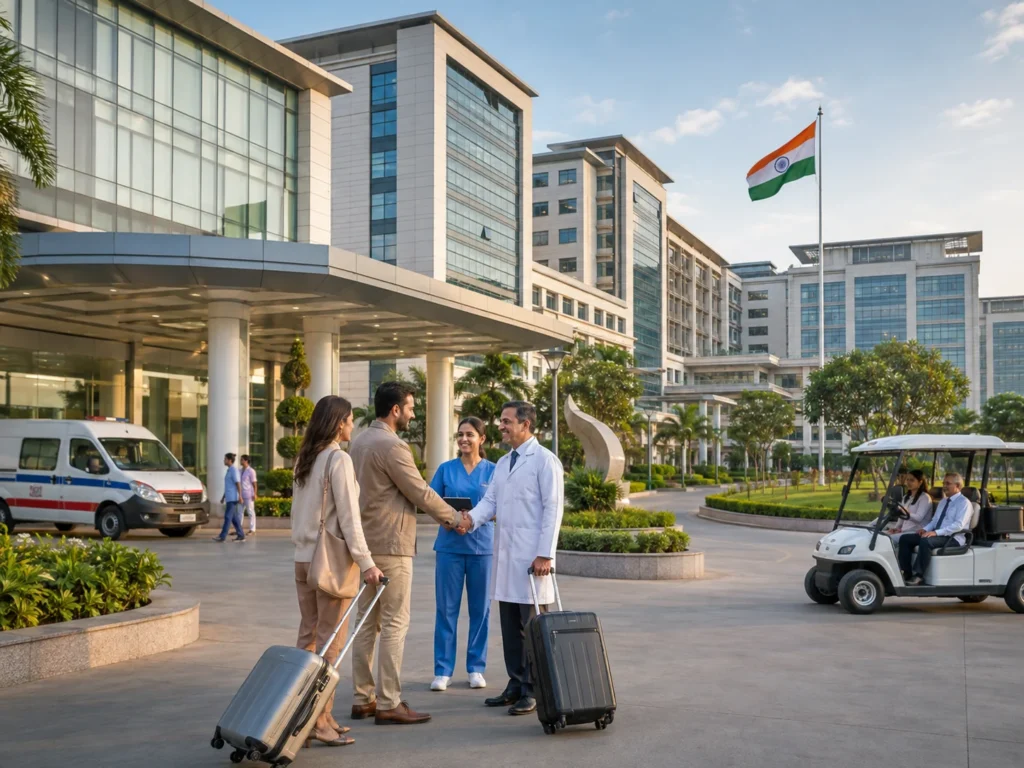
North India’s medical tourism infrastructure is set for a substantial transformation as leading healthcare operator Park Medi World moves forward with an ambitious capital expansion strategy. The company has officially outlined plans to integrate over 2,100 new operational hospital beds across its growing network by fiscal year 2028. Aimed at bolstering healthcare delivery in the Delhi National Capital Region (NCR) and surrounding northern states, this large-scale capacity expansion aligns directly with national efforts to position India as a premier global destination for medical travel and advanced clinical care.
As medical travellers from across South Asia, the Middle East, Central Asia, and Africa increasingly look to India for specialized surgical interventions and cost-effective treatments, expanding high-quality hospital infrastructure in regional urban centers remains crucial. Park Medi World’s roadmap combines greenfield hospital developments with strategic inorganic acquisitions, expanding access to tertiary and quaternary care while reinforcing the country’s global healthcare appeal.
Strategic Capacity Expansion Across Key Healthcare Corridors
The official growth roadmap highlights a structured approach to scaling medical infrastructure in high-demand catchment areas. By increasing total bed capacity toward 5,600 operational beds by the end of FY2028, the hospital chain is enhancing its ability to accommodate both domestic patient volumes and inbound international medical tourists seeking specialized care.
Key operational highlights of the expansion initiative include:
Regional Network Expansion: Launching newly commissioned facilities, including the 330-bed Medicity Hospital in Rudrapur, Uttarakhand, which serves as a major multi-super-specialty health center in northern India.
Strategic Acquisitions: Finalizing the acquisition of Mehar Hospital in Zirakpur, Punjab, for INR 107 crore, expanding tertiary medical access near major airport hubs and regional transport corridors.
Targeted Capital Allocation: Deploying a committed investment of INR 500 crore to scale healthcare network assets, acquire state-of-the-art diagnostic equipment, and develop modern patient recovery facilities.
Greenfield Developments: Building new multi-specialty facilities in high-growth suburban and urban clusters across Delhi NCR, Haryana, and neighboring states.
Executive briefings confirm that newly opened and recently acquired hospitals are steadily ramping up clinical operations. As these advanced medical centers reach full operational capacity over the next two years, overall bed occupancy rates are projected to increase significantly, delivering higher operational efficiency across the group’s medical network.
Strong Financial Momentum Supporting Infrastructure Investment
The accelerated infrastructure rollout is supported by robust financial performance across the hospital chain’s existing operations. Official financial statements for the first quarter of fiscal year 2027 (April to June 2026) demonstrate strong revenue growth and expanding operating margins, providing the capital strength needed to fund ongoing expansion.
During the first quarter of FY2027, Park Medi World reported total operational revenue rising 19 percent year-on-year to reach INR 475.7 crore, up from INR 399 crore recorded in the corresponding period of the previous fiscal year. Earnings before interest, taxes, depreciation, and amortization (EBITDA) rose 20 percent to INR 126.1 crore, maintaining a healthy EBITDA margin of 26.5 percent. Net profit for the quarter experienced a significant 42 percent surge, climbing to INR 82.5 crore compared to INR 58 crore in the prior-year period.
Following its successful initial public offering and listing on the National Stock Exchange (NSE) and Bombay Stock Exchange (BSE) in December 2025, the company’s equity valuation has reflected strong investor confidence in its long-term growth model. The financial resilience of major private hospital operators plays a critical role in sustaining long-term capital investments in advanced medical technologies, specialized clinical staffing, and international patient care facilities.
Elevating Inbound Medical Travel Infrastructure in North India
India’s national tourism and healthcare strategies emphasize the development of world-class medical hubs that combine clinical expertise with seamless patient hospitality. For international medical tourists evaluating overseas treatment options, the availability of accredited, modern hospital facilities near major transportation hubs is a deciding factor.
Expanding hospital capacity in locations like Delhi NCR, Punjab, and Uttarakhand offers several direct advantages for inbound travel and healthcare delivery:
Proximity to International Gateways: Facilities situated in Delhi NCR and adjacent northern states provide international patients with direct air connectivity via Indira Gandhi International Airport and regional airports.
Specialized Clinical Excellence: Scaling capacity across super-specialty departments—including cardiology, oncology, orthopedics, neurology, and gastroenterology—allows hospitals to accommodate complex international referral cases.
Enhanced Bed Availability: Adding 2,100 operational beds reduces waiting times for elective surgeries, ensuring international patients receive prompt treatment schedules upon arrival.
Affordable High-Quality Care: Combining advanced medical technology with competitive treatment pricing reinforces India’s value proposition for overseas health travelers seeking high success rates without prohibitive costs.
In addition to expanding clinical capacity, the integration of advanced medical technologies and specialized clinical teams ensures that regional facilities meet international accreditation standards, further elevating confidence among international medical travel facilitators and insurance networks.
Outlook for Regional Healthcare Infrastructure and Health Tourism
As Park Medi World executes its 2,100-bed expansion strategy, the broader Indian healthcare sector continues to undergo rapid consolidation and modernization. The transition toward corporate-backed multi-specialty hospital networks across Tier-1 and Tier-2 cities ensures that world-class medical infrastructure is no longer confined exclusively to metro centers.
By establishing integrated healthcare corridors across Delhi NCR, Haryana, Punjab, and Uttarakhand, hospital chains are expanding regional care standards while building the infrastructure needed to support growing international medical travel demand. With clear capital commitments, disciplined operational execution, and expanding clinical capabilities, India’s health tourism ecosystem is well-positioned for sustained global leadership.
For more travel news like this, keep reading Global Travel Wire