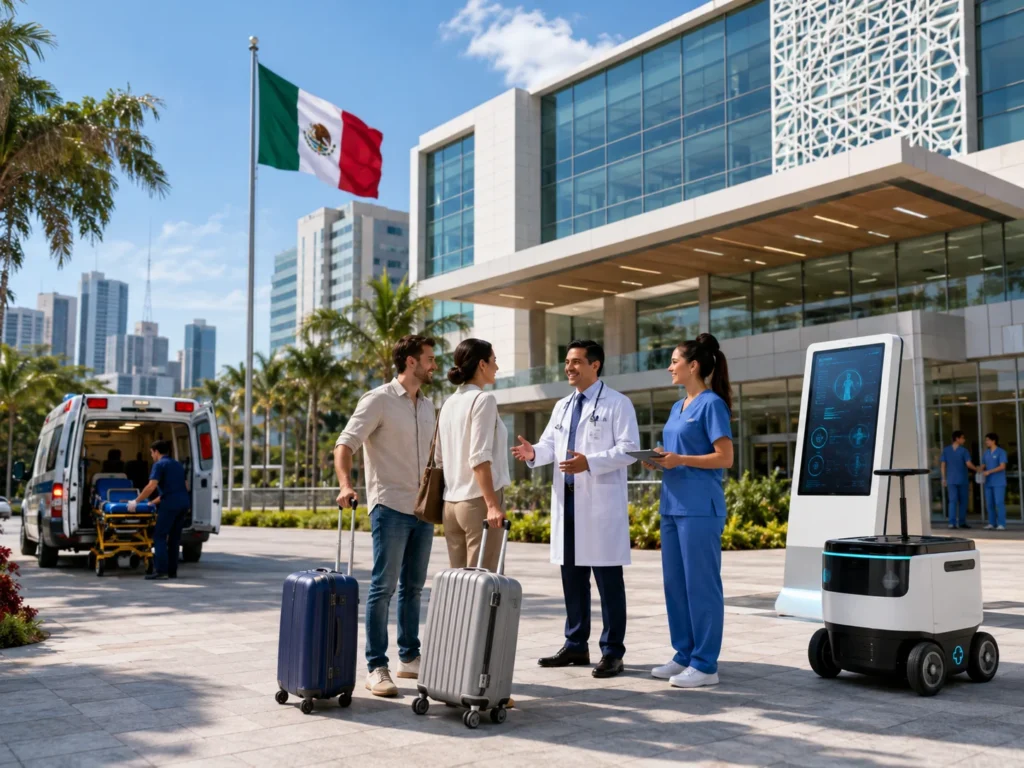
Mexico’s profile as a premier destination for international health travel and specialized medical care is experiencing significant momentum following major public health investments, digital health breakthroughs, and expanded surgical infrastructure. As the country prepares to co-host international events like the 2026 FIFA World Cup, federal health authorities are actively fortifying clinical infrastructure, introducing cutting-edge artificial intelligence research, and enhancing airport screening protocols to ensure public safety and medical excellence.
These comprehensive developments across both public health institutions and private research centers reinforce Mexico’s position as a robust regional hub for health travel, clinical innovation, and specialized patient care across Latin America.
Federal Hospital Megaproject Expands Specialized Care Capacity
A cornerstone of Mexico’s expanding healthcare landscape is the official groundbreaking of the Ciudad Salud Ñuu Tata hospital complex in San Lorenzo Cacaotepec, Oaxaca. Representing a monumental investment estimated at 10 billion Mexican pesos (approximately 578 million US dollars), the flagship health campus brings together major public institutions—including the Mexican Institute of Social Security (IMSS), the Institute for Social Security and Services for State Workers (ISSSTE), and IMSS-Bienestar—under the federal Universal Health Service framework.
Designed to serve up to four million residents across southern Mexico and neighboring regions, the 52-hectare complex will feature over 1,200 hospital beds, 23 operating rooms, and 57 specialized medical disciplines. Crucially for international visitors and domestic health travelers, the complex houses advanced units dedicated to surgical oncology, neurosurgery, nuclear medicine, molecular biology, hemodialysis, and organ transplantation.
By expanding high-specialty medical services in regional centers, Mexico is decentralizing complex surgical care while building modern infrastructure capable of supporting international health travel corridors across the southern states.
Pioneering Artificial Intelligence and Surgical Capacity Expansion
Alongside physical hospital expansions, Mexican medical institutions are rapidly integrating advanced digital health technologies to improve patient outcomes and operational efficiency:
Artificial Intelligence Innovation Center: Hospital General de México “Dr. Eduardo Liceaga” has inaugurated a dedicated research center unifying AI, data science, and engineering. The center formalizes permanent digital health infrastructure designed to optimize clinical diagnostics, administrative workflows, and translational research.
National Surgical Expansion: ISSSTE has set an ambitious target to increase its national surgical volume by 10 percent in 2026. Supported by nationwide surgical campaigns and the modern renovation of 80 operating rooms across the country, the initiative builds on a record baseline of over 308,000 surgeries performed in 2025.
Active Pharmaceutical Production: Local pharmaceutical manufacturing is receiving a significant boost with a 140 million pesos investment at Lerma, targeted at producing active oncology ingredients like 5-fluorouracil, earning the prestigious “Hecho en México” distinction for active pharmaceutical ingredients.
These structural enhancements ensure that patients receiving medical care in Mexico benefit from shorter wait times, state-of-the-art diagnostic tools, and highly coordinated surgical teams.
Strengthening Global Health Surveillance and Oncology Care
As global travel volumes increase, health authorities maintain a vigilant approach to international epidemiology. In response to global health warnings regarding viral outbreaks in central Africa, Mexico’s Ministry of Health has proactively strengthened epidemiological surveillance and health screening procedures across major international airports. These preventive measures safeguard both international tourists and domestic populations while preserving the integrity of Mexico’s travel corridors.
Simultaneously, health experts across Mexico are emphasizing the importance of comprehensive cancer management. With national cancer projections expected to rise over the coming decades, industry leaders advocate for combining advanced medical technology—such as adaptive radiotherapy and AI-assisted diagnostics—with robust patient financial protection and holistic family support systems.
Furthermore, private sector partnerships and open innovation incubators are accelerating the deployment of specialized outpatient centers, precision medicine, and stem cell transplantation networks across the nation, ensuring that clinical breakthroughs translate quickly into patient care.
The Future of Health Travel and Clinical Excellence in Mexico
The convergence of global pharmaceutical manufacturing investments, mega-hospital construction, and artificial intelligence integration establishes a strong foundation for the future of healthcare in Mexico.
For international medical tourists, wellness travelers, and regional healthcare partners, Mexico’s ongoing investment in world-class medical infrastructure offers compelling validation of clinical quality, safety, and specialized care accessibility.
For more travel news like this, keep reading Global Travel Wire