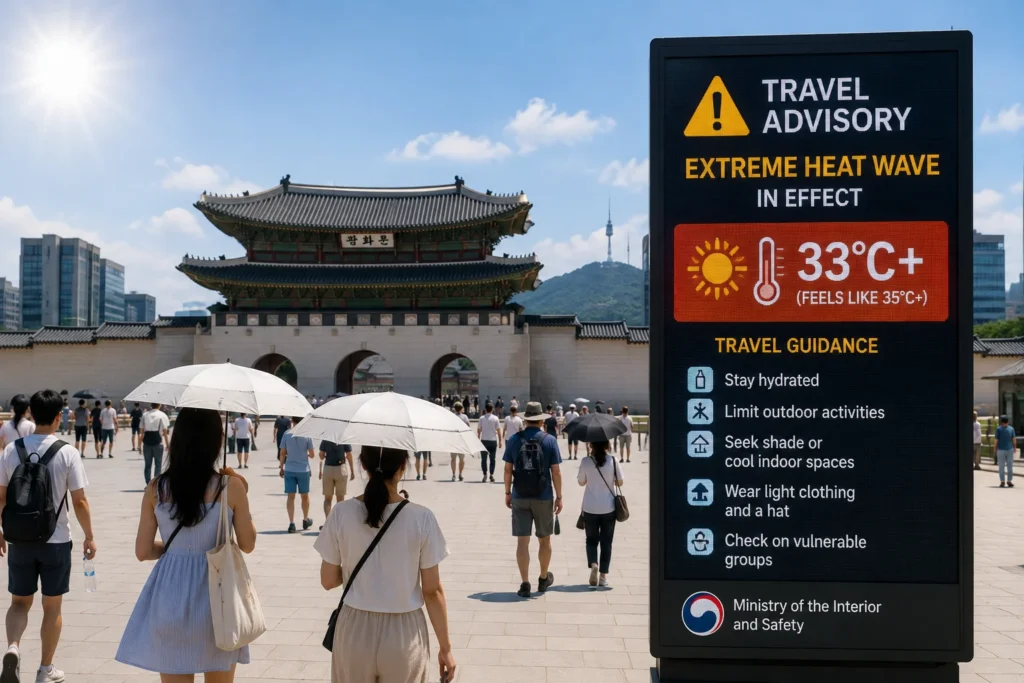
Government authorities have issued updated public safety warnings for international visitors traveling in South Korea as severe summer conditions generate extreme temperature spikes across the peninsula. Global Affairs Canada released an official travel advisory updating health and safety instructions for travelers heading to South Korean destinations between June and September. The advisory warns that prolonged high temperatures can cause rapid dehydration, heat exhaustion, and potential medical emergencies, advising foreign travelers to exercise heightened caution during outdoor sightseeing activities.
The public health warning coincides with formal alerts from South Korea’s Korea Meteorological Administration and the Ministry of the Interior and Safety, which have elevated regional heat wave advisories to top-tier emergency status in several provinces and metropolitan areas. With daily ambient temperatures exceeding 40°C in specific inland zones and urban centers, international tourists are strongly advised to adjust their travel plans and strictly follow safety protocols issued by municipal authorities.
Official Travel Advisories Highlight Extreme Weather Hazards Across East Asia
The Government of Canada’s updated travel bulletin emphasizes that summer environmental conditions in South Korea present serious health risks if precautions are neglected. Official guidance published through Canada’s international travel safety portal instructs travelers to recognize the early physical warning signs of heat-related illness, which can advance quickly under intense humidity and solar radiation.
According to government advisories, foreign nationals currently visiting or planning trips to South Korea should monitor regional weather forecasts continuously and register their contact details with official citizen registration services. Canadian officials advise travelers to limit direct sun exposure during peak afternoon hours, maintain constant hydration, and utilize indoor climate-controlled spaces during midday travel segments.
Record Temperature Spikes Impact Major Tourist Destinations and Urban Hubs
Data published by the Korea Meteorological Administration confirms that severe heat conditions have impacted major tourism destinations, including the capital region of Seoul, the southern port city of Busan, and popular coastal areas across Jeju Island. Meteorological stations recorded localized peak temperatures reaching up to 40.2°C in urban districts of Seoul, where dense infrastructure accelerates localized thermal retention.
In response to the extreme conditions, the Korea Meteorological Administration deployed its updated impact-based Emergency Heatwave Warning system. This top-tier alert is triggered when apparent or perceived temperatures exceed 38°C for consecutive days, or when daily maximum temperatures reach critical levels. Under these official alert thresholds, government agencies recommend that all non-essential outdoor recreational activities, strenuous hiking excursions, and extended walking tours be suspended or rescheduled to cooler times of day.
Public Health Bulletins Detail Escalating Hospitalization and Heat Risks
Public health statistics released by the Korea Disease Control and Prevention Agency demonstrate the physical burden of the ongoing climate event. Official medical monitoring reports indicate that thousands of individuals across the country have required emergency medical attention for thermal shock, heat exhaustion, and severe dehydration during the summer season.
Health authorities emphasize that extreme heat presents acute dangers for vulnerable travel demographics, including elderly visitors, young children, and individuals with pre-existing cardiovascular conditions. Medical officers stress that heatstroke can lead to severe organ damage or fatal complications if medical treatment is delayed. Travelers experiencing dizziness, nausea, rapid pulse, or lack of sweating despite extreme heat are urged to seek immediate emergency care through national emergency service channels.
South Korean Government Activates Emergency Relief and Cooling Infrastructure
To protect public safety and maintain municipal health operations, South Korea’s Ministry of the Interior and Safety raised the national emergency alert level and expanded public cooling infrastructure across major metropolitan zones. Municipal governments have opened thousands of designated public cooling shelters in public buildings, community centers, municipal offices, and transit hubs.
Government safety guidelines, accessible via official public safety portals and real-time mobile emergency alerts, direct both local residents and foreign visitors to nearby cooling centers, medical stations, and fire departments equipped to provide immediate relief. Local municipal services have also deployed water-sprinkling vehicles along major urban thoroughfares and established shaded pedestrian crossings at major tourist intersections to mitigate pavement heat build-up.
Practical Safety Guidelines and Travel Recommendations for Foreign Visitors
Official tourism boards and public health ministries advise international visitors traveling through South Korea during peak summer months to adopt proactive safety measures. Travel itineraries should be structured flexibly to accommodate changing daily heat alerts and regional weather warnings.
Key travel safety recommendations issued by public health authorities include:
Schedule outdoor sightseeing, cultural walking tours, and mountain hikes exclusively during early morning hours or after sunset.
Remain indoors in air-conditioned environments such as museums, art galleries, shopping complexes, and indoor cultural sites during peak solar hours between 11:00 AM and 5:00 PM.
Consume continuous quantities of water and electrolyte-replenishing fluids throughout the day, regardless of physical activity levels.
Wear loose-fitting, light-colored, and breathable clothing along with wide-brimmed hats and high-factor sunscreen to shield against UV radiation.
Ensure mobile devices are enabled to receive official local emergency broadcasts and public safety text alerts sent by municipal civil protection departments.
While South Korea’s world-class transportation networks, cultural landmarks, and hospitality services remain operational, travel experts and government agencies emphasize that adjusting daily routines to match environmental conditions is essential for maintaining safety throughout the summer travel season.
For more travel news like this, keep reading Global Travel Wire