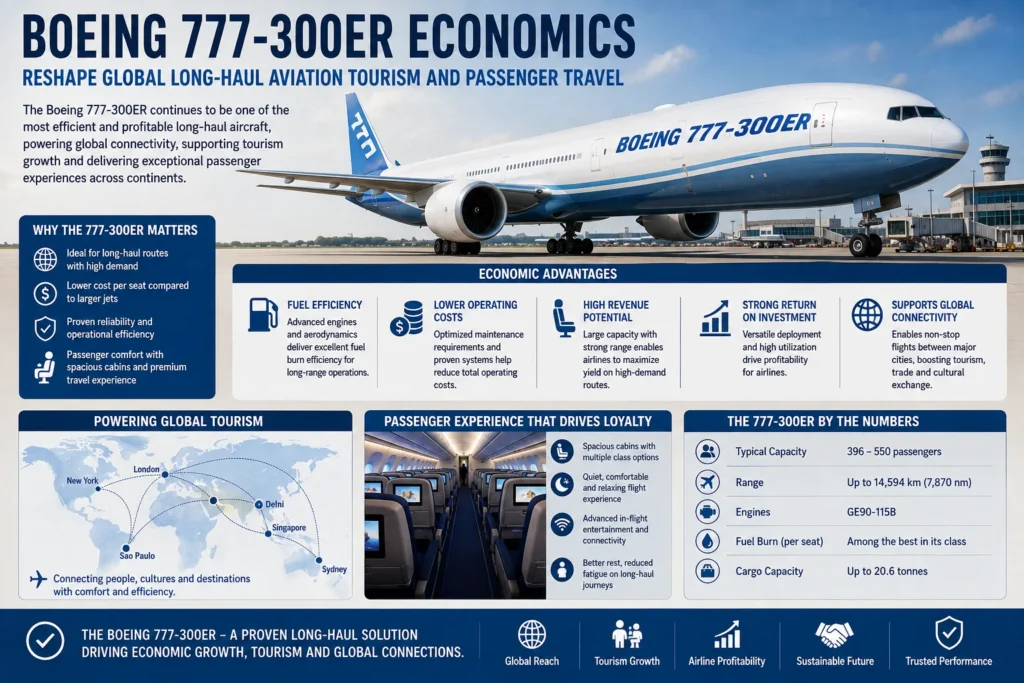
The evolution of modern long-haul aviation tourism has been fundamentally shaped by changes in commercial aircraft economics. Over the past two decades, civil aviation authorities and international air transport organizations have documented a major structural transition in global long-haul travel. At the center of this industry transformation is the Boeing 777-300ER, a long-range wide-body twinjet whose operational efficiency, extended twin-engine range capability, and high payload volume redefined long-haul route viability for international passenger carriers.
Before the widespread deployment of high-capacity twinjets, transoceanic and intercontinental passenger routes were dominated by four-engine aircraft such as the Boeing 747 and Airbus A340. However, rising fuel costs and stringent environmental standards led aviation operators to seek more efficient fleet alternatives. The entry of the Boeing 777-300ER provided a solution that combined the passenger capacity of legacy quadjets with significantly lower fuel consumption and maintenance costs.
The Twin-Engine Efficiency Shift in Global Long-Haul Aviation Tourism
Official civil aviation data demonstrates that fuel consumption represents one of the single largest operating expenses for commercial airlines operating international flight routes. Powered by twin General Electric GE90-115B turbofan engines, the Boeing 777-300ER burns approximately 20 to 25 percent less fuel per seat compared to older four-engine wide-body airliners. Reducing engine count from four to two also substantially lowers routine engine maintenance overhead, offering airlines significant operational savings across long-distance networks.
In standard two-class and three-class passenger layouts, the aircraft accommodates nearly 400 travelers, offering seating capacities comparable to traditional jumbo jets. By pairing high passenger density with twin-engine fuel efficiency, international carriers achieved unprecedented cost performance per seat-kilometer. This improved baseline economy enabled airlines to maintain profitable operations even during seasonal demand fluctuations or at lower passenger load factors, helping stabilize air travel options for international tourists.
ETOPS-330 Certification Unlocks Direct Transoceanic Travel Routes
A key milestone in expanding international flight routes was the regulatory approval of Extended-range Twin-engine Operational Performance Standards, commonly known as ETOPS. Under civil aviation safety regulations, ETOPS dictates the maximum diversion flight time permitted for a twin-engine aircraft operating with one engine inoperative.
When aviation safety authorities granted ETOPS-330 certification to the 777 fleet, it permitted twinjets to fly routes up to 330 minutes—or 5.5 hours—away from the nearest emergency diversion airport. This regulatory milestone opened more than 99 percent of the globe to twin-engine commercial operations, including challenging polar corridors and remote transoceanic pathways across the Pacific and Indian Oceans.
For long-haul aviation tourism, ETOPS-330 eliminated the requirement for circuitous coastal routing previously mandated for two-engine jets. Flight paths became shorter and more direct, reducing total flight times, lowering carbon emissions, and connecting distant tourism markets with unprecedented speed and efficiency.
Lower Operating Costs Expand Point-to-Point Tourism Connectivity
The operational economics of the Boeing 777-300ER accelerated a broader shift in global airline business models from traditional hub-and-spoke networks toward direct point-to-point transit. Historically, international travelers connecting between secondary cities were forced to route through mega-hub airports due to the high cost of operating large intercontinental aircraft.
Because the 777-300ER delivers lower trip costs than larger four-engine airliners, airlines could economically justify launching non-stop transoceanic services between secondary metropolitan areas and international holiday destinations. This expansion of direct international flight routes eliminated unnecessary layovers, broadened geographic access to regional tourism hubs, and allowed municipal airport authorities worldwide to expand their international passenger arrivals.
Cargo Revenue and Operational Reliability Support Secondary Destinations
Beyond passenger transport, the design of the Boeing 777-300ER provides substantial belly-hold cargo capacity. Official transport statistics indicate that belly freight accounts for a vital supplemental revenue stream on long-haul routes, often generating sufficient income to offset operational costs even on flights with lower passenger yields.
High operational dispatch reliability—supported by advanced flight systems and engine performance—further ensured consistent schedule adherence across global networks. For international tour operators and travel management organizations, reliable flight scheduling is critical for coordinating ground transportation, resort bookings, and cruise connections.
Enhanced Passenger Comfort and Lower Fares Transform Modern Travel
The structural efficiency of high-capacity twinjets has yielded direct benefits for global leisure travelers. By driving down the cost per seat-kilometer, airlines were able to offer more competitive international airfares, making long-haul aviation tourism accessible to broader demographics.
Modern cabin architecture on long-range wide-body aircraft also introduced upgraded passenger amenities, including lower cabin altitude pressurization, dynamic interior lighting, quieter engines, and expanded overhead storage. These passenger-focused interior features reduce jet lag and physical fatigue on long journeys spanning 10 to 15 hours.
As international tourism continues to expand, the operational standards established by high-capacity twin-engine aircraft remain the benchmark for long-haul fleet development. By combining fuel efficiency, transoceanic range capabilities, and passenger comfort, twin-engine aircraft continue to serve as the backbone of global air travel networks, linking cultures, commerce, and international destinations around the globe.
For more travel news like this, keep reading Global Travel Wire