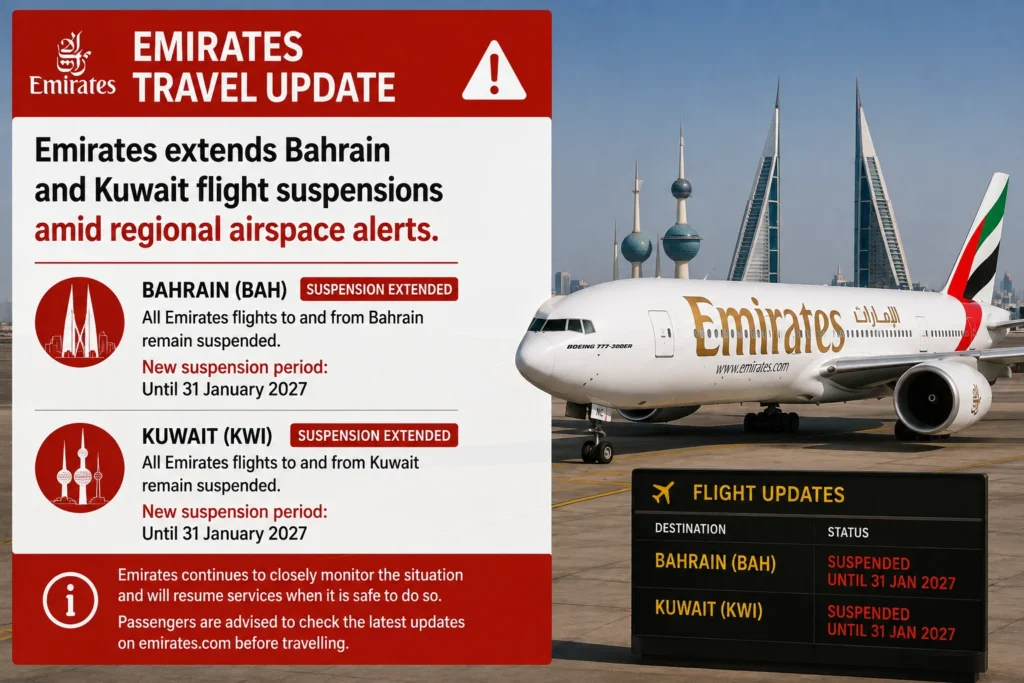
Official operational notices issued by major Middle Eastern carriers indicate an uneven recovery across commercial aviation corridors in early August 2026. Emirates has confirmed the continued suspension of its direct passenger services connecting Dubai International Airport with Bahrain International Airport and Kuwait International Airport through August 10, 2026. This operational pause comes as civil aviation authorities and regional airlines adjust flight networks to navigate ongoing airspace risk assessments and security protocols.
While Emirates maintains grounded operations on these high-frequency sectors, neighboring carriers including Etihad Airways and Qatar Airways have begun reinstating select regional schedules. The divergence in airline operations underscores the dynamic environment facing corporate travelers, tourists, and transit passengers moving across Gulf Cooperation Council destinations.
Operational Divergence Across Gulf Commercial Carriers
Prior to the service disruptions, Emirates operated seven combined daily flights linking Dubai to Bahrain and Kuwait. These high-density routes included three daily rotations to Bahrain (flight numbers EK835, EK837, and EK839) alongside four daily rotations to Kuwait (EK853, EK855, EK857, and EK859). The pause on these flights represents a temporary reduction in direct seating capacity between key financial and cultural centers in the Arabian Gulf.
In contrast, other regional operators have adjusted flight schedules based on updated risk evaluations. Etihad Airways restored scheduled passenger connections out of Zayed International Airport in Abu Dhabi, re-establishing a daily service to Kuwait alongside four weekly flights to Bahrain. Similarly, Qatar Airways announced the resumption of passenger routes connecting Hamad International Airport in Doha with Bahrain, Kuwait, and Erbil.
Low-cost carriers based in the United Arab Emirates, such as flydubai and Air Arabia, continue to maintain scheduled flights to both Bahrain and Kuwait, operating flexible itineraries that remain subject to short-notice schedule modifications.
| Airline Operator | Primary Hub | Operational Status to Bahrain | Operational Status to Kuwait | Service Frequency Baseline |
| Emirates | Dubai International Airport (DXB) | Temporarily Suspended | Temporarily Suspended | 7 daily combined flights paused |
| Etihad Airways | Zayed International Airport (AUH) | Resumed (EY643) | Resumed (EY653) | 4 weekly to Bahrain / Daily to Kuwait |
| Qatar Airways | Hamad International Airport (DOH) | Resumed | Resumed | Daily operational schedules |
| flydubai | Dubai International Airport (DXB) | Active with modifications | Active with modifications | Flexible daily adjustments |
| Air Arabia | Sharjah International Airport (SHJ) | Active with modifications | Active with modifications | Flexible daily adjustments |
Global Carrier Adjustments and Long-Haul Schedule Revisions
The operational adjustments in the Gulf coincide with broader route realignments by international long-haul carriers operating between Europe, North America, and the Middle East. Civil aviation regulatory bodies across Western Europe have advised airlines to maintain enhanced monitoring of regional transit corridors.
Major international airlines have responded by revising their winter and summer schedules to manage operational exposure:
British Airways: Postponed the resumption of direct services to select Middle Eastern destinations, with route restorations deferred until late October 2026.
KLM Royal Dutch Airlines: Extended flight suspensions across specific regional routes through late August 2026 while monitoring airspace conditions.
Lufthansa and Swiss International Air Lines: Implemented dynamic route modifications, adjusting departure times and flight paths based on daily safety assessments.
Air France: Implemented temporary schedule revisions affecting select flight corridors across the Arabian Peninsula.
Impact on Business Tourism and Regional Connectivity
The temporary reduction in direct air connectivity between Dubai, Bahrain, and Kuwait directly affects regional business tourism, short-stay cultural travel, and multi-destination leisure itineraries. High-frequency air shuttles between major Gulf cities serve as essential conduits for corporate executives, trade delegation participants, and regional holidaymakers.
To mitigate passenger gridlock and maintain regional mobility, transportation authorities and airport operators have emphasized multi-modal and multi-hub routing strategies. Passengers seeking transit between Dubai and Kuwait or Bahrain are increasingly utilizing ground transfers to alternative aviation hubs, such as Zayed International Airport in Abu Dhabi or Sharjah International Airport, to access operating flights.
Traveler Logistics Guide and Passenger Advisory Protocols
For international travelers and logistics coordinators managing travel through the Gulf region during active airspace advisories, official civil aviation releases recommend structured contingency planning:
Inter-Emirate Transit Utilization
Passengers with time-sensitive commitments in Bahrain or Kuwait who hold bookings on suspended Dubai departures can consider alternative itineraries originating from Abu Dhabi or Sharjah. Ground transit between Dubai and Abu Dhabi’s Zayed International Airport typically requires a minimum transfer buffer of two hours to ensure timely check-in.
Hub Transfers via Doha
With Qatar Airways maintaining active connections to Bahrain and Kuwait, transit through Doha’s Hamad International Airport offers an alternative connecting pathway. Travelers booking multi-carrier itineraries are advised to confirm luggage transfer agreements and allow ample layover times between connecting flights.
Official Civil Aviation Safety Bulletins
Travelers should monitor updates issued directly by national aviation bodies, such as the UAE General Civil Aviation Authority (GCAA). Official safety bulletins provide verified updates regarding airspace status, flight information regions, and operational directives affecting commercial carriers.
Refund and Rebooking Rights
Under official airline passenger protection framework guidelines, ticket holders on suspended Emirates sectors are eligible for full fare refunds, penalty-free date adjustments, or rebooking options onto operating codeshare partners, including flydubai, where seat availability permits.
As civil aviation oversight authorities and airline safety teams continue to review environmental conditions across regional corridors, carrier schedules will adjust dynamically to prioritize aviation safety while maintaining international travel connectivity.
For more travel news like this, keep reading Global Travel Wire