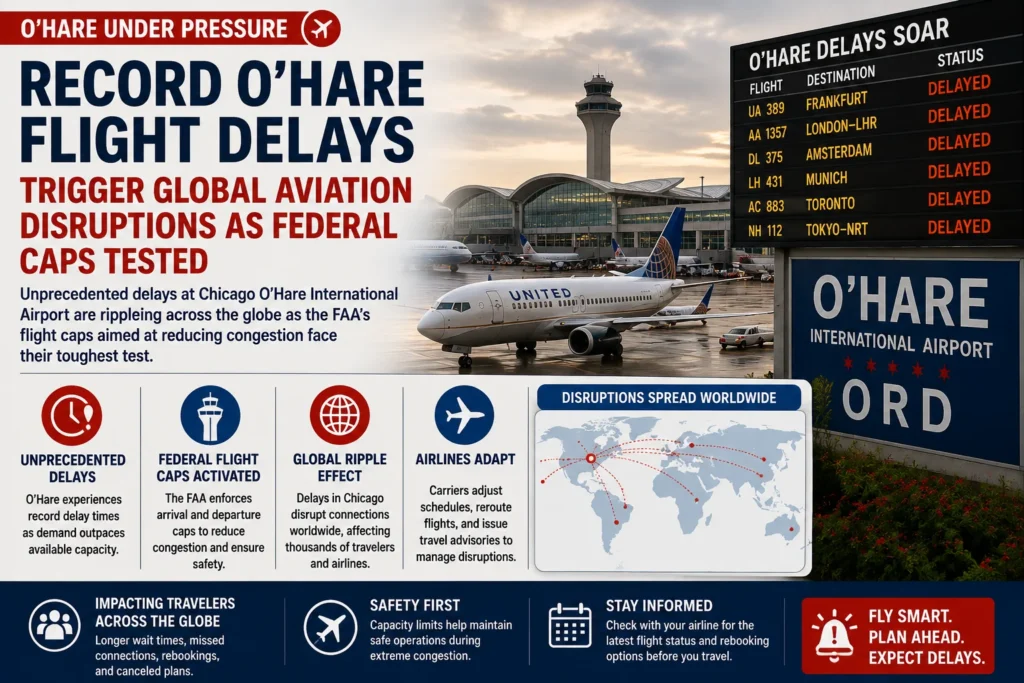
Severe summer thunderstorms rolling across northern Illinois generated severe operational gridlock at Chicago O’Hare International Airport. The weather event led to consecutive Federal Aviation Administration (FAA) ground stops at both O’Hare and Chicago Midway Airport, making O’Hare the most delayed airport globally by the end of the day.
While both major hub carriers faced severe schedule pressure, United Airlines recorded significantly higher cancellations than American Airlines. The difference stems primarily from capacity distribution, as United controls nearly half of O’Hare’s scheduled summer seat capacity.
FAA Ground Stops Halt Operations at Chicago Air Hubs
The FAA’s Air Traffic Organization implemented the initial ground stop at O’Hare just before noon Central Time, placing an immediate hold on inbound aircraft at their origin airports. Unlike ground delay programs that meter aircraft arrival rates, a ground stop completely halts incoming traffic until weather conditions improve.
The stoppage at O’Hare extended for over three hours, lifting mid-afternoon. Even after flight movements resumed, average ground delays exceeded 100 minutes, creating severe departure and arrival backlogs. A second round of severe storms moved into the Chicago metropolitan area later in the evening, extending delays into overnight operating hours.
Midway Airport experienced a parallel ground stop, which halted inbound flights for nearly three hours. Flight tracking data confirmed widespread disruptions across the U.S. National Airspace System, with the FAA issuing ground stops at five primary aviation hubs:
Chicago O’Hare International Airport (ORD): Severe thunderstorm activity and ground stops.
Chicago Midway Airport (MDW): Thunderstorm activity and operational holds.
Denver International Airport (DEN): High-velocity surface winds and convective storm activity.
Las Vegas Harry Reid International Airport (LAS): Extreme wind conditions and traffic management initiatives.
Tampa International Airport (TPA): Regional thunderstorm activity and arrival holds.
Flight Delay Rankings and Hub Capacity Concentration
Flight status tracking registries confirmed that O’Hare logged 148 canceled departures and 124 canceled arrivals alongside more than 1,300 flight delays, leading global delay metrics for the day. The backlog spilled into subsequent operating days, with O’Hare recording additional morning cancellations as aircraft and flight crews were repositioned.
Analytic operational data demonstrates a clear contrast between the airport’s primary hub airlines. United Airlines recorded 52 cancellations and over 1,000 total flight delays, whereas American Airlines recorded 10 cancellations alongside a similar delay count.
This divergence highlights the impact of hub schedule architecture. Official carrier capacity figures indicate that United maintains approximately 48% of all scheduled summer passenger seats at O’Hare, compared to 34.3% held by American Airlines. When FAA ground stops hold inbound flights at departure cities, the carrier with the largest physical footprint absorbs the highest volume of aircraft displacement and crew scheduling conflicts.
Federal Schedule Caps and Summer Operating Constraints
The severe flight backlogs occurred despite federal regulatory interventions implemented earlier in the season. The FAA finalized a summer flight cap at O’Hare limiting the facility to 2,708 daily operations. The agency imposed the schedule limits after airlines increased peak-day schedules to over 3,000 daily flights, warning that unadjusted volumes would strain air traffic control, runway, and terminal capacity during adverse weather events.
To comply with federal guidelines, United removed thousands of scheduled summer departures from its O’Hare timetable. However, even after these schedule reductions, the airline’s operating footprint remained well above prior-year baselines. The storm event illustrated that while schedule caps flatten peak hourly flight movements, high carrier concentration still leaves hub operations vulnerable to systemic delays when severe weather impacts airspace capacity.
Passenger Rebooking Policies and Federal Refund Guidelines
Following the initial storm front, American Airlines established a flexible travel rebooking waiver for passengers traveling through Chicago. The waiver permitted eligible ticket holders to adjust travel dates within a multi-day window without incurring change fees, provided the origin and destination cities remained unchanged.
Passengers navigating flight cancellations maintain specific statutory protections under Department of Transportation rules. Key regulatory guidelines governing airline weather disruptions include:
Automatic Cash Refund Mandates
Federal regulations mandate that airlines provide full cash refunds to the original form of payment when a flight is canceled and the passenger elects not to accept alternative transportation. This entitlement applies to all ticket categories, including Basic Economy, regardless of whether the cancellation stems from weather or carrier operations.
Delay Compensation Limitations
Federal rules do not mandate cash compensation or lodging vouchers for flight delays caused by severe weather events. While carriers may issue meal or hotel vouchers under individual customer service policies, weather-related disruptions are classified as uncontrollable events under current federal civil aviation guidelines.
Traveler Logistics and Outlook for Midwest Transit Corridors
National Weather Service bulletins indicate that severe weather threats and heavy rainfall cycles remain active across the Midwest, Lower Great Lakes, and Ohio Valley regions. Aviation authorities advise passengers flying through major Chicago hubs to observe several logistical recommendations:
Monitor Real-Time NAS Status: Travelers should consult the FAA National Airspace System status platform to track active ground stops and airport traffic management initiatives prior to departing for the airport.
Utilize Self-Service Rebooking Tools: During high-volume disruption events, passengers holding eligible tickets should process schedule adjustments via official mobile applications or web portals to bypass extended call-center wait times.
Track Flight Status Transits: Utilizing live flight tracking platforms alongside carrier notifications helps passengers identify potential inbound aircraft delays before arriving at the terminal.
For more travel news like this, keep reading Global Travel Wire