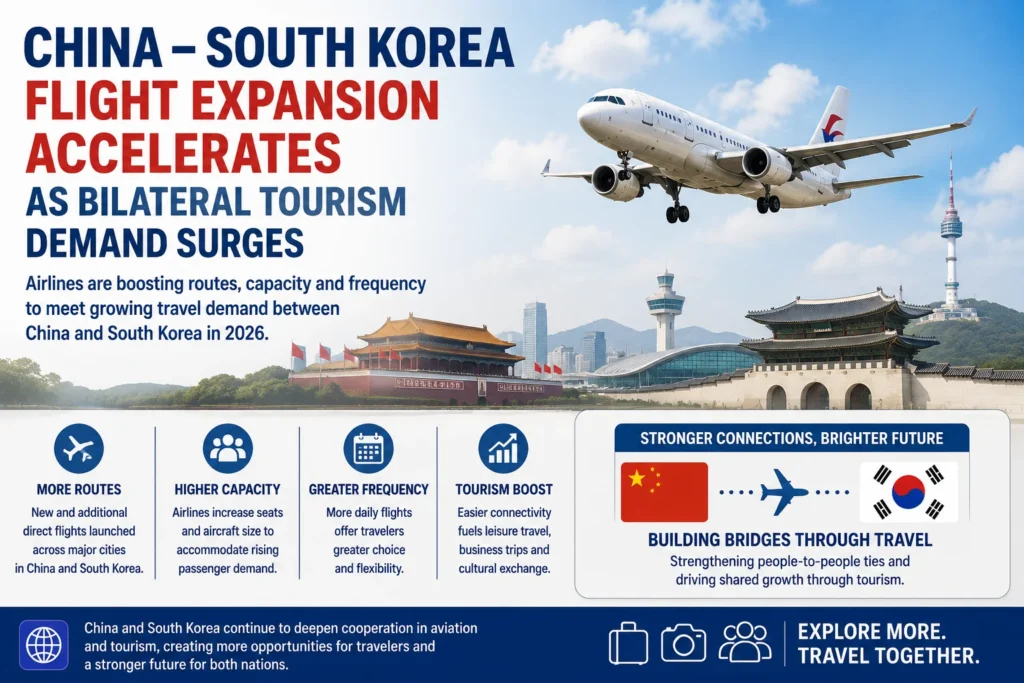
Civil aviation monitoring data reveals that passenger flight operations between China and South Korea reached over 5,140 scheduled flights during late July and early August 2026. This sustained high volume demonstrates a strong recovery and growth trajectory for cross-border mobility in East Asia, driven by expanding airline route networks, reciprocal travel interest, and favorable visa entry policies.
Compared with earlier summer travel periods, flight volumes remained virtually flat while recording a 10.7% increase over the same period in 2025. Flight operations surpassed pre-pandemic benchmark figures from 2019 by 12%, confirming that bilateral air capacity has expanded beyond historical peak levels.
Unilateral Visa Policies and Short-Break Tourism Trends
A primary catalyst behind the surge in passenger volumes is the implementation of China’s unilateral 30-day visa-free entry policy for South Korean passport holders. Designed to facilitate leisure travel, business meetings, and cultural exchanges, the policy has simplified international travel logistics for short-haul trips.
Bilateral travel patterns show a distinct rise in weekend getaways and short-break urban tourism. Commercial airlines operating routes into primary coastal gateways report significant increases in inbound passenger traffic from South Korea, particularly on Friday and Sunday flight sectors:
Shanghai Inbound Surges: South Korean leisure travelers account for up to 80% of total passenger loads on peak weekend flights originating from regional cities such as Busan into Shanghai.
Capital and Commercial Links: High-frequency daily air links connecting Seoul with major economic centers maintain elevated seat load factors throughout peak summer departure windows.
Expanded Destination Access: Direct flights now connect South Korean air travel hubs with diverse Chinese destinations, including Shanghai, Jeju, Busan, Cheongju, Seoul, and interior regional cities.
Official Inbound Tourism Metrics and Growth Statistics
According to official immigration records and national tourism board data, South Korea established itself as China’s primary source market for foreign tourist arrivals during the first half of 2026. Approximately 1.7 million South Korean visitors entered China between January and June 2026, representing a 16% year-over-year increase compared to 2025.
Commercial carriers serving these corridors have expanded overall seat capacity to match growing traveler demand. Operational performance metrics across regional airlines demonstrate strong capacity utilization:
| Performance Indicator | Verified Operational Growth Metric | Key Contributing Factor |
| Bilateral Flight Operations | +10.7% year-over-year growth | Expanded regional route permits and carrier frequencies |
| Pre-Pandemic Capacity Comparison | +12.0% above 2019 levels | Broadened regional destination connectivity |
| Low-Cost Carrier Seat Capacity | +26.8% increase (Jan–Jul 2026) | Fleet deployments on regional short-haul corridors |
| Low-Cost Carrier Passenger Volume | +37.4% surge (reaching 427,000+ passengers) | Visa-free entry policies and short-break tour popularity |
| Average Route Load Factor | 86.4% seat occupancy rate | High weekend passenger demand and group bookings |
Regional Airport Networks and Strategic Route Additions
The expansion of air transit capacity extends across both major international aviation hubs and secondary regional gateways. Regional airports in Northern and Eastern China have established high-density flight corridors to manage growing passenger flows:
Qingdao Aviation Gateway
Following frequency adjustments on key routes, average daily passenger flights between Qingdao and South Korean airports reached 18 departures, with 16 daily flights dedicated directly to Seoul Incheon and Gimpo airports.
Yanji Chaoyangchuan International Airport
Positioned as a major regional transit point in Northeast China, the airport expanded its South Korean route network to serve six destinations—including Busan, Cheongju, and Daegu—operating up to 668 monthly flights. Peak July operational schedules reached 26 daily flights carrying over 4,100 passenger trips per day.
New Inland Network Connections
Airlines are continuously launching new non-stop connections to expand geographic reach. Recent route launches include new direct services linking Incheon with Hohhot, operating twice weekly to serve growing interest in cultural and nature-based inland tourism.
Broader Economic and Cultural Implications
Academic researchers and international trade specialists note that the sustained expansion of aviation connectivity reflects broader warming in bilateral relations and commercial ties. Increased flight frequencies provide vital support for mutual investment, university exchange programs, corporate commerce, and independent leisure travel.
As official civil aviation departments and tourism administration bodies continue to streamline border entry procedures, the strong flight numbers observed in mid-2026 signal a long-term structural expansion in East Asian regional travel.
For more travel news like this, keep reading Global Travel Wire