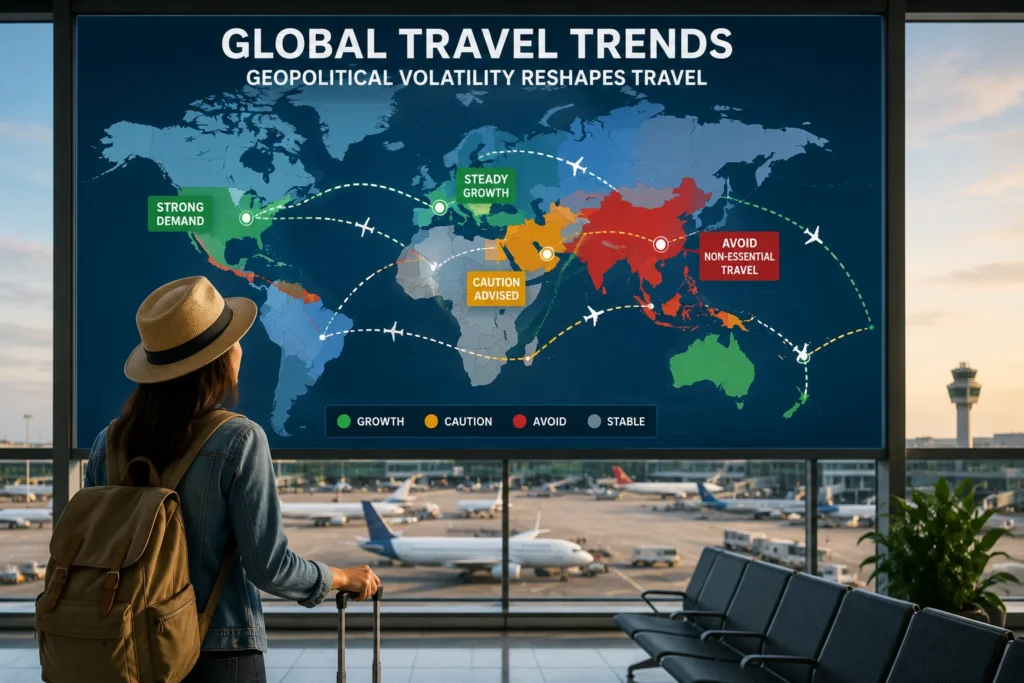
Geopolitical shifts and regional conflicts are fundamentally altering global travel trends in 2026. While international consumer demand for exploration and holiday travel remains strong, international travel patterns are undergoing a profound structural redistribution. Rather than canceling vacation plans entirely, travelers around the world are adapting through rapid destination substitution, prioritizing nations that demonstrate clear operational stability, transparent border policies, and predictable travel infrastructure.
Official statistical releases from international tourism organizations and national ministries highlight a resilient global travel market. UN Tourism reports that global international tourist arrivals expanded during the first quarter of 2026, reaching over 307 million cross-border trips. However, performance metrics across specific geographic corridors reveal major shifts as travelers actively avoid active conflict zones, shifting air corridors, and volatile transit hubs.
Evaluating Entire Journeys: From Destinations to Air Corridors
The defining consumer shift in 2026 centers on how travelers evaluate potential risk. Rather than simply asking whether a hotel or resort is safe, holidaymakers and corporate travelers are examining the operational integrity of the entire journey. Travelers are increasingly scrutinizing aircraft routings, layover locations, visa consistency, and aviation safety across transit corridors.
This heightened awareness has transformed how air travel is booked worldwide:
Preference for Nonstop Flights: Passengers are increasingly willing to pay premium fares for direct, non-stop flight paths that eliminate layovers in regions experiencing political friction or airspace restrictions.
Prioritizing Flexible Bookings: Consumers are shifting toward refundable hotel rates, flexible airline tickets, and comprehensive travel insurance protection to safeguard against unexpected itinerary disruptions.
Compressed Booking Windows: Many long-haul travelers are delaying final booking commitments until 30 to 60 days before departure, closely monitoring government travel advisories and aviation notices.
By focusing on journey predictability, consumers are insulating their travel plans from sudden border adjustments or mid-trip rerouting, ensuring a smoother door-to-door experience.
Air Hub Disruption and the Rise of Alternative Safe Destinations
Regional instability in the Middle East has had a pronounced impact on global aviation flows. Historically dominant connecting hubs across the Gulf region have recorded notable drops in international transit passenger volume, as travelers seek alternative flight connections between Europe, Asia, and Africa. Airspace re-routings and higher jet fuel expenses have also altered long-haul flight economics, prompting major carriers to adjust seasonal schedules.
As a result, secondary regional destinations that offer perceived stability are experiencing significant increases in visitor arrivals. Destinations across Northern and Western Europe—including Spain, Portugal, Greece, Ireland, and Scotland—are capturing redirected leisure demand. Similarly, long-haul island destinations such as Mauritius and the Maldives continue to position themselves as peaceful, self-contained retreats for international travelers.
In East Africa, official tourism statistics from the Ministry of Natural Resources and Tourism highlight strong regional growth. Tanzania, for instance, welcomed over 2.29 million international arrivals in its latest annual total, driven by sustained demand for world-renowned eco-tourism destinations such as Serengeti National Park, Mount Kilimanjaro, and Zanzibar. By offering stable, nature-focused travel experiences supported by continuous national park infrastructure upgrades, East African destinations are capturing a growing share of global travel spending.
Domestic Travel and Regional Short-Haul Vacations Gain Momentum
Geopolitical uncertainty is also fueling a major expansion in domestic and short-haul regional travel. In North America and Europe, national tourism boards report high domestic tourism participation as residents choose drive-to destinations, national parks, and regional coastal resorts over complex intercontinental travel.
Tourism ministries across Asia and Latin America are similarly benefiting from robust intra-regional travel corridors. Simplified visa-waiver agreements between neighboring countries, expanded regional low-cost airline capacity, and high-speed rail network developments have made short-haul cross-border travel more attractive and cost-effective.
National tourism development strategies increasingly focus on strengthening domestic travel resilience. Establishing a vibrant domestic tourism baseline provides a dependable economic cushion for local hospitality businesses, protecting employment and regional infrastructure regardless of global geopolitical fluctuations.
Tourism Board Strategies in a Changing Travel Landscape
In response to evolving consumer preferences, official tourism boards and destination marketing organizations are revamping their promotional strategies. Rather than relying solely on traditional landscape imagery and cultural marketing, tourism authorities are actively communicating operational readiness, modern health and safety protocols, and seamless transport connectivity.
Government aviation authorities and transport departments are working closely with national airlines to expand direct flight capacity to high-growth market originations. Concurrently, national governments are investing heavily in digital border management systems, streamlined e-visa portals, and airport terminal modernization to reduce transit friction for arriving guests.
As the international travel landscape continues to adapt throughout 2026, industry data clearly demonstrates that the global appetite for travel remains fundamentally strong. Destinations that offer operational predictability, direct aviation access, and safe, high-quality visitor experiences are well-positioned to lead the next era of global tourism growth.
For more travel news like this, keep reading Global Travel Wire