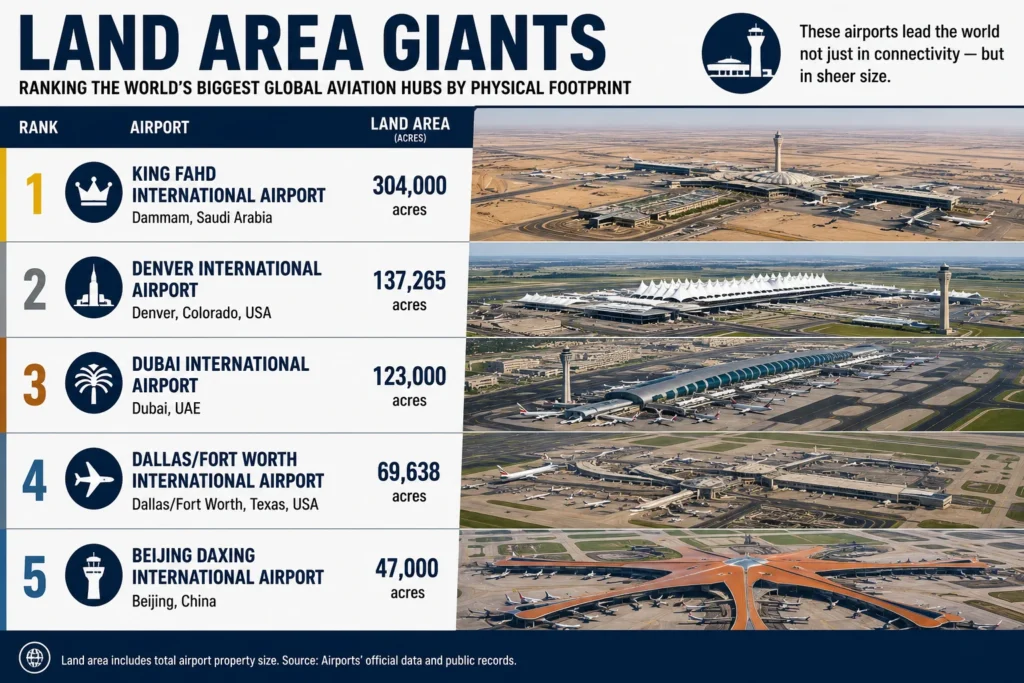
When analyzing global aviation hubs, metrics like passenger throughput, total flight operations, and direct international connectivity usually dominate industry discussions. However, another crucial indicator of an airport’s operational capacity and future strategic value is its physical footprint.
The total land area of an airport directly influences its long-term expansion potential, runway configurations, terminal placement, logistics zones, and environmental buffer zones. Spanning expansive desert terrains, coastal plains, and rural corridors, these mega-facilities operate less like simple transit stops and more like autonomous, self-contained infrastructure hubs.
Based on official airport statistics and verified land measurement data, here is an in-depth breakdown of the world’s most expansive aviation facilities by total land area.
The World’s Top 10 Largest Airports by Physical Land Area
| Rank | Aviation Facility Name | Primary Location | Land Area (sq km) | Land Area (sq miles) |
| 1 | King Fahd International Airport (DMM) | Dammam, Saudi Arabia | 776.0 | 300.0 |
| 2 | Denver International Airport (DEN) | Denver, Colorado, United States | 137.8 | 53.2 |
| 3 | Kuala Lumpur International Airport (KUL) | Selangor, Malaysia | 100.0 | 38.6 |
| 4 | Istanbul Airport (IST) | Istanbul, Türkiye | 76.5 | 29.5 |
| 5 | Dallas/Fort Worth International Airport (DFW) | Dallas/Fort Worth, Texas, United States | 69.7 | 26.9 |
| 6 | Washington Dulles International Airport (IAD) | Dulles, Virginia, United States | 47.8 | 18.4 |
| 7 | Beijing Daxing International Airport (PKX) | Beijing, China | 47.0 | 18.1 |
| 8 | Orlando International Airport (MCO) | Orlando, Florida, United States | 46.9 | 18.0 |
| 9 | George Bush Intercontinental Airport (IAH) | Houston, Texas, United States | 44.5 | 17.2 |
| 10 | Shanghai Pudong International Airport (PVG) | Shanghai, China | 40.0 | 15.4 |
Exploring the Planet’s Expansive Aviation Gateways
1. King Fahd International Airport (DMM) – 776.0 sq km
Holding the Guinness World Record for total land area, King Fahd International Airport in Dammam, Saudi Arabia, dwarfs every other commercial airfield on Earth. Covering a staggering 776 square kilometers, its official boundary is larger than the entire landmass of neighboring Bahrain. The massive site incorporates dedicated commercial passenger terminals, an Aramco corporate flight center, a Royal Terminal, and vast undeveloped reserves designated for future logistics expansion under Saudi Arabia’s Vision 2030 initiatives.
2. Denver International Airport (DEN) – 137.8 sq km
Spanning nearly 138 square kilometers in Colorado, Denver International Airport is the largest commercial airport by land area in North America and the second-largest globally. Designed with an iconic tented roof profile reflecting the nearby Rocky Mountains, the expansive footprint allowed planners to build six active runways—including North America’s longest commercial runway at 4,877 meters—arranged in a non-intersecting layout to maximize simultaneous flight departures and arrivals.
3. Kuala Lumpur International Airport (KUL) – 100.0 sq km
Covering 100 square kilometers in Selangor, Malaysia, Kuala Lumpur International Airport was engineered under the concept of an “airport in the forest and a forest in the airport.” Built to handle regional low-cost air travel alongside full-service flag carriers, its vast land reservation supports multiple long runways, extensive cargo handling yards, and high-speed rail links connecting the terminal complex directly to the capital city.
4. Istanbul Airport (IST) – 76.5 sq km
Strategically situated where Europe and Asia converge along the Black Sea coast, Istanbul Airport covers 76.5 square kilometers. Designed to serve as a massive global transit hub connecting Europe, the Middle East, Africa, and Asia, IST features a massive single-roof terminal building. Its expansive land boundary accommodates multiple parallel runways, enabling high-density simultaneous air traffic movements.
5. Dallas/Fort Worth International Airport (DFW) – 69.7 sq km
Occupying nearly 70 square kilometers between the cities of Dallas and Fort Worth, DFW operates as a primary domestic and international hub for the North American energy and trade corridors. Equipped with five main passenger terminals, seven active runways, and its own municipal services department, the airport’s physical infrastructure functions as a self-sustaining city, handling heavy daily passenger volume and multi-directional freight logistics.
6. Washington Dulles International Airport (IAD) – 47.8 sq km
Located in northern Virginia near the United States capital, Washington Dulles International Airport encompasses nearly 48 square kilometers. Master-planned in the late 1950s to serve as the region’s main international gateway, the extensive land parcel provides essential acoustic buffer zones from surrounding suburban communities while accommodating four operational runways and extensive diplomatic aviation facilities.
7. Beijing Daxing International Airport (PKX) – 47.0 sq km
Opened in late 2019 to relieve congestion at Beijing Capital, Daxing International occupies 47 square kilometers south of the central municipality. The mega-facility is globally famous for its star-shaped central terminal building, engineered to minimize passenger walking distances to outlying gates. The underlying land allocation supports an integrated multi-modal transit hub beneath the central concourse, connecting high-speed rail lines directly with domestic and international flight gates.
8. Orlando International Airport (MCO) – 46.9 sq km
Encompassing 46.9 square kilometers in central Florida, Orlando International Airport transformed a former military airfield into one of North America’s most active leisure travel gateways. MCO’s large land area accommodates multiple terminal buildings, four parallel runways, extensive parking structures, and dedicated ground transportation networks designed specifically to manage heavy seasonal tourism surges heading to regional theme parks and coastal resorts.
9. George Bush Intercontinental Airport (IAH) – 44.5 sq km
Serving the greater Houston metropolitan region, George Bush Intercontinental Airport spans 44.5 square kilometers. As a major gateway to Latin America and transatlantic destinations, IAH’s layout includes five distinct passenger terminals, five active runways, and an expansive air cargo center supporting the regional energy, healthcare, and manufacturing sectors.
10. Shanghai Pudong International Airport (PVG) – 40.0 sq km
Positioned along the coastal line of Pudong district, Shanghai Pudong International Airport covers 40 square kilometers as one of East Asia’s premier aviation facilities. PVG features multiple parallel runways, massive passenger concourses, and extensive international freight facilities that support the trade, commercial, and tourism infrastructure of China’s financial capital.
The Strategic Importance of Land Allocations in Aviation Planning
The physical footprint of modern global aviation hubs determines their long-term operational resilience. Facilities with expansive land allocations maintain clear competitive advantages:
Noise Mitigation Buffers: Large land reserves insulate surrounding residential areas from jet engine noise during high-frequency departure and arrival windows.
Simultaneous Runway Operations: Expansive horizontal space permits the construction of widely spaced parallel runways, allowing dual or triple simultaneous instrument landings during peak congestion.
Integrated Air Cargo Hubs: Dedicated land area allows airports to construct specialized cold-storage, customs clearance, and freight facilities directly adjacent to aircraft aprons.
Future Infrastructure Adaptability: Generous land holdings allow aviation authorities to construct new terminals, high-speed rail connections, and green energy installations without requiring complex land acquisitions.
For more travel news like this, keep reading Global Travel Wire