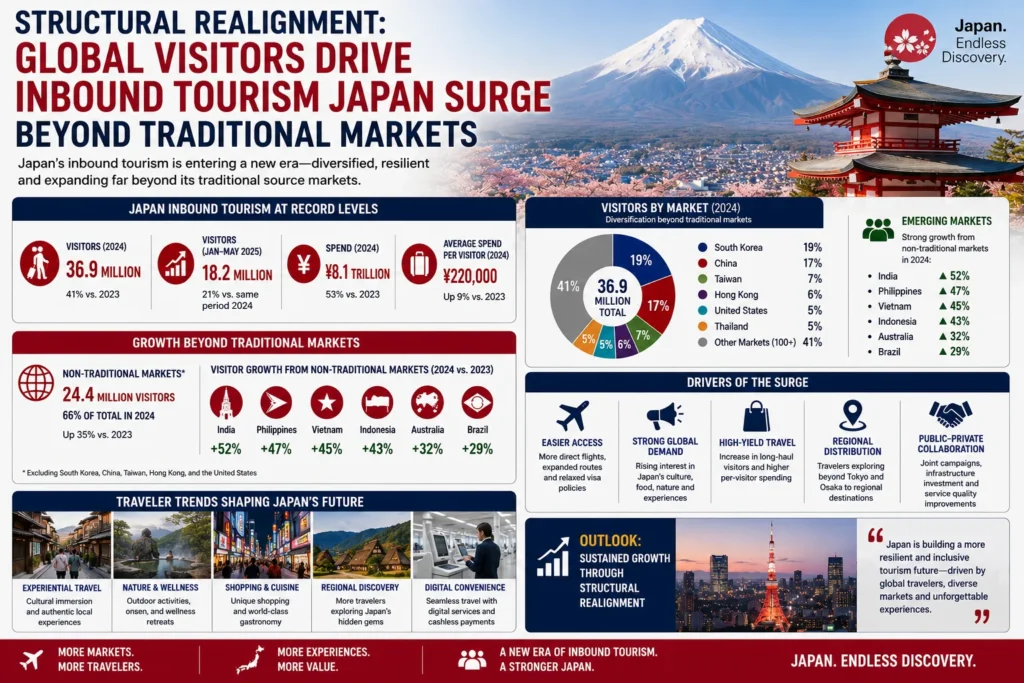
Japan’s national travel sector is undergoing a profound structural transition, actively diversifying its visitor demographic to mitigate a sharp downturn in arrivals from mainland China. Official data released by the Japan National Tourism Organization (JNTO) and the Japan Tourism Agency confirms that rising visitor volumes from North America, Europe, and neighboring Asian markets—such as South Korea and Taiwan—are sustaining the nation’s visitor economy.
Supported by favorable foreign exchange rates and sustained international demand for luxury, cultural, and regional experiences, total foreign visitor expenditure reached record territory in the first half of the year. This shift highlights a strategic transition away from single-market volume reliance toward a high-value, diversified international visitor profile.
Shift in Source Markets and Visitor Arrival Demographics
Historical inbound travel to Japan relied heavily on high-density tour groups originating from China. However, persistent diplomatic friction and official travel guidance issued by Beijing have led to a 56.4 percent decline in Chinese arrivals during the January-to-June period.
Despite this contraction, overall international visitor totals remained stable, with Japan welcoming 21.08 million foreign guests in the first six months of the year—reaching the 20-million milestone for the second consecutive year. Surges across alternative long-haul and regional corridors have successfully cushioned the impact of reduced Chinese arrivals.
South Korea: Solidified its status as Japan’s largest source market, generating 5.67 million arrivals in the first half of the year, representing an 18.6 percent year-on-year increase.
Taiwan: Advanced to the second-largest inbound market, contributing 3.97 million visitors, up 20.9 percent compared to the same period in the previous year.
United States and Europe: Recorded peak seasonal arrivals, with U.S. visitor numbers rising to 354,500 in June alone, marking a record monthly high for that corridor.
Emerging Long-Haul Corridors: Strong growth was recorded across South Asian and European markets, driven by expanded direct flight connections and long-stay itineraries.
Comprehensive Inbound Tourism Japan Performance Metrics
Data compiled from government tourism releases outlines the shifting volume and expenditure metrics recorded across the first half of the year:
| Tourism Performance Metric | Official Government Record | Comparative Trend | Primary Market Contributor |
| H1 International Visitors | 21.08 Million | Slight 2.0% dip vs peak 2025 | South Korea (5.67M), Taiwan (3.97M) |
| Q2 Total Visitor Expenditure | ¥2.5096 Trillion | Up 0.2% (Quarterly Record) | United States (¥384.8B), Taiwan (¥363.9B) |
| Average Per-Visitor Spend | ¥244,457 | Up 3.3% (All-Time High) | United Kingdom, Australia, United States |
| Mainland China Arrivals | 2.06 Million | Down 56.4% year-on-year | Market share contracted significantly |
| Japanese Outbound Travel | 6.94 Million (H1) | Stagnant vs pre-2020 levels | Impacted by weak Yen & inflation |
Transition to High-Value Tourism and Regional Dispersal
While total volume dipped slightly, overall financial yield per visitor reached unprecedented levels. Data from the Japan Tourism Agency shows that long-haul travelers from the United Kingdom, Australia, and the United States recorded the highest per-capita spending, driven by longer average stays exceeding 10 to 14 nights.
Accommodation accounted for the largest share of visitor expenditure at 37 percent, followed by shopping (26.8 percent) and culinary experiences (21.7 percent). Furthermore, public tourism authorities are actively encouraging travelers to venture beyond the traditional “Golden Route” (Tokyo-Kyoto-Osaka). Regional destinations, such as Fukuoka Prefecture in Kyushu and alpine sectors in Hokkaido, are capturing a higher percentage of regional Asian visitors seeking authentic natural and historic sites.
The Outbound Travel Gap and Long-Term Outlook
In contrast to the thriving inbound sector, outbound travel by Japanese citizens faces a slower recovery trajectory. Driven by currency devaluation, rising aviation fuel surcharges, and increased cost-of-living expenses, Japanese departures in the first half reached only 6.94 million—well below historical averages. Government initiatives aimed at subsidizing passport acquisition fees remain active to encourage two-way international travel.
The long-term outlook for inbound tourism Japan remains exceptionally resilient. By expanding infrastructure investments, supporting sustainable regional travel, and cultivating high-value long-haul markets, Japan is establishing a balanced, resilient visitor economy capable of navigating global geopolitical shifts.
For more travel news like this, keep reading Global Travel Wire