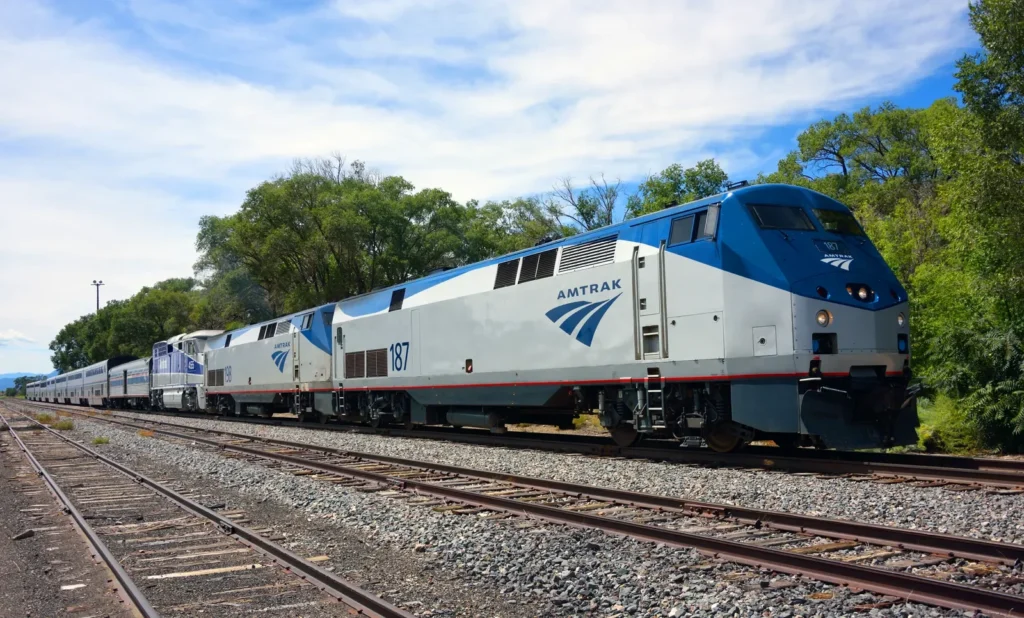
Amtrak’s Mardi Gras Service has completed its first year connecting New Orleans and Mobile with passenger demand dramatically exceeding expectations, reinforcing the Gulf Coast’s potential as a growing rail tourism corridor.
More than 150,000 passenger journeys were recorded during the service’s first year following its August 18, 2025 launch. The performance came after nearly two decades without regular passenger rail service along this part of the Gulf Coast.
The twice-daily service connects New Orleans and Mobile through Bay Saint Louis, Gulfport, Biloxi and Pascagoula in Mississippi. It gives residents and visitors an alternative to driving while linking several destinations known for beaches, festivals, food and Gulf Coast culture.
For tourism businesses, the strong first-year response provides evidence that restored passenger rail can generate new visitor movement between communities traditionally connected primarily by highways.
Ridership races ahead of original expectations
Demand began strongly almost immediately after trains returned.
Amtrak reported more than 18,000 passenger trips during the first month. By early December 2025, total ridership had surpassed 46,000, with Amtrak describing demand as considerably stronger than anticipated.
Passenger numbers continued rising during 2026.
By the end of January, approximately 70,500 passengers had used the service. Ridership subsequently passed 100,000 during April and exceeded 115,000 within the first nine months of operations.
The first-year total of more than 150,000 therefore represents a substantial increase over forecasts developed before passenger service returned.
Earlier expectations had placed annual ridership considerably lower, with later projections around 70,000 to 75,000 passengers.
Actual performance has demonstrated a much larger market for Gulf Coast passenger rail.
Passenger trains return after two decades
The Mardi Gras Service represents the restoration of a connection that disappeared following Hurricane Katrina in 2005.
The devastating storm damaged railway infrastructure across the Gulf Coast, including tracks, bridges and other facilities. Freight rail eventually returned, but regular Amtrak passenger operations remained absent for almost 20 years.
Federal, state and regional agencies subsequently worked together on restoring service.
Major infrastructure investment supported track and signal improvements, station facilities, grade crossings and operational preparations required for twice-daily passenger trains.
The return therefore represented more than the introduction of another Amtrak route. For communities across coastal Mississippi and Alabama, it restored access to a transportation option unavailable to an entire generation of travellers.
Tourism demand strengthens Gulf Coast communities
The route has quickly become relevant to regional tourism.
Passengers can travel between New Orleans, Mississippi’s coastal destinations and Mobile without hiring cars or navigating highway traffic.
New Orleans provides internationally recognised music, food and cultural attractions. Mobile offers historic districts, museums and its own Mardi Gras traditions, while Mississippi stops provide access to beaches, casinos, restaurants and waterfront communities.
Amtrak has specifically positioned the route for day trips and weekend escapes.
Special events have produced particularly strong demand. Trains sold out around several New Orleans Saints home games during the service’s opening months, while events such as Cruisin’ the Coast also attracted heavy passenger volumes.
Amtrak responded to some high-demand periods by adding additional seating capacity.
Rail creates opportunities beyond transportation
Higher ridership can generate economic benefits beyond ticket revenue.
Visitors arriving by train spend money on hotels, restaurants, attractions, taxis, local transportation and entertainment. Rail stations can therefore become gateways that distribute tourism spending into surrounding communities.
The Southern Rail Commission has consistently identified tourism and local economic development among the core benefits of restoring passenger service.
The corridor also connects with the wider Amtrak network through New Orleans.
Passengers can make connections towards destinations served by the City of New Orleans, Crescent and Sunset Limited, extending the Gulf Coast route’s usefulness beyond regional journeys.
Strong demand could shape future expansion
The first-year performance raises questions about future capacity and additional destinations.
Sustained demand could support consideration of additional train capacity during festivals, sporting events and holiday periods.
Regional discussions have also included opportunities to improve station access and potentially extend the benefits of passenger rail to additional Gulf Coast communities.
Any expansion would require infrastructure, operating and funding decisions, but the first year provides planners with something that was difficult to obtain before launch: current evidence of passenger behaviour.
Gulf Coast rail enters its next chapter
The biggest achievement of the Amtrak Mardi Gras Service may be proving that demand survived the route’s two-decade absence.
Passengers quickly returned once a reliable train option became available.
With first-year ridership exceeding 150,000 journeys and outperforming earlier forecasts, the New Orleans-Mobile corridor has established itself as a significant new component of Gulf Coast mobility.
For travellers, it offers another way to experience Louisiana, Mississippi and Alabama. For destinations along the route, it creates new visitor flows and economic opportunities.
After almost 20 years without regular passenger trains, the Gulf Coast rail revival has moved from an experiment into a rapidly growing tourism connection.
For more travel news like this, keep reading Global Travel Wire