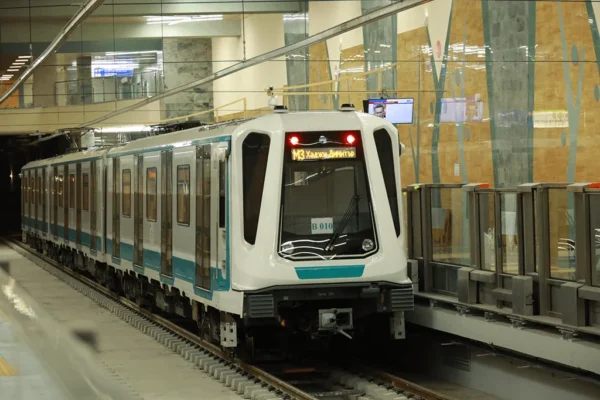
Sofia has expanded Metro Line 3 with three new stations, strengthening public transport connections across northeastern districts of Bulgaria’s capital and creating faster journeys for residents and visitors.
The approximately three-kilometre extension runs from the existing Hadzhi Dimitar section toward the Levski area along Vladimir Vazov Boulevard. The three stations are Georgi Asparuhov Stadium, Bessarabia and General Vladimir Vazov.
Service on the new section began in August 2026, bringing rapid transit closer to residential neighbourhoods, businesses and one of Sofia’s prominent sporting venues.
The expansion represents an important step in Sofia’s long-term strategy to increase metro coverage while reducing pressure on road transport. City authorities estimate that more than 45,000 people will benefit from faster daily journeys in areas including Hadzhi Dimitar, Suhata Reka and Levski.
Three stations expand Sofia’s transport reach
The new stations extend Line 3 into parts of Sofia that previously depended more heavily on road-based public transport.
Georgi Asparuhov Stadium station lies beside the stadium bearing the name of celebrated Bulgarian footballer Georgi Asparuhov. Its location gives football supporters and visitors easier access to the sporting venue while connecting the surrounding Suhata Reka area directly with the metro.
Bessarabia station strengthens connectivity around Vladimir Vazov Boulevard and nearby communities. Surface public transport stops have also been reorganised to integrate the new metro connection into Sofia’s broader transport network.
General Vladimir Vazov station serves the Levski area and acts as the eastern end of the new extension.
Together, the stations create a continuous rapid transit connection through northeastern Sofia and improve access to central and western parts of the capital.
Faster journeys improve visitor mobility
Sofia Municipality has said passengers from the expanded Line 3 corridor can reach the National Palace of Culture area in approximately 12 minutes.
That improvement is particularly significant for travellers because Line 3 connects with other metro services serving major parts of the city.
Passengers can interchange for additional metro routes near key central transport points, making it easier to reach Sofia Airport, the Central Railway Station and the Central Bus Station.
For international tourists, a stronger metro network can reduce dependence on taxis and private vehicles while making accommodation outside the traditional city centre more practical.
Visitors can also use the expanded system to explore neighbourhoods that may previously have required longer bus or road journeys.
Football heritage becomes part of the journey
Georgi Asparuhov Stadium station gives the project a distinctive cultural dimension.
Located near the home stadium associated with one of Bulgaria’s best-known football institutions, the station connects public transport infrastructure with the city’s sporting heritage.
This can provide additional benefits on match days, when large numbers of spectators travel toward the stadium area.
Improved metro access can reduce pressure on nearby roads and provide visitors with a predictable transport option before and after sporting events.
For tourists interested in Bulgarian football culture, the station also creates another recognisable point within Sofia’s expanding urban transport map.
Metro expansion supports greener Sofia tourism
Sustainable mobility is becoming increasingly important for European city destinations, particularly as travellers seek convenient alternatives to cars.
Sofia’s metro expansion supports that trend by encouraging greater use of electrified mass transit.
Metropolitan Sofia has previously estimated that the extension could help reduce road traffic in the affected corridor while lowering transport-related emissions.
The benefits extend beyond daily commuting. Efficient urban rail can improve the overall tourism experience by shortening travel times between hotels, attractions, transport terminals and local neighbourhoods.
For business travellers, the extension also provides greater reliability when moving between meetings and accommodation areas.
Sofia continues major metro development
The Vladimir Vazov Boulevard extension forms part of a wider expansion of Sofia’s underground railway system.
Construction is continuing on additional Line 3 sections, including the route through Geo Milev and Slatina toward Tsarigradsko Shose.
Metropolitan Sofia expects ongoing projects to significantly increase the network’s length and passenger capacity, strengthening the metro’s role within the capital’s public transport system.
Additional investment also includes new trains and infrastructure designed to accommodate future demand.
The development reflects Sofia’s ambition to create a more connected, efficient and environmentally responsible European capital.
New connections reshape the Sofia visitor experience
For tourists arriving in Bulgaria, transport accessibility can have a major influence on how easily a destination can be explored.
The three new Line 3 stations expand the parts of Sofia that visitors can reach quickly by metro while improving connections between local communities and the city centre.
Georgi Asparuhov Stadium, Bessarabia and General Vladimir Vazov therefore represent more than three additional stops.
They expand Sofia’s accessible tourism landscape, support sustainable travel and bring northeastern neighbourhoods closer to the capital’s major attractions and transport gateways.
As Sofia continues investing in its metro network, the city is building a transportation system capable of supporting both everyday mobility and the growing expectations of international travellers exploring Bulgaria’s capital.
For more travel news like this, keep reading Global Travel Wire