East Sussex rail travel is facing major disruption following the August 13, 2026 derailment near Lewes, as investigators widen their examination of track condition, previous maintenance, hot weather and the embankment beneath the railway.
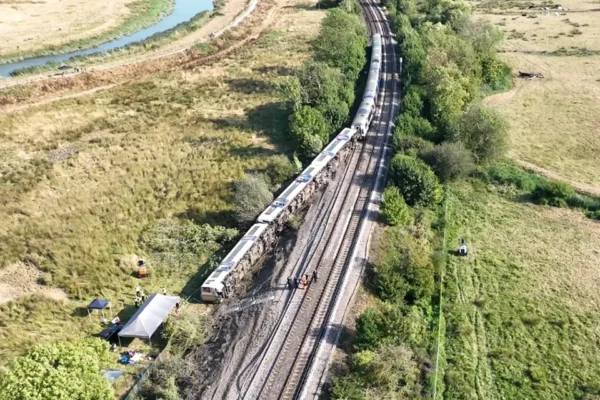
The Southern service from London Victoria to Eastbourne derailed near Lewes at about 3:54 p.m. with approximately 150 people aboard. Thirty people were injured and 20 required hospital treatment.
Three rear vehicles of the eight-carriage train derailed and ended up on their sides, creating a complex recovery operation and forcing the closure of the railway between Haywards Heath and Lewes.
For travellers, the immediate impact remains significant. Direct journeys between London and Eastbourne are disrupted, while passengers heading toward East Sussex destinations must use alternative routes, replacement transport and longer connections.
London to Eastbourne journeys take longer
Southern has warned passengers to expect major disruption while recovery and infrastructure work continue.
There are currently no direct Southern trains between London and Eastbourne via the normal Lewes route. Travellers heading from London toward Eastbourne can travel via Brighton and change there for onward services.
Replacement buses are also operating between Haywards Heath and Lewes.
Passengers have been advised to allow at least an additional hour for some journeys, particularly where replacement transport or multiple changes are required.
Additional capacity has been introduced between Brighton and Eastbourne to help manage demand while the damaged section remains closed.
The disruption is especially important during the summer travel period, when Eastbourne, Lewes, Brighton and surrounding coastal areas attract significant leisure traffic.
Investigation focuses on track irregularity
The Rail Accident Investigation Branch is examining several factors and has not yet established the final cause of the derailment.
Preliminary evidence identified a track geometry irregularity immediately before the derailment point.
Investigators are examining CCTV from earlier trains, previous track maintenance activity and reports from passengers who experienced rough riding at the same location before the accident.
Initial analysis of the train’s onboard data recorder indicates that it was travelling at approximately 65 mph as it approached the derailment site.
The permitted maximum speed at that location was 70 mph.
That means investigators are looking beyond train speed and examining the condition and behaviour of the railway infrastructure itself.
Hot weather becomes key area of scrutiny
Weather conditions are another important part of the investigation.
RAIB recorded hot, sunny and dry conditions on August 13 following a sustained period of high temperatures. The nearest weather station recorded an air temperature of approximately 27°C around the time of the accident.
Investigators will examine whether measures designed to manage railway risks during hot weather were adequate.
However, no final conclusion has been reached linking heat directly to the derailment.
High temperatures can place additional stress on railway infrastructure, which is why track monitoring and preventative controls form an important part of summer rail operations.
RAIB will assess these systems alongside maintenance history and physical evidence gathered from the site.
Embankment condition also under examination
The railway embankment near the derailment site has also become part of the investigation.
Officials have noted that the structure contains material that can respond to changes in water content.
At this stage, investigators have found no evidence of a major embankment slip immediately before the crash. However, evidence indicates that some movement had previously occurred in the area.
The investigation will therefore examine the relationship between the embankment, track geometry and other factors that may have contributed to the incident.
This wider approach means the final findings could have implications for railway maintenance and resilience beyond the Lewes corridor.
East Sussex tourism connectivity comes under pressure
Rail connections play an important role in East Sussex tourism.
London services provide access to Eastbourne, Lewes and other south-coast destinations used for weekend breaks, cultural visits, outdoor tourism and seaside holidays.
When a major route is closed, visitors face longer journey times and additional planning.
Travellers heading toward Eastbourne may need to travel through Brighton, while passengers using replacement buses should expect less predictable journey times than normal rail services.
Visitors are therefore being encouraged to check official travel information before leaving and allow additional time.
Passenger confidence becomes wider concern
The derailment also creates a broader challenge for rail operators and infrastructure managers.
Network Rail has acknowledged concerns following the Lewes incident and a separate derailment near Wickford the following day.
Safety officials have stressed that investigations must establish exactly what happened before conclusions are drawn.
For passengers, that distinction matters.
The immediate priority is maintaining safe alternative journeys while damaged infrastructure is recovered and repaired. The longer-term priority will be implementing any safety lessons identified by investigators.
As East Sussex approaches the final weeks of the summer travel season, the Lewes derailment has therefore become both a transport disruption and a test of railway resilience.
For visitors travelling between London, Lewes and Eastbourne, journeys remain possible, but extra time, route changes and careful planning will remain essential until normal services are fully restored.
For more travel news like this, keep reading Global Travel Wire