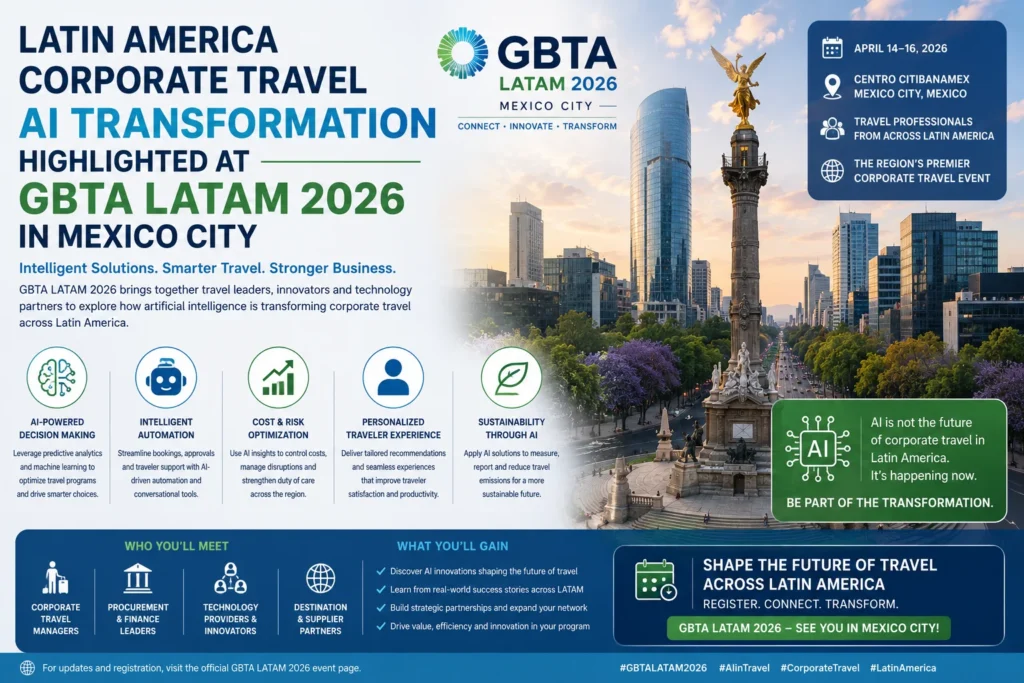
Industry executives and travel procurement professionals will gather in Mexico City on October 1, 2026, for the annual GBTA LATAM Conference to examine how artificial intelligence, economic shifts, and evolving Duty of Care frameworks are reshaping regional business mobility. Hosted by the Global Business Travel Association, the regional event serves as a strategic forum for corporate travel buyers, suppliers, and technology developers operating across Latin America.
The upcoming summit focuses on the operational migration from basic software automation toward autonomous digital ecosystems. As organizations across Latin America optimize Travel and Expense systems, artificial intelligence is transitioning from introductory data processing tools into agentic systems capable of executing complex administrative tasks with minimal human intervention. This technological evolution enables business travel managers to shift away from manual workflow management and focus on strategic supplier procurement and policy oversight.
By synthesizing fragmented data across global reservation platforms, corporate travel policies, real-time risk assessments, and employee preferences, autonomous travel software streamlines corporate travel management. Integrated systems reduce administrative friction while improving data accuracy across enterprise resource planning systems. Industry leaders emphasize that successful deployment requires reliable underlying operational data and strong corporate governance structures.
Navigating macroeconomic shifts remains a primary operational objective for organizations expanding across Latin America. The conference program incorporates empirical data from the Global Business Travel Association Business Travel Index, a comprehensive global benchmark tracking travel expenditure and volume across 72 countries and dozens of distinct commercial sectors. By utilizing industry spending indicators, corporate travel planners can establish data-driven travel budgets that balance cost controls with the documented commercial value of in-person client engagements.
The evolution of risk management and Duty of Care strategies represents another core focus for the regional summit. Modern risk management frameworks are shifting from reactive incident response models to proactive, predictive protection systems. Advanced risk evaluation software can analyze destination disruptions in real time, evaluate event severity, and automatically generate alternative travel logistics for affected employees. This technology-driven approach strengthens operational resilience while ensuring compliance with corporate legal responsibilities.
Beyond technological efficiency, the regional summit addresses corporate traveler wellbeing and workplace sustainability. Recognizing the mental health impact of high-frequency business travel, specialized conference sessions examine strategies for reducing travel fatigue and preventing employee burnout. Integrating wellness initiatives alongside technology discussions reflects a growing industry recognition that automated systems must support workforce health rather than increase workload demands.
The event structure facilitates cross-sector networking and technical learning through a structured one-day agenda:
| Time | Activity | Program Focus |
| 07:30 | Registration | Attendee Check-In |
| 08:00 | Networking Breakfast | Peer-to-Peer Engagement |
| 09:00 | Main Stage Sessions | Executive Industry Keynotes |
| Mid-Day | Expo & Networking Lunch | Vendor Collaboration & Solutions |
| Afternoon | Educational Sessions | Specialized Technical Workshops |
| Evening | Closing Reception | Final Networking Event |
To ensure broad accessibility for international delegates, real-time automated translation technologies will provide multi-language captions and transcripts in over 25 languages, including Spanish, Portuguese, and English. This seamless communication showcase demonstrates how technology removes language barriers across international business environments.
The widespread adoption of artificial intelligence across business travel networks generates significant downstream benefits for the broader regional tourism and hospitality sectors. Business travel drives consistent occupancy and revenue for upscale urban hotels, commercial airlines, ground transportation networks, and event venues throughout Mexico and Latin America. As corporate travel platforms integrate directly with supplier distribution systems, friction in booking corporate-approved travel decreases, generating sustained demand across regional hospitality infrastructure.
As corporate mobility management adapts to autonomous tools, legal frameworks surrounding corporate travel policy and risk management continue to evolve. Enterprise risk standards increasingly incorporate real-time tracking data and predictive risk assessments into standard corporate care definitions. For travel professionals and corporate travelers alike, the integration of autonomous platforms reduces time spent on administrative expense reporting, allowing corporate travel programs to deliver maximum strategic value for growing global enterprises.
For more travel news like this, keep reading Global Travel Wire