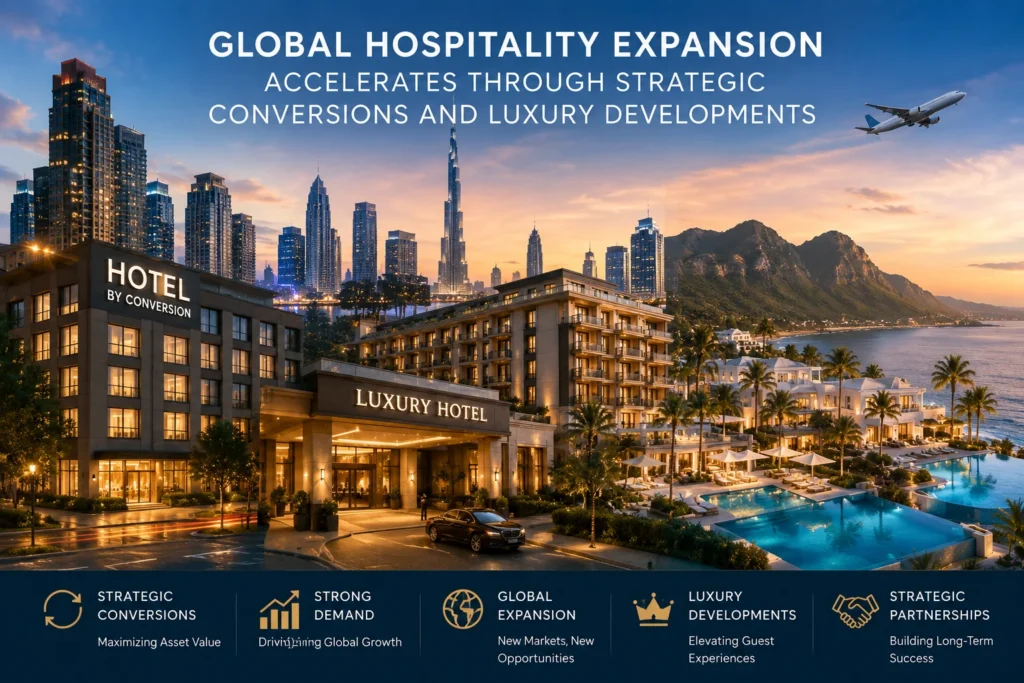
The international hospitality sector continues to undergo rapid transformation, driven by targeted corporate conversions, regional portfolio acquisitions, and high-end resort additions in key coastal and cultural destinations. Official growth figures released by major global hotel groups confirm that international operators are prioritizing rapid expansion, using portfolio conversions to secure market share alongside targeted new builds.
This strategic direction reflects a broader shift across global destination markets. By converting existing high-performing properties and introducing specialized luxury banners into emerging regions, hospitality groups can rapidly extend their international footprint to capture rising global leisure travel demand.
Brand Conversions Accelerate across Premier Leisure Destinations
Major international hospitality groups are increasingly turning to conversion agreements as a primary growth mechanism, allowing established properties to integrate into global loyalty and distribution networks.
In Mexico, official development announcements confirm a major conversion-led expansion along the Riviera Maya. Under an agreement between international hotel operators and regional resort owners, three major beachfront properties in Playa del Carmen comprising nearly 700 rooms will undergo targeted renovations before joining a major global resort collection. This strategy provides international operators with an expanded footprint in the high-growth all-inclusive leisure market while allowing regional properties to maintain distinct local architectural styles.
Similarly, in Japan, official portfolio disclosures highlight a massive urban conversion deal across primary cultural hubs. An agreement covering 14 hotel assets in Kyoto will add more than 1,000 rooms to the regional travel ecosystem. The phased transition of established local properties into recognized international brands illustrates how global operators are scaling their midscale and upscale lifestyle brands in highly sought-after cultural destinations.
Emerging Cultural Hubs and Nature-Oriented Resorts
High-end hospitality development is increasingly focusing on destinations known for unique natural landscapes, cultural heritage, and biodiversity, moving beyond traditional urban gateways.
In Southwest China, official openings mark the arrival of new luxury brands into the mountainous Yunnan province. Positioned along the slopes of Cangshan Mountain overlooking Erhai Lake, newly developed high-end properties are designed to integrate directly with regional topography and local Bai architectural traditions. Regional tourism boards report that such developments elevate the international profile of interior cultural destinations, providing visitors with immersive luxury experiences grounded in local natural heritage.
Across Western Europe, official planning disclosures point to growing demand for low-density luxury offerings along coastal regions. In Portugal, public municipal plans confirm the introduction of ultra-luxury brand resorts and branded residences along the Alentejo coastline. Located within reach of the national capital, this regional development underscores an expanding preference among international visitors for eco-conscious, lower-density European coastal retreats.
Central America is experiencing a parallel trend. In Costa Rica, official environmental and tourism filings confirm plans for a multi-acre coastal estate along the Pacific coast near Manuel Antonio National Park. The project includes a luxury resort paired with private branded residences, using sustainable mass-timber architectural frameworks designed to blend into the surrounding rainforest canopy.
Large-Scale Infrastructure Expansion in the Middle East
The Middle East remains one of the world’s most active regions for large-scale hotel infrastructure development, backed by state-level tourism master plans and public investment programs.
In Saudi Arabia, official ministry updates highlight expanded hospitality partnerships supporting national development frameworks. Recent agreements have finalized plans for major multi-hundred-room properties in primary religious and urban centers, including Makkah. Public disclosures from international hotel operators indicate that overall room capacity across the Kingdom is expanding exponentially, with dozens of active projects in the development pipeline to support growing domestic and international visitor flows.
Industry Challenges and Operational Resilience
While project pipelines remain robust, public project monitoring documents demonstrate that developers and resort operators must navigate regional operational realities. Global supply chain adjustments, localized environmental compliance reviews, and climate-related infrastructure rebuilding—particularly across island destinations in the Caribbean—highlight the need for sustainable development practices.
Despite these operational considerations, overall investment momentum across the global hotel and resort sector remains strong. Strategic conversions, luxury expansions into nature-rich destinations, and massive regional infrastructure investments continue to drive the evolution of international tourism.
For more travel news like this, keep reading Global Travel Wire