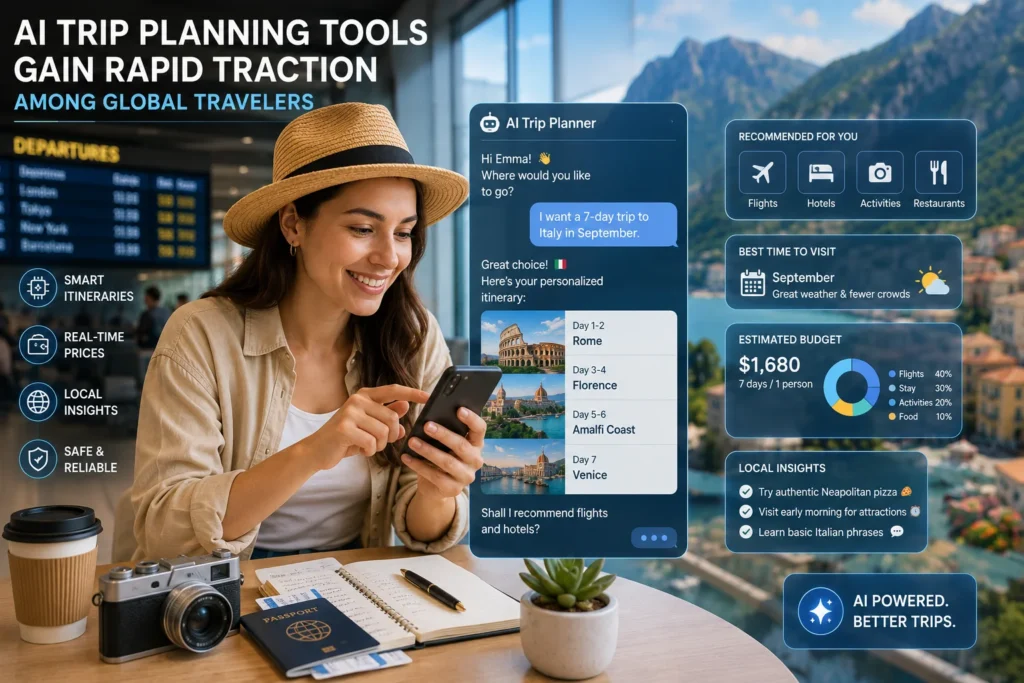
Artificial intelligence is quickly transitioning from an emerging technology to an essential research mechanism within international travel. Official survey findings published in the latest Global Rescue Traveler Sentiment and Safety Survey demonstrate a 64 percent surge in the adoption of AI trip planning tools among experienced global travelers over a six-month period.
Between January and mid-2026, the proportion of international travelers utilizing artificial intelligence to assist with trip preparation rose from 22 percent to 36 percent. Concurrently, traveler reluctance to engage with AI technology dropped from 40 percent to 35 percent, indicating a steady softening of resistance as digital literacy and tool accessibility improve.
Despite this significant uptake, travelers are utilizing artificial intelligence primarily to enhance information gathering rather than outsourcing final decision-making. Travelers rely on digital tools to compile destination insights, compare flight choices, and structure daily itineraries, while retaining complete control over financial bookings and risk assessments.
Global Adoption Patterns Reveal Regional Disparities
Adoption rates for AI travel research vary substantially based on traveler residency. Data indicates that international travelers residing outside the United States are embracing digital planning mechanisms at a significantly faster rate than their American counterparts.
Nearly 48 percent of non-US international travelers report actively using AI platforms to assist with trip preparation, compared to 33 percent of US-based travelers. Furthermore, non-US travelers lead across nearly all information-intensive tasks, including researching visa requirements, evaluating entry protocols, generating accommodation options, and utilizing dynamic language translation tools.
For destination marketing organizations and international travel operators, this geographic divergence underscores the necessity of optimizing digital travel content for search engines, generative algorithms, and multi-language AI platforms to maintain visibility among overseas visitors.
Primary Applications Favor Destination Research Over Automated Bookings
Rather than acting as automated booking agents, AI platforms serve overwhelmingly as advisory mechanisms during the early discovery and itinerary-building phases of travel planning. Survey data categorizes the top operational uses of AI among international travelers:
Destination research and local attraction discovery: 30 percent
Structuring detailed daily travel itineraries: 22 percent
Evaluating flight schedules and hotel recommendations: 19 percent
Navigating international visa and entry requirements: 18 percent
Ground transportation and route planning: 14 percent
Restaurant recommendations and local culinary discovery: 11 percent
Real-time language translation assistance: 10 percent
The low adoption rate for travel budgeting tools—sitting at just 3 percent—highlights that while travelers trust AI to surface ideas and organize logistical frameworks, they remain cautious about relinquishing financial management or direct booking authority to algorithmic software.
Human Expertise and Real-Time Support Remain Essential in Travel Safety
While digital tools continue to streamline routine travel research, industry experts emphasize that technology cannot fully replace human judgment, local context, and professional guidance. This distinction becomes particularly critical during unexpected operational disruptions, severe weather events, geopolitical tensions, or regional infrastructure failures.
When unexpected crisis situations arise in foreign destinations, travelers prioritize real-time intelligence, professional medical and security support, and human decision-making. AI applications excel at processing structured data and organizing information, but human advisory services remain irreplaceable when evaluating complex safety protocols and executing emergency response management.
As artificial intelligence becomes deeply integrated into consumer travel habits, the ideal travel ecosystem will merge scalable digital planning tools with verified human expertise, ensuring that travelers enjoy both seamless trip preparation and comprehensive safety assurances worldwide.
For more travel news like this, keep reading Global Travel Wire