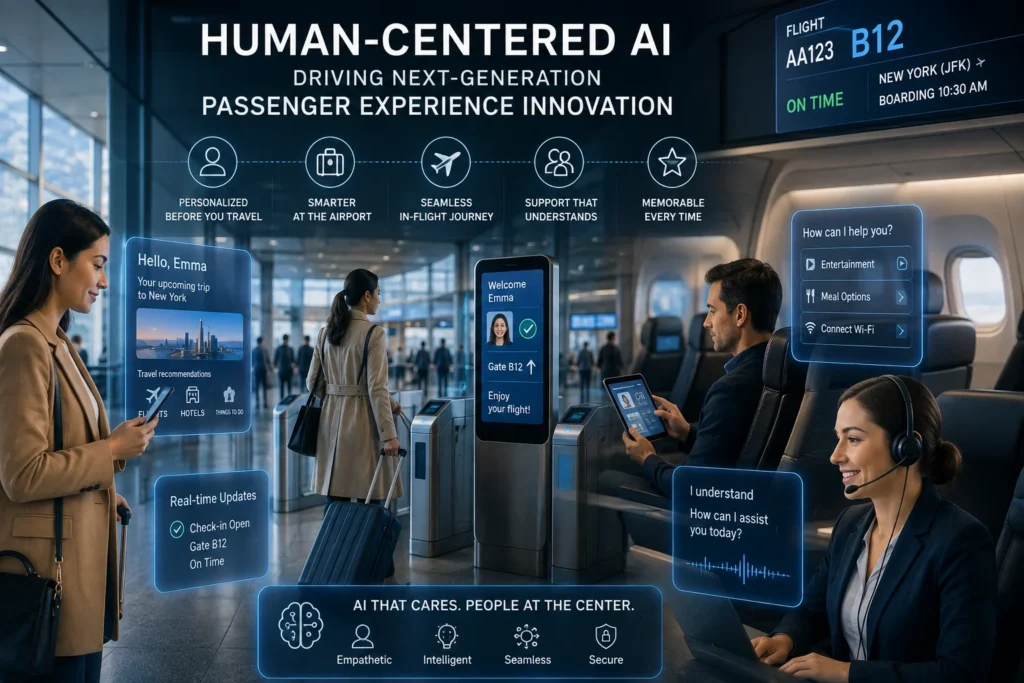
As traveler expectations evolve across global transport sectors, commercial airlines, international airports, and cruise operators face a fundamental challenge: integrating artificial intelligence (AI) to streamline journeys without diminishing the human connections central to hospitality.
Rather than treating digital automation as a direct replacement for service staff, forward-thinking travel providers are deploying AI tools as operational enablers. By removing administrative friction, automating repetitive touchpoints, and predicting passenger needs, technology creates the operational bandwidth necessary for frontline staff to deliver empathetic, personalized, and memorable guest interactions.
Official announcements from international aviation and travel forums highlight that future passenger experience innovation depends on balancing operational efficiency with high-touch hospitality. As AI adoption accelerates across global transport networks, leading operators prioritize solutions that enhance human engagement rather than isolate travelers behind digital screens.
Cross-Sector Insights: What Aviation Transport Can Learn from Cruise Hospitality
The convergence of global travel sectors offers valuable operational frameworks for airline executives and airport authorities. While aviation and maritime transport operate under different physical constraints, both share the baseline objective of delivering safe, seamless, and welcoming journeys to millions of annual passengers.
Travel hospitality leaders emphasize that exceptional guest journeys rest on a two-part foundation: strict operational excellence followed by genuine emotional connection. Operational reliability—such as on-time departures, efficient baggage handling, and seamless boarding—eliminates friction. However, the human interactions delivered by onboard crews and ground staff remain the primary driver of brand loyalty and long-term customer satisfaction.
For aviation administrators, adopting hospitality-first design principles involves rethinking traditional operational bottlenecks. Rather than making incremental modifications to legacy check-in, security, and boarding procedures, travel providers are encouraged to redesign passenger workflows from scratch using integrated digital tools.
Shifting Benchmark Standards Across Global Travel Platforms
Modern consumers no longer evaluate travel experiences solely against competing airlines or neighboring airports. Instead, passengers judge every journey against the single best digital or hospitality interaction they have experienced across any consumer sector.
This cross-industry shift has raised expectations for hyper-personalization, immediate communication, and frictionless transit. AI algorithms now allow travel platforms to anticipate passenger preferences, offer dynamic trip adjustments, and provide real-time updates directly to mobile devices.
However, travel technology experts warn that excessive automation risks commoditizing the journey. The primary goal of advanced personalization tools should be providing frontline aviation and hospitality personnel with actionable insights, enabling employees to deliver timely, context-aware assistance during moments of travel disruption.
Strategic Alignment and Frontline Inclusion Drive Scalable Innovation
Successfully deploying passenger experience innovation requires strong organizational alignment between executive leadership, technology vendors, and frontline operational teams. Promising digital initiatives often stall when developed without direct input from the employees managing daily airport or shipboard operations.
Involving frontline staff early in the system design process ensures that new software tools address practical operational friction points. Frontline employees possess unique insights into passenger anxieties, physical queue bottlenecks, and communication gaps.
Key strategies for implementing human-centered travel technology include:
Establishing a clear, customer-focused digital transformation strategy across all passenger touchpoints.
Engaging frontline airport, cabin, and terminal crews during initial technology testing and deployment phases.
Utilizing predictive AI models to handle routine inquiries, freeing service teams for complex guest assistance.
Fostering an organizational culture that measures technology success by guest satisfaction rather than process automation alone.
Global Industry Gatherings Shape the Future of Air and Maritime Travel
The future of global travel systems will be a central focus at major international transport assemblies, including the upcoming 20th anniversary edition of FTE Global in Dallas, Texas. Convening leaders from airlines, airport authorities, cruise lines, and technology platforms, the event focuses on cross-industry collaboration under the banner of transforming travel together.
Keynotes from global fleet experience executives, aviation CEOs, and airport authorities will explore how AI-driven automation, biometric processing, and hospitality design can coexist to build resilient, human-centered transport ecosystems.
As global passenger volumes expand, the destinations, carriers, and transit hubs that successfully merge technological precision with authentic human service will define the standard for global travel excellence.
For more travel news like this, keep reading Global Travel Wire