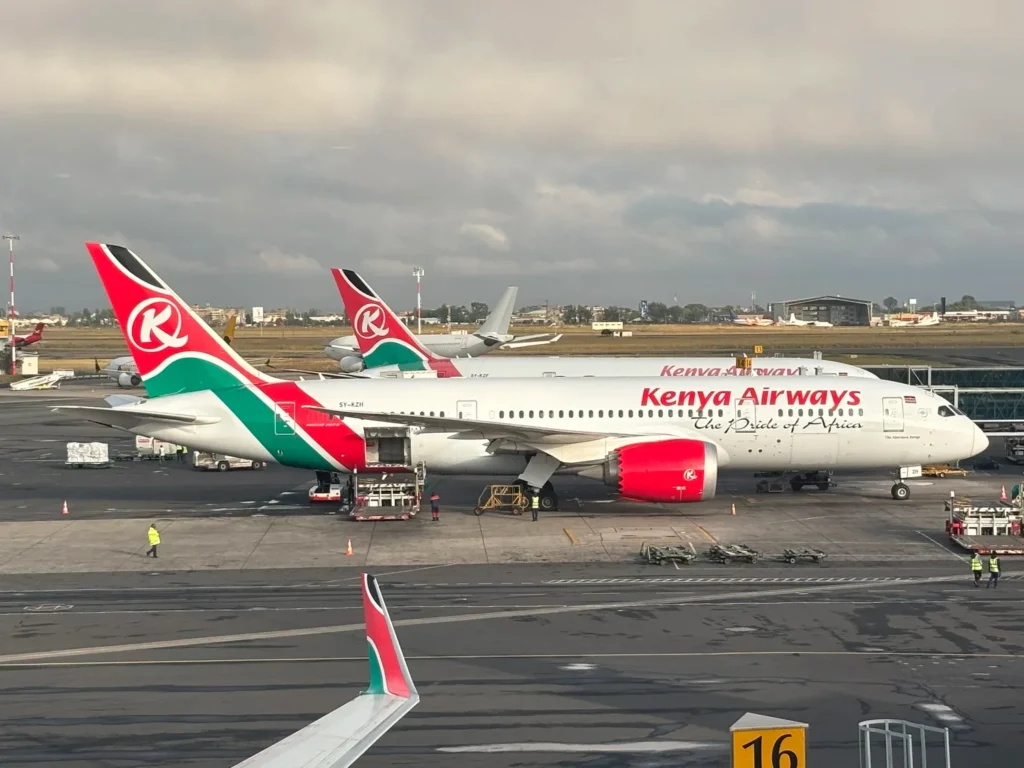
Kenya Airways passengers faced delays averaging two to three hours at Jomo Kenyatta International Airport on August 30, 2026, following operational constraints within air traffic control services.
The carrier confirmed that flights arriving at and departing from JKIA were affected. At 2 p.m. East Africa Time, only 30% of its scheduled flights for the day had departed, with some departure delays exceeding three hours.
By 5 p.m., scheduled services had departed with an average delay of between two and three hours. Kenya Airways apologised to customers and said it was proactively contacting passengers about flight changes.
The airline emphasised that passenger and crew safety remained its highest priority. Its teams worked with aviation stakeholders to maintain safe operations and reduce the disruption affecting travellers.
The delays created challenges for passengers travelling from Nairobi and those connecting through Kenya Airways’ primary hub. Missed onward services, delayed baggage transfers and disrupted hotel or safari arrangements were among the potential consequences.
Air traffic control constraints slow operations
Kenya Airways attributed the disruption to operational constraints within air traffic control services. However, its official notices did not identify a specific technical failure or provide detailed information about the underlying problem.
Air traffic controllers maintain safe separation between aircraft, manage runway movements and coordinate traffic through controlled airspace. When available capacity becomes constrained, authorities may reduce aircraft movements to protect safe operations.
This can create queues for departing flights and delay arriving aircraft. Passengers may see aircraft waiting at gates even when boarding has finished because departure still depends on air traffic clearance and available runway capacity.
A safety-led reduction in traffic flow can also produce delays that continue after the original constraint improves. Airlines must reposition aircraft and crews while assisting customers who have missed connections.
Nairobi hub disruption spreads across Africa
JKIA serves as Kenya Airways’ operational hub and one of Africa’s important international gateways. The airline’s network connects Nairobi with destinations across Africa and several intercontinental markets.
Its hub model brings flights into Nairobi in coordinated waves, allowing passengers to transfer between regional and long-haul services. However, this structure means a delay affecting one departure can influence several later journeys.
An aircraft leaving Nairobi behind schedule may arrive late at another airport and delay its next flight. Crew duty limitations can create further complications if pilots or cabin staff no longer have enough permitted working time to complete a sector.
Passengers travelling on a single booking may be reprotected on alternative services if they miss a connection. Those using separate tickets face greater risk because the second airline may not treat the first carrier’s delay as its responsibility.
Travellers advised to monitor bookings
Affected passengers should check their flight status through official Kenya Airways channels before travelling. The carrier has advised customers to update the contact information stored in their bookings to receive current notifications.
A delay does not automatically mean passengers should arrive at the airport later. Check-in counters and boarding gates may continue operating according to established deadlines, while estimated departure times can improve.
Travellers should confirm their terminal, check-in status and revised boarding time. Connecting passengers should also review every flight in their itinerary and ask whether checked baggage will transfer automatically.
Passengers should keep boarding passes, baggage receipts, booking confirmations and written delay notices. They should also retain receipts for necessary expenses in case their airline or travel insurer requests supporting documentation.
Tourists with hotel transfers, safari departures or domestic connections should inform local operators immediately. Early communication can help hotels protect late arrivals and allow tour companies to revise transport arrangements.
Capacity pressures challenge JKIA resilience
The disruption occurred as JKIA manages passenger volumes above its intended capacity. Kenya’s Ministry of Roads and Transport reported that the airport handled approximately 8.93 million passengers in 2025, compared with a designed annual capacity of around 7.5 million.
JKIA currently operates with one runway, while its terminal complex has expanded incrementally. The government has identified terminal congestion, insufficient aircraft stands, limited runway redundancy and growing road-access pressure among the airport’s challenges.
These limitations were not officially identified as the direct cause of the August 30 delays. Nevertheless, an airport operating near or above capacity has less flexibility when unexpected constraints reduce aircraft movements.
Kenya expects passenger traffic at JKIA to reach approximately 22.31 million by 2045. Air cargo could rise from 407,214 tonnes in 2025 to around 860,400 tonnes during the same period.
Airport modernisation targets future growth
Kenya’s government has outlined a phased modernisation programme for JKIA. Near-term proposals include runway improvements, a partial parallel taxiway, rapid-exit taxiways and upgrades to terminals, security, immigration and baggage systems.
Longer-term plans include a new passenger terminal and additional runway capacity. The first terminal phase is expected to add capacity for 10 million passengers, with further expansion planned later.
The government has also proposed constructing a new runway by 2029. These projects remain planned developments and will depend on financing, procurement, regulatory approval and construction delivery.
For Kenya’s tourism industry, reliable airport operations remain essential. JKIA supports safari travel, conferences, hotel demand, cargo movement and international business.
The Kenya Airways flight delays demonstrate how air traffic constraints at a major hub can disrupt journeys far beyond Nairobi. Passengers should continue prioritising official flight updates, connection planning and flexible travel arrangements whenever operations remain unsettled.
For more travel news like this, keep reading Global Travel Wire