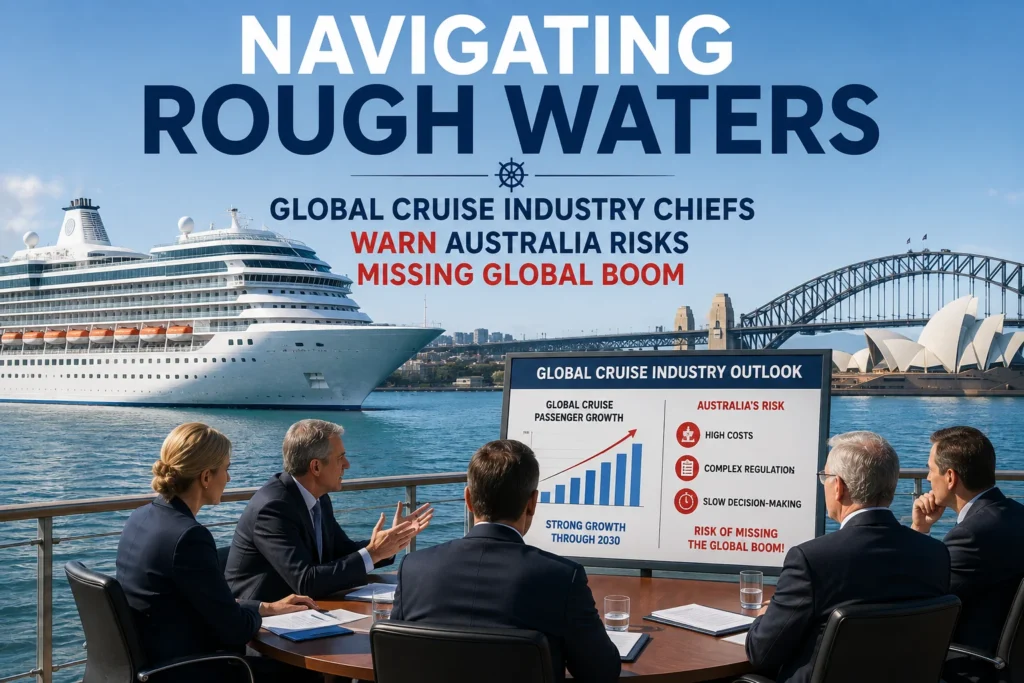
Global maritime leadership has issued a critical warning regarding Australia’s position in the international travel market, cautioning that local operations risk stalling while global passenger volumes hit record highs. Speaking at an industry event celebrating the commencement of the Australian summer wave season, Cruise Lines International Association President and CEO Charles “Bud” Darr highlighted that high operating expenses, regulatory hurdles, and inflexible local requirements threaten to limit the nation’s participation in broader international growth.
The warning coincided with the release of the national economic impact findings, which revealed that the cruise sector contributed $7.32 billion in total economic output to the national economy while supporting more than 22,000 local jobs. However, despite strong domestic consumer demand, Australia’s homeported fleet has contracted from 18 vessels during the 2023–24 season down to 11 ships scheduled for the upcoming 2026–27 deployment window.
Soaring Costs and Complex Regulatory Environments
Industry representatives underscored that while consumer appetite down under remains exceptionally high, controllable factors like regional port fees, operational overheads, and regulatory uncertainties are creating significant headwinds for ship deployment.
Key challenges confronting local cruise operations include:
High Operational Costs: Ship operators report that local port charges and service fees remain well above global averages, reducing the relative economic viability of regional itineraries.
Regulatory Instability: Proposed attempts to apply domestic labor frameworks to foreign-flagged international vessels create compliance friction for ships operating across multiple global jurisdictions.
Deployment Constraints: Long lead times require cruise lines to finalize itinerary routes up to three years in advance, making regulatory predictability essential for long-term fleet allocations.
Fleet Allocation Shifts: Rising costs have led major international operators to reassign widebody vessels to higher-yielding international corridors across Europe, Asia, and North America.
Global Expansion Versus Local Stagnation
The warning comes at a time of unprecedented investment across the global cruise landscape. Global order books currently reflect 86 new ships under construction representing roughly US$96 billion (AU$147 billion) in committed capital stretching past 2036. Global passenger numbers expanded from 34.3 million in 2024 to 37.3 million in 2025, with long-term projections estimating 42 million annual cruise travelers by 2029.
Despite Australia ranking as the fourth-largest cruise market globally—with 1.4 million residents taking a cruise annually out of a population of 27 million—the local market experienced a $1.1 billion drop in year-on-year economic activity compared to its previous peak.
Industry representatives urged federal and state government authorities to collaborate with maritime stakeholders to implement practical, predictable, and globally competitive policies that encourage international ship operators to return to local ports.
Economic Value of Cruise Operations
| Economic Indicator | Official Impact Data |
| Total Economic Contribution | $7.32 Billion (Annual Output) |
| Local Jobs Supported | 22,720 Jobs Nationally |
| Direct Passenger Destination Spend | $1.82 Billion |
| Cruise Line Supply Chain Spending | $1.50 Billion |
| Global Ship Order Book Value | US$96 Billion (86 Vessels On Order) |
Frequently Asked Questions
Why is Australia’s cruise fleet size declining despite high passenger demand?
While domestic passenger demand remains strong, international cruise lines are reallocating ships to other global regions due to high local operating costs, expensive port fees, and regulatory uncertainties in Australia.
What is the economic impact of cruise tourism in Australia?
According to official industry economic impact reports, cruise tourism generates $7.32 billion in annual economic output for the Australian economy, contributing $1.5 billion in direct supplier purchases and supporting over 22,000 jobs across agriculture, transport, and hospitality.
How far in advance do global cruise lines plan their ship itineraries?
Cruise lines typically lock in global ship deployments and port schedules two to three years in advance, requiring long-term policy stability and predictable cost structures from host nations.
For more travel news like this, keep reading Global Travel Wire