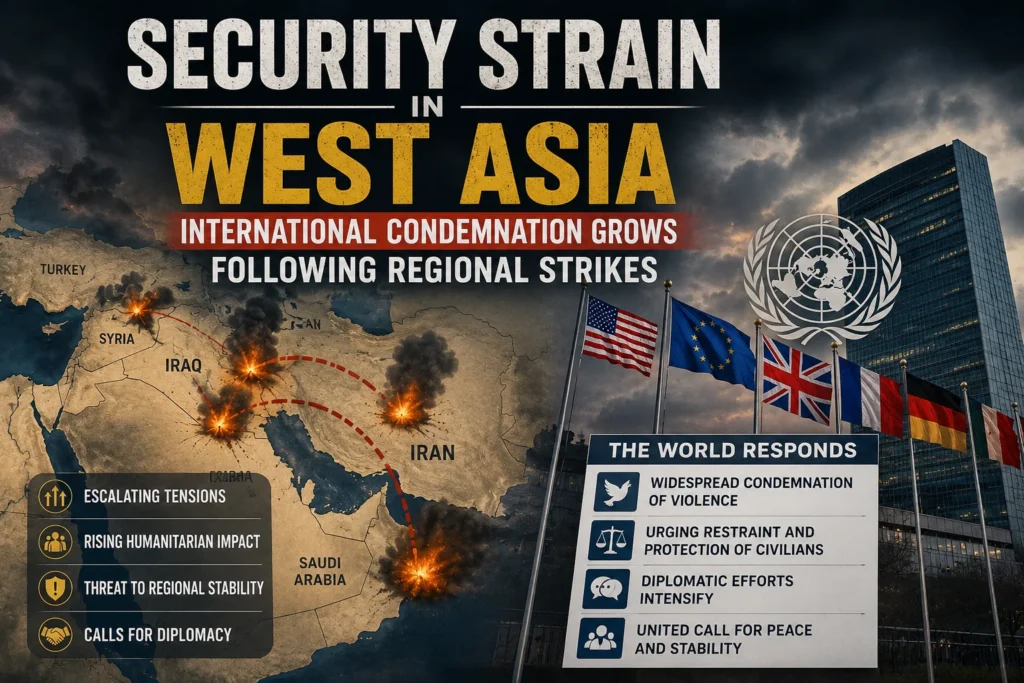
Global leaders and diplomatic bodies have issued coordinated statements condemning recent missile and aerial drone strikes across the United Arab Emirates. Regional governments and international aviation authorities have voiced deep concern over escalating tensions in West Asia, warning that maritime and aerial security disruptions pose serious risks to global travel hubs, regional commerce, and international transit corridors.
The diplomatic fallout follows defensive activations across the Arabian Gulf, where air defense networks intercepted multiple ballistic projectiles, cruise missiles, and unmanned aerial vehicles aimed at regional targets. While the majority of incoming threats were neutralized by active defense infrastructure, localized incidents—including an operational disruption at an oil facility in Fujairah—have heightened security monitoring across civil aviation and maritime sectors.
Governments across the Gulf Cooperation Council, alongside the Arab League, formally denounced the actions as direct violations of national sovereignty. Broad international support followed, with the European Union, the United Kingdom, France, Germany, India, Japan, Australia, and Canada issuing official statements urging immediate restraint, de-escalation, and strict adherence to international maritime and aviation laws.
Aviation Infrastructure and Airspace Status
The United Arab Emirates serves as one of the world’s premier international aviation crossroads, connecting millions of global transit passengers daily through Dubai and Abu Dhabi. In response to regional developments, civil aviation authorities and international air carriers have enacted precautionary protocols to guarantee passenger safety.
Key operational measures currently governing regional transport include:
Real-Time Airspace Monitoring: Civil aviation regulators maintain continuous surveillance over flight corridors across the Arabian Gulf to adjust flight tracks dynamically.
Precautionary Rerouting: Long-haul commercial air carriers are utilizing modified air corridors to bypass high-risk airspace sectors, ensuring uninterrupted international connectivity.
Carrier Flight Adjustments: Selected international airlines have implemented temporary schedule modifications and route evaluations to manage regional air traffic flow smoothly.
Terminal Safety Protocols: Transport hubs across the country continue to operate under heightened security frameworks, prioritizing passenger safety and operational continuity.
Official statements from national transport agencies emphasize that civil aviation infrastructure remains functional, with comprehensive contingency plans activated to support stranded passengers, manage flight rescheduling, and clear operational backlogs.
Advisory Guidance for International Travelers
Travel advisories issued by foreign ministries highlight the necessity of careful itinerary planning for those traveling to or transiting through West Asia. While internal infrastructure, hospitality operations, and urban transit systems within major commercial hubs operate normally, international travel logistics require added flexibility.
Diplomatic missions and travel safety organizations advise international passengers to follow these operational recommendations:
Flight Status Verification: Confirm flight schedules directly with operating airlines prior to departing for origin airports, as timing adjustments remain possible.
Flexible Booking Options: Opt for refundable or rebookable ticket categories when arranging travel across Middle Eastern transit hubs.
Consular Registration: Foreign nationals residing in or visiting the region are encouraged to register their presence with their respective embassies for real-time safety alerts.
Official Information Sources: Rely exclusively on verified updates released by national civil aviation bodies, state news agencies, and official government advisories.
International diplomatic efforts remain focused on restoring stability to critical shipping lanes through the Strait of Hormuz and protecting civilian transport infrastructure across the region.
Regional Travel & Aviation Status Overview
| Operational Sector | Current Regional Status |
| Primary Airport Operations | Active with precautionary flight rerouting and schedule adjustments |
| Airspace Security Level | Heightened monitoring with temporary corridor adjustments |
| International Travel Advisories | Updated monitoring advisories issued by global diplomatic bodies |
| Commercial Hospitality & Services | Fully operational across major urban and tourism centers |
| Maritime Transit Safety | Enhanced naval escorts and monitoring along Gulf shipping lanes |
Frequently Asked Questions
How are current regional developments impacting flights through the UAE?
While major international transit hubs remain open, civil aviation authorities have adjusted certain flight corridors. Travelers may experience temporary flight delays, longer flight times due to rerouting, or schedule adjustments depending on their airline and destination.
What safety measures are in place for international visitors in the UAE?
National defense and civil security systems maintain state-of-the-art protection across all civilian infrastructure, airports, and public areas. Foreign embassies continue to coordinate closely with local authorities to ensure visitor safety.
What steps should travelers take before flying to or through the region?
Travelers should check their flight status directly with their airline before heading to the airport, choose flexible ticket options, purchase comprehensive travel insurance, and monitor official government travel advisories.
For more travel news like this, keep reading Global Travel Wire