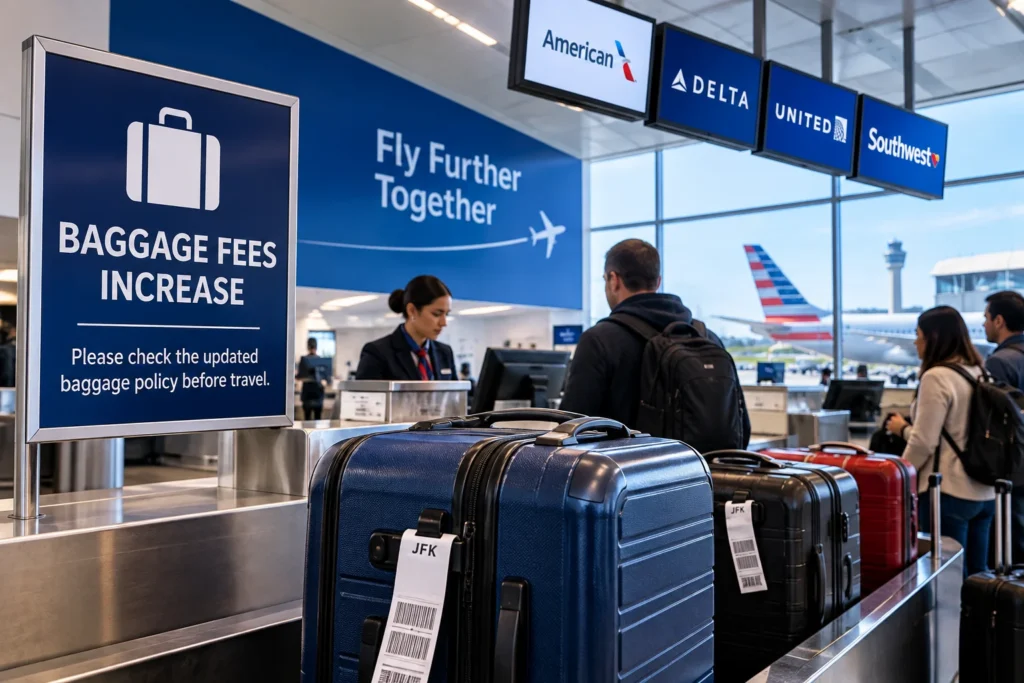
The cost of air travel is rising across North America as major airlines revise ancillary pricing structures to offset surging jet fuel expenditures. Leading commercial carriers—including American Airlines, Alaska Airlines, United Airlines, Delta Air Lines, Southwest Airlines, and JetBlue Airways—have formally adjusted checked luggage policy schedules for domestic and short-haul international flights.
The policy updates come as global energy market volatility drives aviation fuel expenditures to record levels, prompting transport executive teams to reassess baseline operational overhead. Because jet fuel represents an airline’s second-largest operating cost after labor, carrier management strategies rely on ancillary price shifts to protect operational liquidity without making immediate across-the-board fare baseline hikes.
Key Factors Driving Checked Luggage Policy Changes
Commercial aviation operations face persistent cost pressures linked directly to global fuel market conditions. Official economic data released by energy intelligence monitoring groups reveals that average U.S. aviation fuel costs doubled over a tight multi-month window, rising from historical baselines near $2.50 per gallon to over $4.80 per gallon.
When jet fuel prices experience severe shocks, airline financial models adapt through two primary mechanisms: adjusting base airfares and recalibrating optional service charges. Federal regulatory disclosures note that ancillary charges, such as checked luggage fees, provide immediate net revenue streams for operational cost recovery.
As a result, multiple major airlines have aligned their standard baggage pricing tiers, ending several long-standing advance-purchase discount structures and raising baseline rates across standard travel cabins.
Updated Baggage Pricing Structures Across Major U.S. Carriers
Travelers booking domestic and short-haul international itineraries face higher checked bag rates across major market operators. Official carrier statements outline the specific price breakdowns for passengers traveling in standard economy classes.
American Airlines
American Airlines updated its domestic and short-haul international fee schedule across standard economy tickets. Under the revised rules, passengers checking a first bag at the airport encounter a $50 charge, while a second checked bag costs $60. Travelers who settle baggage fees online via the airline’s website or digital application prior to arriving at the airport receive a $5 advance processing discount, bringing costs to $45 for a first bag and $55 for a second bag. For domestic Basic Economy tickets, specialized fee structures apply, setting first bag charges at $55 and second bag charges at $65, subject to the same $5 prepayment discount.
Alaska Airlines and Hawaiian Airlines
Alaska Air Group introduced a $5 increase on standard first checked bags and a $10 increase on second checked bags across its North American route network, bringing rates to $45 and $55 respectively. The third checked bag fee increased to $200. Additionally, Alaska Airlines discontinued its legacy advance-purchase baggage discount, standardizing fee payment timing across digital and counter check-in channels. These updated rate structures apply across both Alaska Airlines and Hawaiian Airlines flight operations.
United Airlines
United Airlines updated its checked luggage policy for domestic, Canadian, and short-haul Latin American routes. Standard economy travelers who prepay checked baggage online more than 24 hours prior to departure pay $45 for a first bag and $55 for a second bag. Passengers settling baggage charges within 24 hours of departure or directly at the airport counter face a $5 surcharge, bringing first and second bag costs to $50 and $60.
Delta Air Lines
Delta Air Lines implemented a $10 increase across domestic and select short-haul international itineraries. The updated policy sets first checked bag fees at $45 and second checked bag fees at $55. A third checked bag carries a $200 charge. The fee adjustments apply exclusively to short-haul operations, leaving long-haul international baggage policies unchanged.
Southwest Airlines
Southwest Airlines updated its fee matrix for travelers purchasing Basic, Choice, and Choice Preferred fare classes. Standard first checked bag charges rose from $35 to $45, while second checked bag charges increased from $45 to $55. The carrier maintained complimentary baggage allowances for active-duty military personnel and elite tier frequent flyer members.
JetBlue Airways
JetBlue Airways adjusted its seasonal fee tiers to address operating cost shifts. During off-peak travel periods, passengers paying for a first checked bag more than 24 hours prior to flight departure pay $39. During peak travel windows—including summer, spring break, and winter holiday periods—standard first checked bag fees rise to $59, with second checked bags reaching $79. A $10 administrative fee applies to payments processed within 24 hours of flight departure.
Strategic Considerations for Passengers and Travel Organizers
Industry analysts recommend that leisure and business travelers review specific fare rules carefully prior to airport arrival. While baseline checked luggage fees have risen across standard economy classes, airlines continue to offer fee exemptions for specific customer categories.
Active-duty military personnel, premium cabin ticket holders, elite frequent flyer loyalty members, and co-branded airline credit cardholders generally retain complimentary checked bag benefits across most major carriers. To minimize out-of-pocket transit expenses, industry experts advise passengers to leverage digital prepay options where available, explore co-branded card perks, or consolidate travel items into standard carry-on luggage dimensions that comply with cabin overhead bin guidelines.
For more travel news like this, keep reading Global Travel Wire