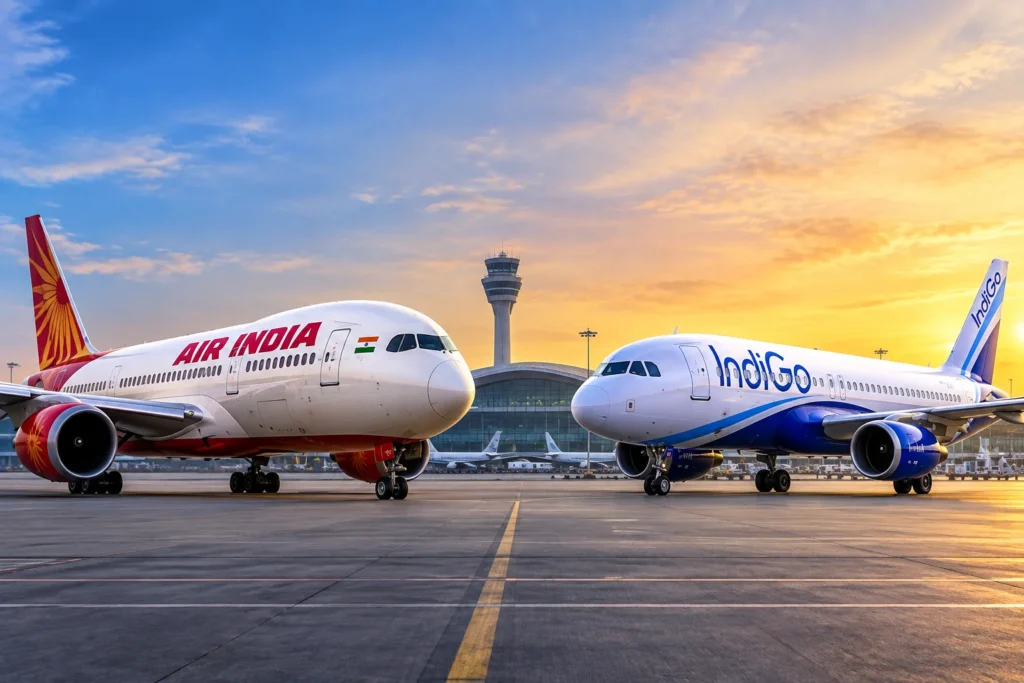
The South Asian civil aviation sector is undergoing a major leadership realignment at a critical turning point for global travel networks. India’s two largest carriers, Air India and IndiGo—which together command nearly nine-tenths of the domestic air travel market—have placed operational command in the hands of seasoned international aviation executives.
Tewolde Gebremariam has formally assumed leadership responsibilities at Air India, while William “Willie” Walsh took office as Chief Executive Officer of IndiGo in August. These executive transitions arrive as the broader commercial aviation ecosystem copes with persistent supply chain bottlenecks, global geopolitical airspace disruptions, escalating jet fuel overheads, and unprecedented regional passenger demand. While both airlines occupy dominant positions in one of the world’s fastest-growing travel markets, their immediate operational mandates diverge significantly.
Air India Prioritizes Operational Fundamentals and Safety Management
For Air India, the appointment of Tewolde Gebremariam represents a deliberate shift toward foundational stabilization, operational execution, and rigorous safety governance. Bringing over three decades of commercial aviation experience—including a transformative tenure leading Ethiopian Airlines Group through major long-haul network expansion and MRO infrastructure development—Gebremariam takes charge of an expanded airline group undergoing a multi-phase structural consolidation.
The carrier’s immediate focus centers on cementing operational reliability across flight schedules, expanding engineering and maintenance capabilities, and instilling a absolute safety-first operational culture across all divisions. Following the structural integration of regional and full-service brand entities under a unified corporate banner, the leadership priority remains focused on getting the basics right. This includes optimizing on-time arrival and departure metrics, streamlining baggage handling workflows, and maintaining rigorous fleet maintenance schedules.
Concurrently, the leadership team is tasked with enforcing financial discipline and improving capital performance across long-haul routes as new aircraft deliveries are gradually integrated into the active fleet. Air India aims to position itself as a trusted, world-class global hub carrier connecting domestic destinations directly to international financial centers.
IndiGo Focuses on Network Expansion and International Operational Scale
At IndiGo, Willie Walsh brings deep global airline executive expertise, having previously served as Director General of the International Air Transport Association (IATA) and Chief Executive Officer of International Airlines Group (IAG). Taking leadership of a carrier operating over 400 aircraft and running thousands of daily departures, Walsh’s strategic charter emphasizes operational discipline while accelerating the airline’s international footprint.
IndiGo’s primary objective involves expanding its international network across Central Asia, the Middle East, Southeast Asia, and Europe while maintaining its trademark operational efficiency and low-cost structure. However, the airline faces broader macro-level complexities, including fluctuating jet fuel prices, engine maintenance turnaround delays, and global airspace realignments.
Under Walsh’s leadership, IndiGo is sharpening its commercial strategy to optimize single-aisle fleet efficiency, strengthen global codeshare partnerships, and elevate passenger service standards. The leadership transition ensures that India’s largest domestic operator remains well-positioned to scale its international point-to-point presence amidst shifting aviation conditions.
Structural Industry Challenges and Future Sector Outlook
The dual executive appointments highlight a mature phase for South Asian commercial aviation. The immediate priorities facing both leadership teams reflect broader macroeconomic and structural pressures across global air transport:
Engine and Fleet Delivery Delays: Worldwide aerospace supply chain constraints continue to impact original equipment manufacturers, causing delivery delays for modern narrow-body and wide-body platforms.
Fuel Volatility and Currency Pressures: Fluctuating jet fuel tariffs alongside foreign exchange rate movements require tight operational cost control and agile route yield management.
Airspace Constraints: Ongoing regional geopolitical tension requires longer routing paths on specific international corridors, impacting fuel burn and flight crew scheduling parameters.
Infrastructure and Hub Development: Civil aviation authorities are actively expanding regional airport capacities to convert secondary cities into viable international transit points.
Despite operational complexities, long-term passenger demand across domestic and international routes remains exceptionally strong. As government aviation authorities continue investing in modern airport infrastructure and regional connectivity schemes, the strategic choices made by Air India and IndiGo will shape global travel corridors connecting South Asia to the rest of the world.
Through strong operational oversight, fleet modernization, and strict compliance with global safety benchmarks, both carriers are positioning themselves to transform regional civil aviation into a premier global aviation hub.
For more travel news like this, keep reading Global Travel Wire