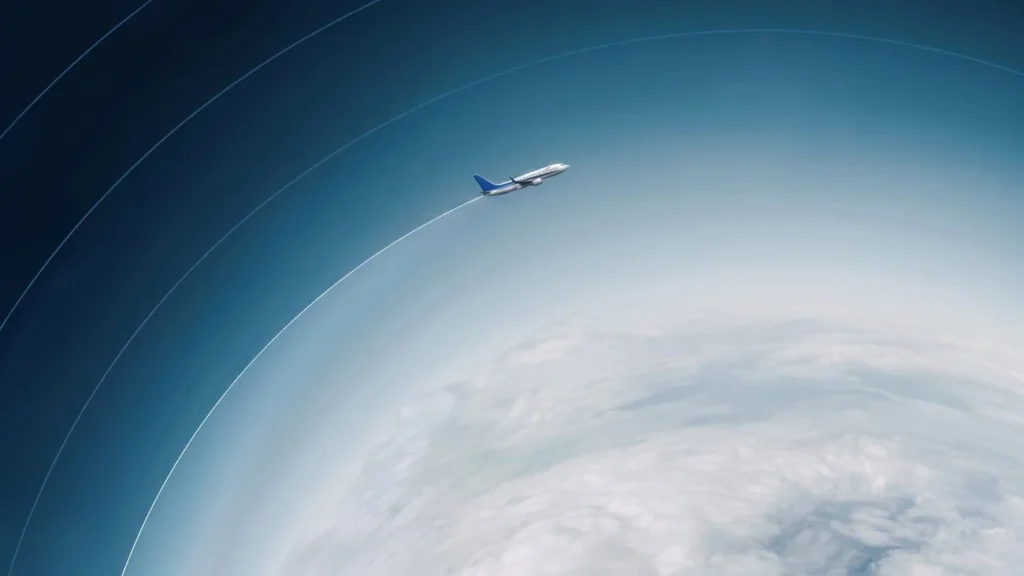
US-developed artificial intelligence expertise and earlier American airline research are helping support a major UK-led trial aimed at reducing the climate impact of aircraft contrails.
Operation Blue Skies will test AI-guided contrail avoidance across the eastern half of the North Atlantic’s Shanwick airspace. The 30-month programme is described as the first state-backed initiative to address contrails across an entire oceanic airspace.
The project is backed by the UK Government and brings together Google UK, NATS, the Met Office, Contrails.org, Imperial College London and the University of Cambridge.
It builds on earlier work involving Google Research, American Airlines and Breakthrough Energy in the United States. Those trials demonstrated that commercial pilots could use AI-generated forecasts to avoid atmospheric areas likely to create contrails.
The new programme represents a significant move from individual airline experiments towards coordinated airspace management. If successful, it could provide a practical model for aviation authorities, airlines and flight-planning companies worldwide.
Why Contrails Matter For Aviation
Contrails form when aircraft fly through cold, humid atmospheric layers. Water vapour condenses around particles in jet exhaust before freezing into visible ice crystals.
Some trails disappear quickly. Others persist and spread into cirrus-like clouds that trap heat within the atmosphere. Although contrails may also reflect sunlight during daytime, their overall effect contributes to warming.
Research referenced by Google indicates that contrail-created clouds account for roughly one-third of aviation’s total climate impact. This makes avoidance an important short-term opportunity while airlines develop lower-carbon fuels and cleaner aircraft technology.
Unlike fleet replacement, contrail mitigation can use existing aircraft. Flight crews or controllers only need to adjust selected routes when forecasts identify areas capable of creating strongly warming trails.
Artificial Intelligence Predicts High-Risk Zones
AI models combine satellite imagery, weather forecasts and aircraft trajectory data to predict where persistent contrails are most likely to form.
Flight planners can then assess whether a small vertical or horizontal deviation could avoid the affected atmospheric layer. Air traffic controllers must ensure that any change remains compatible with aircraft separation and established safety procedures.
The approach does not require every flight to change course. Operation Blue Skies will target a small percentage of aircraft expected to enter contrail-sensitive areas during trial periods.
Shanwick airspace was selected because it handles important transatlantic traffic and accounts for an estimated 5% of global contrail warming. Around 10,000 flights originating from hundreds of cities are expected to pass through the area during trial hours each year.
American Airlines Trial Delivered Early Evidence
The earlier US trial provided an important proof of concept. American Airlines pilots conducted 70 test flights over six months using AI-based contrail forecasts and open-source atmospheric models.
Satellite analysis found that pilots reduced contrail formation by 54% on the test flights. Aircraft involved in avoidance manoeuvres used approximately 2% more fuel.
However, only a limited share of services would require adjustments across an airline network. Research suggests the fleet-wide fuel impact could be as low as 0.3%.
Estimated mitigation costs ranged from $5 to $25 for each tonne of carbon dioxide equivalent avoided. These findings positioned contrail avoidance as a potentially cost-effective aviation climate measure.
Operation Blue Skies will now test whether similar methods can operate safely and consistently across a busy international corridor.
UK Partners Bring Airspace And Weather Expertise
Each member of the UK consortium has a defined role. Google UK will develop AI models and use machine learning with satellite observations to measure results.
NATS will manage operational coordination, safety assessments and controller training. The Met Office will develop a UK contrail forecasting capability and provide meteorological expertise.
Contrails.org will support forecast evaluation, trial design and data analysis. Imperial College London and the University of Cambridge will independently assess climate outcomes.
The programme will include two operational trials lasting approximately four months each. Funding comes from industry partners and the UK Government through the Aerospace Technology Institute programme. Google UK is contributing £1.4 million of in-kind expertise and computing resources.
Safe Scaling Remains The Main Challenge
Contrail avoidance must fit within strict aviation safety requirements. Aircraft cannot change altitude or direction without considering traffic, turbulence, weather and fuel reserves.
Forecast accuracy also matters. Unnecessary deviations could consume fuel without producing a meaningful climate benefit. Regulators and navigation providers will therefore need reliable evidence before introducing mitigation across additional airspace.
For passengers, the process should remain largely invisible. Operational changes would occur through flight planning and air traffic management rather than altering the normal onboard travel experience.
Operation Blue Skies could mark an important step toward cleaner international aviation. By connecting American AI research with UK government support and airspace expertise, the project will test whether targeted route adjustments can deliver meaningful climate gains without disrupting global passenger flights.
For more travel news like this, keep reading Global Travel Wire