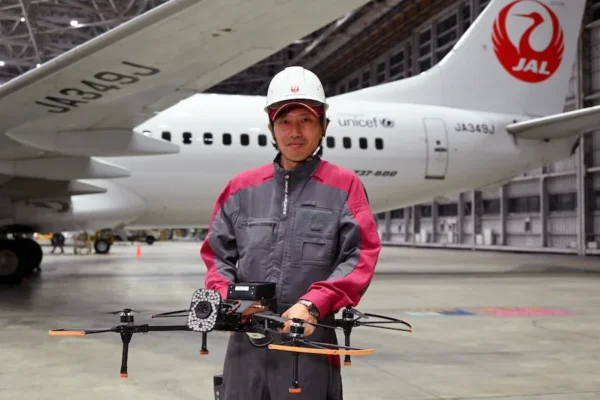
Japan Airlines is testing fully autonomous drones that could reduce aircraft exterior inspection work by approximately 60%, marking a significant aviation maintenance development in Japan.
The carrier is working with French drone manufacturer Donecle to evaluate high-resolution, image-based aircraft inspections inside its maintenance facilities. The project uses autonomous technology to photograph aircraft surfaces before trained mechanics review the resulting images.
The initiative supports faster and more consistent General Visual Inspections, commonly known as GVI. These checks help maintenance teams identify visible damage, corrosion, cracks, paint deterioration and other external irregularities.
JAL has deployed one drone at Tokyo’s Haneda Airport. Operator training and procedure development began in March 2026, followed by practical testing from late June. The airline expanded the evaluation to aircraft paint-condition monitoring in September.
Although the technology will not replace licensed aircraft mechanics, it could reduce physically demanding work and allow engineers to focus on technical assessments and necessary repairs.
For passengers, greater maintenance efficiency could eventually improve aircraft availability and reduce delays linked to lengthy inspection processes. However, safety requirements and manufacturer-approved procedures will continue to determine when an aircraft can return to service.
Autonomous Drone Captures Detailed Aircraft Images
JAL is testing Donecle’s Iris GVI, a fully autonomous drone designed specifically for aircraft exterior inspections.
The drone measures 855 millimetres in length and width, stands 245 millimetres high and weighs 3.7 kilograms with its battery. A 24-megapixel camera captures detailed images while laser-based positioning and obstacle detection guide the aircraft around a predetermined route.
Because the system operates autonomously, personnel do not need specialized piloting skills for each inspection flight. Maintenance teams establish the process, supervise the operation and analyze the images through a dedicated application.
During a demonstration inside a Haneda Airport hangar on September 11, the drone captured 428 images of a Boeing 737-800. It completed the image-gathering flight in 14 minutes and four seconds.
Larger aircraft naturally require more coverage. JAL reported that the system can take approximately 1,500 to 1,600 images of a Boeing 777-300ER within about one hour.
The standardized flight path enables the drone to capture aircraft sections from consistent positions. This approach could make it easier for engineers to compare images over time and monitor changes in an aircraft’s exterior condition.
Inspection Work Could Become Faster
Conventional visual inspections can take approximately five to 10 hours, depending on the aircraft and maintenance requirement. Engineers may need elevated platforms or scaffolding to examine vertical stabilizers and other difficult areas.
The drone-supported process could reduce the overall task to around two or three hours, including preparation and image analysis. JAL expects this approach to lower associated maintenance man-hours by about 60%.
Traditional inspections usually involve at least two people. More complex work may require teams of three or four. The drone process generally involves two people during operation, followed by image review conducted by a mechanic.
Additional personnel would still become involved if the inspection identifies possible damage requiring closer examination or repair.
Reducing work at height could also improve conditions for maintenance employees. Meanwhile, digital photographs provide a structured record that can support follow-up checks, condition tracking and future maintenance decisions.
Manufacturer Approval Determines Aircraft Coverage
Drone inspections can only be used for tasks covered by aircraft manufacturers’ approved maintenance procedures. This requirement ensures that airlines introduce the technology without weakening established safety standards.
Current applications include exterior visual inspections of Boeing 737-800 and Boeing 777 aircraft. Drone-supported checks can also assist with approved lightning-strike inspections on members of the Airbus A320 family.
JAL plans to explore future applications involving Boeing 787 and Airbus A350 aircraft. Wider fleet deployment will depend on technical evaluation, manufacturer guidance and relevant regulatory conditions.
The airline is also examining additional inspection categories, including lightning damage and paint condition monitoring. Each use must demonstrate that the drone can capture images of suitable quality and consistency for professional assessment.
Maintenance Innovation Supports Airline Reliability
Aircraft maintenance organizations face growing operational pressure as global fleets expand and demand for air travel increases. At the same time, airlines must prepare for possible shortages of experienced technical personnel.
Autonomous inspection systems could help address this challenge by handling repetitive image collection. Mechanics can then dedicate more time to diagnosis, repair planning and complex engineering work.
The technology may also support a gradual shift toward data-driven maintenance. Consistently captured digital images could help airlines identify changes earlier and build more detailed aircraft condition histories.
Nevertheless, human judgment remains central. The drone gathers visual evidence, while qualified mechanics determine whether a defect exists and what action is required.
JAL’s testing is currently taking place inside controlled hangars because drone operations around active airports face strict limitations. Passengers are therefore unlikely to see these inspections beside operating terminals soon.
Even so, the project shows how automation may strengthen the less visible systems supporting every journey. If trials succeed and approvals expand, autonomous drones could help JAL improve maintenance productivity, aircraft availability and operational resilience while preserving rigorous aviation safety oversight.
For more travel news like this, keep reading Global Travel Wire