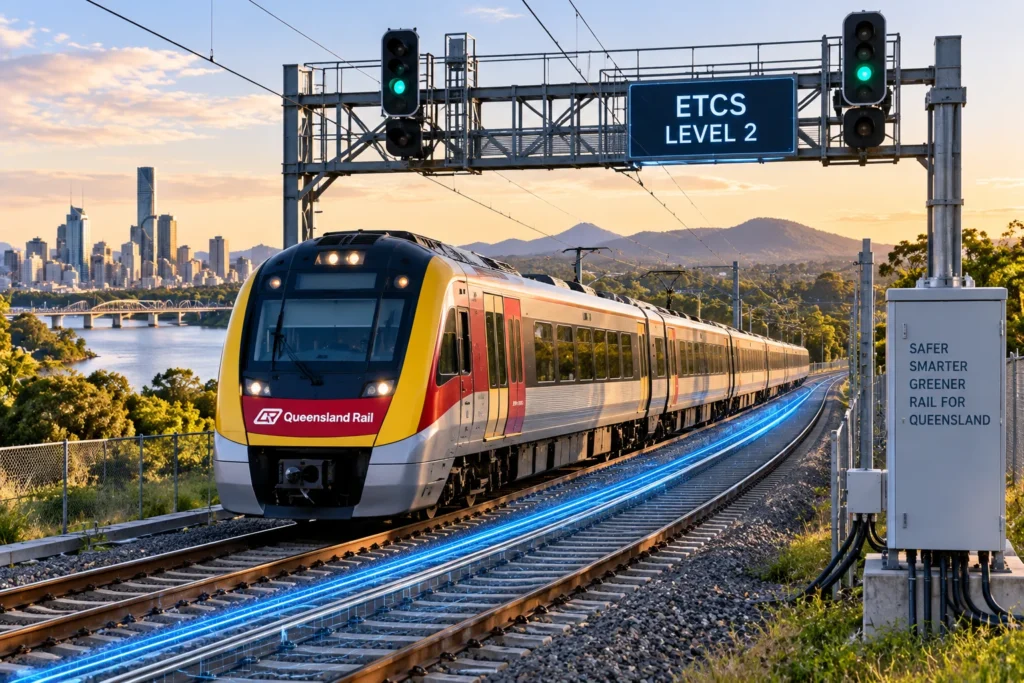
Official releases from Queensland Rail, the Department of Transport and Main Roads, and the Cross River Rail Delivery Authority confirm the historic launch of the European Train Control System (ETCS) Level 2 in revenue passenger service. The deployment commenced in September 2026 along the Northgate–Shorncliffe corridor. This milestone marks the first transition from traditional fixed-block trackside signaling to a fully integrated digital moving-block control framework in South East Queensland.
The technical transition establishes continuous, near real-time data exchange between onboard train computers and the central Rail Management Centre. By transmitting exact location, direction, and speed metrics digitally, the network dynamically regulates safety separation between active trainsets. This migration enhances network safety while creating the foundation required to scale service frequency across high-density passenger corridors.
Legacy Systems vs. Digital Signaling Integration
The transition to ETCS Level 2 replaces physical trackside light signals with an onboard driver display, reducing operational reliance on manual observations and fixed spatial blocks.
| Operational Feature | Legacy Fixed-Block Signaling | ETCS Level 2 Digital System | Systemic Network Benefit | Primary Oversight Agency |
| Signal Transmission | Fixed trackside light indicators | Continuous digital radio communications | Minimizes signal failures and trackside hardware | Queensland Rail |
| Train Spacing Rules | Static block distances | Dynamic safety margins based on live telemetry | Enables higher service frequency on single tracks | Rail Management Centre |
| Telemetry Monitoring | Manual driver observation | Automated real-time fleet tracking | Enhances overall timetable reliability | Sequence Alliance |
| Network Integration | Standalone corridor operation | Seamless link to Cross River Rail tunnels | Increases overall network throughput | Cross River Rail Delivery Authority |
| Event Capacity | Limited by physical block spacing | Scalable software-managed capacity | Prepares rail network for Brisbane 2032 Games | Department of Transport & Main Roads |
Public announcements emphasize that during initial operational phases, passenger shuttle services will run between Northgate and Shorncliffe stations. While the physical ride experience inside train cars remains unchanged, passengers traveling on the pilot branch line must transfer at Northgate Station to access connecting mainline services.
Infrastructure Modernization Ahead of the Brisbane 2032 Games
The digital signaling rollout forms a key technical pillar of Queensland’s multi-billion-dollar transit modernization strategy. Designed to support rapid population growth across South East Queensland, the ETCS Level 2 architecture will progressively integrate into the twin tunnels of the Cross River Rail project and extend to high-volume coastal lines.
By replacing physical signaling infrastructure with continuous digital communications, Queensland Rail plans to increase total capacity across core passenger routes. The technological upgrade addresses future passenger demand surges anticipated during the Brisbane 2032 Olympic and Paralympic Games, establishing a high-capacity, automated rail network capable of moving millions of international visitors across the region.
The pilot program on the Shorncliffe line follows thousands of hours of real-world testing conducted by the Sequence Alliance—an operational consortium comprising Queensland Rail, the Department of Transport and Main Roads, the Cross River Rail Delivery Authority, and Hitachi Rail. Following the successful validation of the pilot corridor, installation activities will expand along the Gold Coast line between Beenleigh and Varsity Lakes, as well as the Sunshine Coast corridor.
Traveler Guidance and Network Impact
Service Operations: Weekend shuttle services on the Shorncliffe line operate under ETCS Level 2 digital signaling, requiring passengers to change trains at Northgate Station.
Onboard Experience: The interior passenger experience, vehicle speeds, and ticketing systems remain baseline-identical to standard Queensland Rail services.
Timetable Reliability: Digital tracking minimizes cascading delays across connected lines, improving on-time performance across South East Queensland.
Future Network Scope: Digital signaling deployment will expand to the Cross River Rail tunnels and coastal suburban lines as part of a multi-year rollout.
Frequently Asked Questions
What is ETCS Level 2 and how does it improve train operations in Queensland?
ETCS Level 2 is a digital signaling technology that replaces physical trackside signals with continuous, real-time wireless communication between trains and the Rail Management Centre, allowing trains to safely travel closer together and increasing overall line capacity.
Will train fares increase due to the digital signaling rollout?
No. Official releases confirm that signaling upgrades are part of state-funded capital transit infrastructure programs designed to enhance safety and capacity, with no changes to standard public transit fare structures.
Which lines in South East Queensland will receive digital signaling next?
Following the operational validation on the Shorncliffe line, ETCS Level 2 digital signaling is scheduled to be installed in the Cross River Rail tunnels, the Gold Coast corridor, and the Sunshine Coast line.
For more travel news like this, keep reading Global Travel Wire