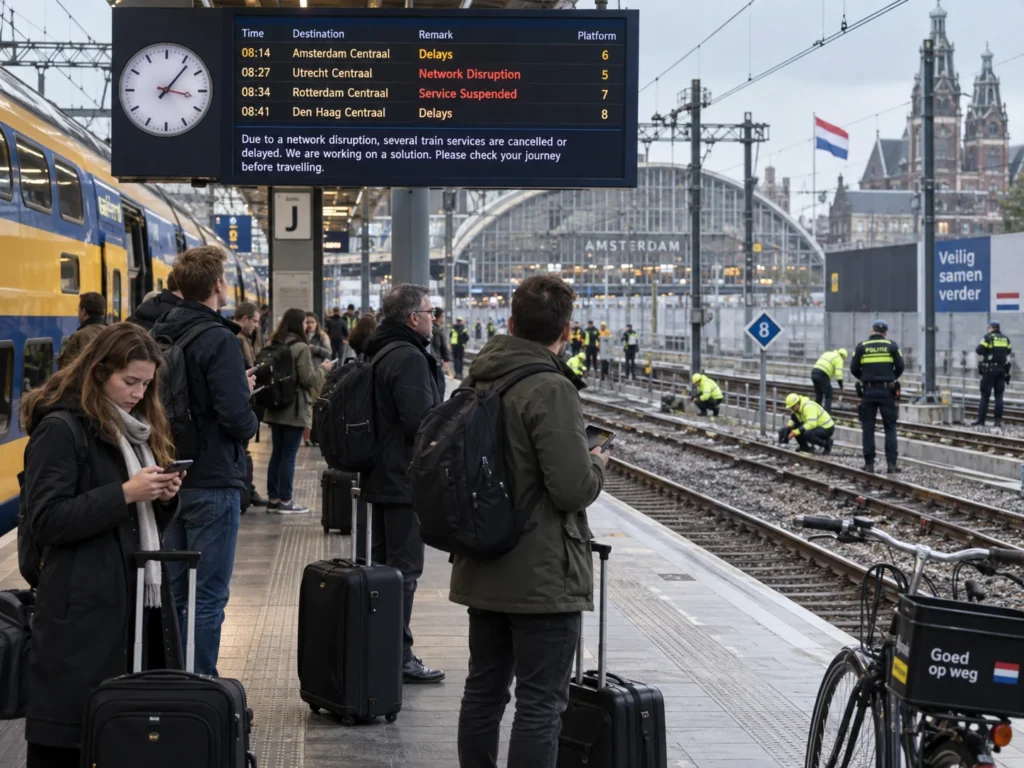
Official statements from Dutch railway infrastructure manager ProRail confirm widespread travel delays across central and eastern regions of the Netherlands following coordinated track disruptions. Safety monitoring systems detected objects intentionally attached to rail sections at numerous locations, prompting emergency safety protocols. The incident has temporarily paralyzed key passenger rail corridors, impacting national transit logistics and international connections.
National rail operator ProRail reported that emergency crews discovered metal tubes deliberately fixed to running rails starting during early morning operations on 15 September 2026. The intentional placement of these items triggered automated signal block mechanisms, forcing signal lights to switch to red and preventing trains from traversing affected segments.
Operational Mechanics of Automated Track Safety Systems
The Dutch passenger rail network operates under stringent automated safety protocols designed to prevent collisions. When solid materials or metallic objects bridge or interfere with railway circuits, monitoring systems interpret the physical obstruction as an occupied track segment.
| Operational Category | Impact Status | Verified System Reaction | Traveler Implication | Oversight Authority |
| Signal Safeguards | Active Trigger | Signals automatically switch to red | Prevents train movements across sections | ProRail Infrastructure |
| Track Inspection | Ongoing Clearence | Technical teams clear physical debris | Extended delays on primary corridors | ProRail Field Logistics |
| Police Investigation | Active Inquiry | Forensic evidence collection on-site | Portions of network remain closed | Dutch National Police |
| Passenger Transit | Widespread Impact | Reduced service frequency and rerouting | Travelers advised to check live timetables | Nederlandse Spoorwegen (NS) |
According to official updates from ProRail representatives, one passenger train made minor contact with a pipe structure positioned near Steenwijk. Official reports confirm no injuries were sustained by passengers or crew members. However, because automated systems interpret affected sections as occupied, services were brought to a halt to allow maintenance crews and law enforcement personnel to inspect the infrastructure safely.
Network Impact Across Key Dutch Passenger Corridors
The disruptions primarily impacted critical travel hubs in the central and eastern provinces, creating cascading delays that extended toward major metropolitan centers. High-density transfer stations, including Amersfoort, Zwolle, and Deventer, experienced severe service suspensions as technicians systematically checked tracks for additional obstructions.
The signaling failures also caused secondary disruptions to local road transportation. Several automated level crossings remained locked in closed positions as a safety precaution, impacting surrounding vehicular traffic corridors. National rail operator Nederlandse Spoorwegen (NS) deployed extra station staff to assist stranded passengers while emergency crews cleared remaining track sections.
Dutch law enforcement authorities launched a formal criminal investigation to identify the origin and motive behind the coordinated disruptions. Technical personnel worked alongside forensic investigators to secure evidence from recovered materials while prioritizing the safe restoration of passenger rail operations.
Key Safety and Travel Guidance for Passengers
Real-Time Itinerary Verification: Passengers utilizing the Netherlands train travel network are urged to check digital journey planners and official rail operator updates before traveling.
Alternate Transit Planning: Due to the widespread nature of signal section failures, alternative bus transport may be limited along heavily affected rural and intercity corridors.
Operational Safety Compliance: Rail infrastructure managers maintain strict protocols that prohibit train movement through red signals until manual inspections confirm tracks are clear.
Official Information Sourcing: Inbound tourists and daily commuters should rely strictly on verified releases from ProRail, Nederlandse Spoorwegen, and national transport authorities for schedule restorations.
Frequently Asked Questions
What caused the recent train disruptions across the Netherlands rail network?
ProRail confirmed that objects were intentionally placed on tracks at multiple locations, triggering automated safety systems that turned signals red and prevented train movements.
Were any passengers injured during the railway track incidents?
No injuries were reported. While one train made contact with an object placed on the track near Steenwijk, safety protocols prevented high-speed impacts, and emergency procedures were executed safely.
How long will train services in the central and eastern Netherlands be delayed?
Service restoration depends on the completion of track inspections and forensic clearances by national police. Passengers are advised to consult live travel planners for real-time corridor updates.
For more travel news like this, keep reading Global Travel Wire