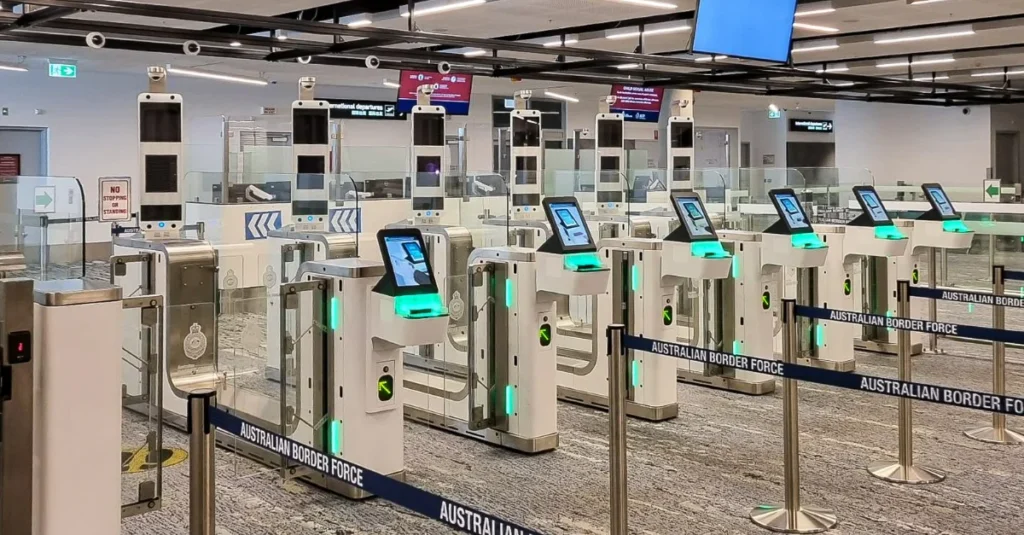
Australia’s latest automated border-processing disruption has intensified scrutiny of backup systems at Sydney, Melbourne and other major international gateways.
The incident raises a critical travel-technology question. Can manual passport processing handle large passenger volumes when automated systems become temporarily unavailable?
Australian Border Force guidance confirms that manual processing remains available when travellers cannot complete SmartGate procedures. Paper arrival declarations also continue alongside the developing digital system.
However, public information provides limited detail about nationwide manual-processing capacity during a simultaneous multi-airport failure.
This issue is becoming more important as Australia accelerates border digitisation. The Federal Government has committed A$56.1 million over four years from 2026–27 for traveller modernisation.
The programme includes the nationwide Australia Travel Declaration, contactless arrival clearance and more streamlined baggage processing for domestic transfers.
SmartGate Carries Most Eligible Travellers
Australia’s border-processing system handles tens of millions of air passengers annually.
The Department of Home Affairs processed 45,390,834 air travellers during 2024–25. Among them, 36,006,730 passengers qualified to use SmartGate technology.
A total of 27,654,177 eligible travellers completed processing through SmartGates. This represented 76.80% of eligible passengers, compared with 74.90% one year earlier.
These figures show that SmartGate is not simply an optional airport convenience. It has become a major part of Australia’s international passenger-processing model.
International scheduled passenger traffic is also increasing. Government aviation statistics recorded 45.647 million movements during the year ending June 2026.
That represented 6.1% annual growth from 43.011 million movements. The figures use different methods from border-clearance statistics but still demonstrate the system’s scale.
As international demand grows, even a temporary technology problem can affect large passenger groups. Pressure becomes particularly intense when several wide-body aircraft arrive within a short period.
Manual Processing Remains Official Backup
Australian Border Force procedures provide a human alternative when an individual traveller cannot complete SmartGate processing.
Passengers unsuccessful at the first arrivals kiosk stage proceed to Manual Passport Control. Those encountering problems at the gate can receive SmartGate assistance.
Departure passengers who cannot use an automated gate are manually processed by an officer.
This structure provides an established fallback for individual cases. Yet a systemwide disruption creates a different operational challenge because many travellers may require manual assistance simultaneously.
Historical Home Affairs records show that border authorities previously used paper-based business-continuity procedures during SmartGate outages.
Officials recorded that passenger information could be collected on cards and entered into border systems later. They also considered offline information collection for future traveller platforms.
Those historical procedures do not confirm the precise nationwide protocol operating in September 2026. However, they demonstrate longstanding official recognition that digital border systems require offline alternatives.
Digital Declarations Expand Nationally
Australia plans to introduce the Australia Travel Declaration across all international airports and seaports before the end of 2027.
The digital declaration will progressively replace the paper Incoming Passenger Card. It forms part of a wider transition towards an interconnected digital border journey.
By July 13, 2026, more than 450,000 eligible Qantas passengers arriving in Brisbane, Sydney and Melbourne had joined the trial.
The pilot is scheduled to expand to other capitals, including Perth and Adelaide, before the end of 2026.
Despite this expansion, paper has not disappeared. Travellers outside the pilot continue using Incoming Passenger Cards.
Paper cards also remain available when a digital declaration becomes unusable following a cancelled or rescheduled flight. A different arrival airport can create the same requirement.
Passengers unable to access their digital declaration pass can seek assistance from an Australian Border Force officer.
Therefore, travellers should not assume that mobile technology has completely replaced physical border documentation.
Sydney Faces Major Capacity Test
Sydney Airport demonstrates the advantages and limitations of border automation at scale.
The airport handled 8.44 million international passengers during the first half of 2026. This represented 2.1% growth from the corresponding 2025 period.
Eight additional SmartGate kiosks installed at Terminal 1 were expected to process another 640 inbound travellers every hour.
Sydney Airport previously reported that 90% of arriving international passengers cleared immigration within 36 minutes after passenger-flow improvements.
Automation helped achieve that performance. However, technical faults can require officers to assist passengers or assess equipment.
This can reduce the personnel available for manual desks precisely when human processing becomes more important.
Melbourne Combines Growth and Digital Trials
Melbourne Airport handled 12,256,328 international passengers across 57,002 passenger flights during the 2026 financial year.
This was its highest annual international passenger volume since the airport opened in 1970.
The Australia Travel Declaration pilot reached Melbourne on May 26, initially covering eligible passengers on selected Qantas services from Auckland and Queenstown.
Participants could complete declarations up to 72 hours before departure and receive a QR-based pass.
However, Melbourne Airport acknowledges that international arrivals can become congested during peak periods. It has discussed additional ePassport kiosks and personnel with border authorities.
Travellers Need Greater Connection Time
The disruption highlights practical risks for passengers with tight international-to-domestic transfers or separate tickets.
Travellers should allow additional border-processing time and avoid treating SmartGate clearance estimates as guaranteed. Completing digital documentation does not ensure faster processing during a wider system failure.
Australia’s digital border offers substantial benefits through automation, biometrics and pre-arrival information. Yet those advantages depend on systems that can continue functioning during disruption.
Manual officers, paper declarations and assistance channels already provide important safeguards.
The next challenge is ensuring these fallbacks can scale across high-volume airports. Australia’s digital border will increasingly be judged not only by its speed, but also by its resilience.
For more travel news like this, keep reading Global Travel Wire